
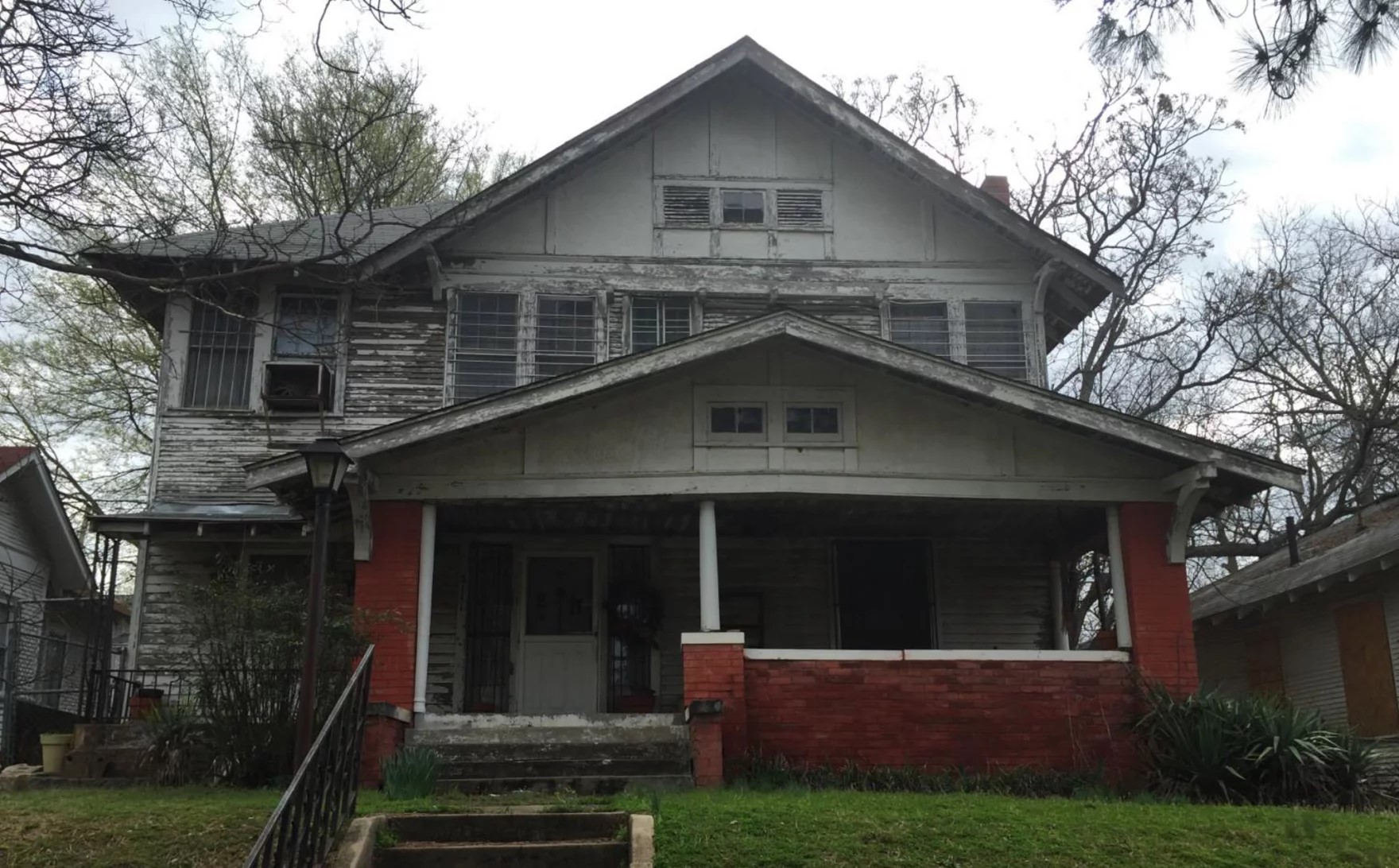
For years the home at 2111 Cross St. languished, and with it, the memories of a landmark in Little Rock’s history.
Its once-proud face was worn. Strips of paint peeled away, laying its wood open to the wounds of wind and water. The weight of decades sat on its darkened porch. The nonprofit organization Preserve Arkansas even listed the home as one of the state’s most endangered in 2016.
But in 2019, new owners took possession of it and poured much-needed love into the wood-and-brick house that was once the home of Arkansas’ first Black agricultural extension workers and the childhood home of the Little Rock Nine’s Gloria Ray.
This spring, the Dunbar neighborhood house is among those being featured in the Quapaw Quarter Association’s 59th annual tour of homes May 11-12.
“We were looking for some houses in the area and the current owners were happy to open their house to us and to have it on tour,” said Callie Williams, a Quapaw Quarter Association volunteer and architectural historian. “They’re newer homeowners. They recently purchased the home and have recently done a big renovation and rehabilitation job on the house.
Independent reporting for Pine Bluff & Jefferson County since 1879.
“It was in kind of a sorry state and had fallen into disrepair. They were able to get the house and bring it back,” Williams said.
MARY LEE AND HARVEY RAY
The story begins with Mary Lee McCrary and the man who would become her husband, Harvey Cincinnatus Ray.
Educated at the Tuskegee Institute and graduating in 1897, Mary Lee McCrary began teaching at private schools in Alabama and South Carolina. She moved into public education in 1900. She served as an instructor at what was then the new Colored Agricultural and Normal University in the Oklahoma Territory. McCrary was also an entrepreneur and during her time in Oklahoma, she built a successful dressmaking business.
McCrary’s life changed when she met Harvey Cincinnatus Ray, a fellow college educator. The couple married, moving to Arkansas. They made their home at 2111 Cross St.
Harvey Ray would be the first Black county agent of the Arkansas Agricultural Extension Service in 1915 and Mary Ray would become the first Black home demonstration agent in 1916. Their jobs involved bringing the latest university discoveries to help people live better, whether it meant growing more crops or being able to better feed a family.
Work done by the Agricultural Extension Service is undertaken today by the Cooperative Extension Service, the outreach arm of the University of Arkansas System Division of Agriculture.
THE RAYS’ WORK
Harvey Ray’s appointment included working with farmers in a large swath of Arkansas: Pulaski, Phillips, Jefferson, Lee, Monroe, Crittenden and Arkansas counties. In 1918, he was named district agent, a title he held until his death in the 1950s.
Mary Ray would conduct her outreach efforts in Pulaski, Phillips and St. Francis counties until July 1918, when she was promoted to district agent for home demonstration work. According to the Encyclopedia of Arkansas, the promotion would expand “her responsibility to as many counties as emergency wartime funding would support — at least 30 based on her 1918 report.”
Mary Ray’s projects included canning demonstrations, garden clubs and school lunch programs.
She held the post of district agent until her death in 1934.
“We stand on the shoulders of pioneers like Mary Lee McCrary Ray who modeled the way of home demonstrations, strength in adversity and program advocacy,” said Nina Roofe, assistant vice president for family and consumer sciences at the Cooperative Extension Service. “Our classrooms and technology are different today, but our focus on bringing education in everyday language to individuals and families in our communities remains the same.
“We bring financial management, health and nutrition, civil engagement and more to empower Arkansans to make informed decisions to improve their lives,” Roofe said.
“And as Mary Ray did, our agents engage with their quorum courts and other stakeholders to ensure sustainable funding of programs for future generations,” Roofe said.
THE LITTLE ROCK NINE
After Mary Ray’s death, Harvey Ray married another home demonstration agent, Julia Miller. The pair raised three children, including Gloria Ray. In 1957 at age 15, Gloria Ray was one of the Little Rock Nine who were denied entry to Little Rock Central High School. President Dwight D. Eisenhower ordered units of the Army’s 101st Airborne to the scene and federalized the Arkansas National Guard soldiers that Gov. Orval Faubus sent to the school to prevent integration. The Nine were later escorted into the school by federal troops.
Amy Cofer, an extension program associate for early childhood professional development, will be a tour guide for the Ray house.
“It’s an excellent opportunity for us and the Quapaw Quarter Association to highlight the rich history of the Cooperative Extension Service in the state and remind people we’re still here, providing the same free education to Arkansans,” Cofer said.
TOUR INFORMATION
The Quapaw Quarter Association’s tour includes homes in the Dunbar and Governor’s Mansion neighborhoods of Little Rock. Tours run from 1-5 p.m. on May 11-12. Tickets are $30 in advance, or $40 at the door.
Want to volunteer as a tour guide? There’s a signup page at https://www.signupgenius.com/go/9040E4AA8AF2FABFD0-48725400-59th#/.
The tour is a key fundraiser for the Quapaw Quarter Association, whose mission is to preserve Greater Little Rock’s historic places.
To learn about extension programs in Arkansas, contact a local Cooperative Extension Service agent or visit www.uaex.uada.edu.
Mary Hightower is with the University of Arkansas System Division of Agriculture.