
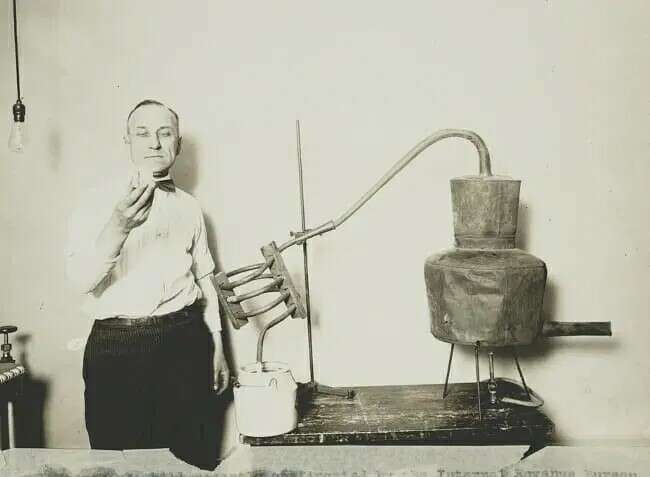
Limiting the public consumption of alcohol in Arkansas can be traced back to the earliest Arkansas settlement, the Arkansas Post. When the Arkansas Post was occupied by the Spanish, the sale of alcohol to the Quapaw and other Native American tribes was a thriving business and tool of diplomacy that the Spanish sought to limit. However, as Arkansas’ population increased, so did the interest and efforts of prohibition.
During the American Civil War, prohibition efforts rose as the state passed a ban on distilleries, making alcohol production illegal to save grain for the war efforts. Consequently, secret stills sprang up across Arkansas as bootlegging caused an increase in the production of whiskey and moonshine. Most of the whiskey was made from corn.
During and after the Civil War, farmers realized that they could make more money by selling their corn to moonshiners than selling it at the market. In 2005, in his book, John Barleycorn Must Die: The War Against Drink in Arkansas, Ben F. Johnson III wrote, “In the 1890s a southern farmer could make about $10 when he hauled his 20 bushels of corn to town, whereas distilling 40 bushels into 120 gallons of whiskey could clear $150, without the federal tax.”
As a result, from the 1870s to the early 1900s, the moonshine wars began between local bootleggers and the U.S. Marshals accompanied by federal revenue agents searching for illegal stills across Arkansas.
In 1915, Arkansas passed the Newberry Act which banned the manufacturing and sale of alcohol in the state. By this time, only 12 Arkansas counties were still “wet” counties allowing the sale of alcohol. In 1917, Arkansas banned the importing of alcohol, becoming a “dry” state before the 18th Amendment of 1920 made prohibition the national law.
Independent reporting for Pine Bluff & Jefferson County since 1879.
During the early 1900s, Pine Bluff authorities arrested large numbers of Black and white moonshiners. Bootlegging was so common that everyone was guaranteed to know at least one moonshiner or even more. In Pine Bluff, a great deal many more African Americans were arrested on bootlegging charges as many of them were poor and used bootlegging as a source of income. Bootlegging was popular along the bayou as most Black bootleggers could drive their stills into the spring water.
By the late 1920s, the enthusiasm for prohibition dwindled as the law became more and more difficult and costly to enforce. The federal and local governments were spending a great deal of money to pursue bootleggers and hold them in jail. In 1929, when the Great Depression began, prohibition received its dying blow. On July 18, 1933, the majority of Arkansans voted to end prohibition.
After prohibition ended some counties didn’t embrace the sale of alcohol. Many elected to remain “dry.” The effects of prohibition can still be felt through the state of Arkansas even 100 years later as 34 counties remain “dry” counties today, and the sale of alcohol on Sundays throughout the state is still illegal in most places.
This article is from ExplorePineBluff.com, a program of the Pine Bluff Advertising and Promotion Commission. Sources: www.onlyinark.com – The Long Road to Prohibition in Arkansas; www.encyclopediaofarkansas.net – Prohibition; www.newspapers.com; DeArmond-Huskey, R. Bartholomew’s Song. A Bayou History. (2001). Heritage Books. Image credit: Library of Congress.
Ninfa O. Barnard wrote this article for ExplorePineBluff.com.