
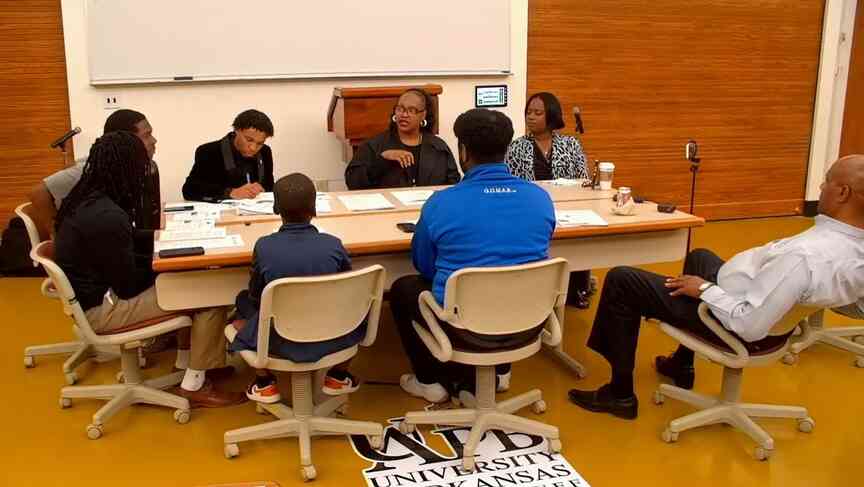
A discussion last week between city leaders and young residents of Pine Bluff revealed deep concerns over economic stagnation, lack of recreational opportunities and decaying infrastructure, with young adults questioning whether they will be able to build a life in their hometown.
The conversation, which included college students and longtime residents, served as a platform for Mayor Vivian Flowers and her staff to address the challenges and advocate for a renewed investment strategy tied to a forthcoming ballot measure.
A recurring theme was the lack of jobs for college graduates, forcing young people to seek careers elsewhere. One young person highlighted the disparity, stating, “One thing I want to see in the city … for me to really stay here is more job opportunities.”
Another major concern was the absence of activities for youth and young families, particularly for those not involved in organized sports. A freshman mass communications student noted there weren’t too many things to do, especially for those who don’t play sports. Another participant mentioned the need to travel to Little Rock for attractions like movies and other recreational facilities.
Frustration over the city’s infrastructure was also a topic of discussion. One young resident described conditions in their area filled with potholes, dark streets and trash. The consensus was a yearning for the sense of community and the public spaces of the past, with one participant emphasizing that they wanted to see the community grow like a big family.
Independent reporting for Pine Bluff & Jefferson County since 1879.
Flowers acknowledged the severity of the issues, framing the path forward as a necessary but difficult change requiring civic participation. She drew on her own decision to run for office as an example of stepping out of a comfort zone to drive progress.
“Change is really hard,” she said. “I ran because I wanted to be a change agent for the people. I ran because of all the things that you all have said at this table.”
Flowers connected the city’s economic struggles to its unused assets, specifically its port.
“We have an infrastructure that we’re not using … But if we do not repair our port, jobs won’t come here. Industry will not come here,” she said.
She explained that investing in infrastructure — including streets, the port, and recreation — is crucial to retaining young, educated people. She also made a strong commitment to fixing the issues residents see daily. “It is definitely my priority to address long-neglected areas first,” she said.
Addressing the youth, Flowers stressed the power of their vote, noting that 18-to-40-year-olds represent the largest voting block in the county, yet they vote the least.
“The largest voting block in the country is 18 to 40, young voters. But guess who votes the least? 18 to 40,” she stated, encouraging young people to leverage their numbers to demand the change they want.
She outlined plans to invest in youth programs by “partnering with churches and upgrading the parks so that there’s always something for kids to do in safe spaces”, highlighting existing organizations like STEM programming and TOPS as key partners.
Last week, Flowers announced moving forward with a proposal for a new 1-cent, 10-year sales and use tax, dubbed the “Revitalization Economic Development Tax,” arguing the additional revenue is critical to address chronic city budget deficits and an eroding tax base.
If passed, the revenue from the proposed sales tax would be dedicated to priority projects under defined categories of spending.
Key projects outlined by Flowers include comprehensive blight removal, full-scale renovation of the Pine Bluff Convention Center, citywide pothole repairs, downtown broadband access, and a minimum $5 million repair and expansion project for the Pine Bluff Port. Flowers also noted a significant increase in the Pine Bluff Police Department’s full-time uniformed personnel, rising from 75 to 100 officers, an improvement that requires more sustained funding.
The proposed 1-cent sales and use tax, if approved by voters in March 2026, would be in effect for 10 years (2026 to 2036). Officials project this tax could generate an additional $9.1 million to $14.3 million annually.
Town hall meetings are scheduled to continue throughout the week, with the measure set to be considered by the City Council in December. If it is approved, the measure will go before the public as part of the March 2026 primary election.
Flowers concluded the town hall meeting by assuring attendees that the proposed financial measure is about enabling a future for the city, not repeating past mistakes with tax dollars, stating the goal is to give people what they want: better streets, a functioning port and things for kids to do.