Sheila Waddell and Jalina Williams had their own reasons why they joined the military.
Waddell’s “why” was to work in electronics, so the Dayton, Ohio, native knew in high school she wanted to join the Air Force, despite her mother’s apprehensions.
“I just like the way the uniforms looked, but I also passed the test,” Waddell said, looking back on her decision to join in 1980.
Williams, originally from Columbus, Ga., had her first child at 19 and joined the Army in 1989 to have a job and career so she could build a strong future for herself and her family.
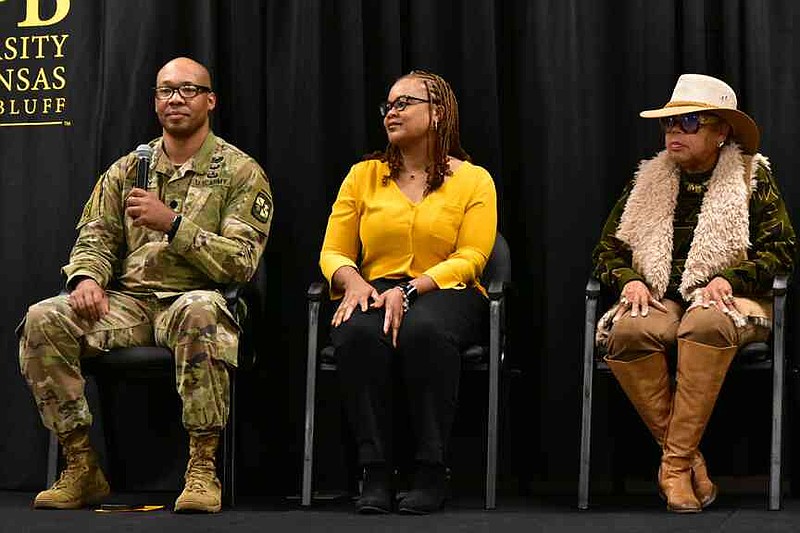
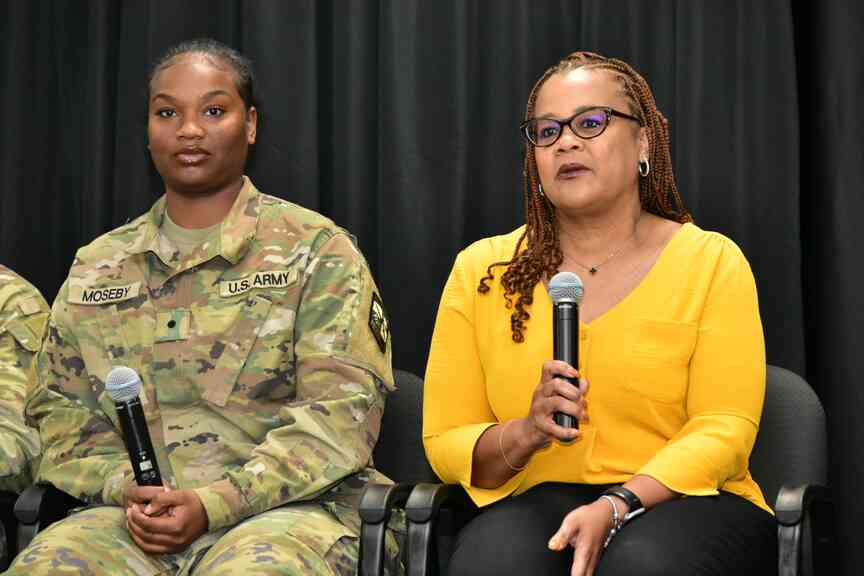
The two veterans shared their experiences of being Black women in the military Tuesday during a panel discussion at the University of Arkansas at Pine Bluff’s annual Veterans Day Celebration assembly at the STEM Conference Center. Between Waddell and Williams, they served more than 40 years in two of America’s military branches.
Independent reporting for Pine Bluff & Jefferson County since 1879.
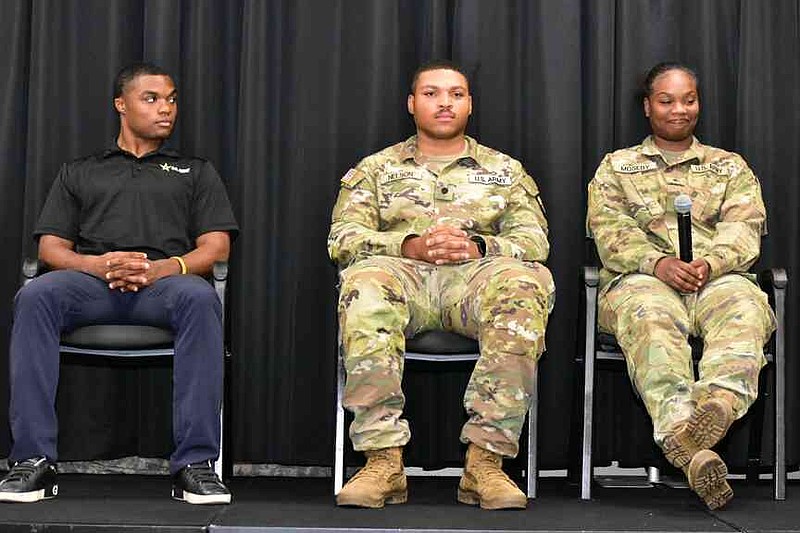
Led by Lt. Col. Brian Waddy, professor of military science, the hourlong ceremony paid tribute to each branch as well as locals and UAPB graduates who served in them. Reserve Officer Training Corps Cadets Erica Moseby, Szkyren Pruitt and Kendrick Nelson joined Waddy, Waddell and Williams on the panel and discussed why they joined.
“Veterans Day is more than a date on our calendar. It’s a moment of reflection,” Waddy said.
Waddell retired along with her husband Eric from Dover Air Force Base in Delaware in 2000 and owns Sheilah’s Designs, a monogramming business on Pullen Avenue in Pine Bluff. (Her mother didn’t want to put the second “h” in her name, Waddell said, so she did just for her business.)
But when she got into the Air Force, she had to prove herself to win the respect of her comrades.
“When I joined at Travis Air Force Base in California, they had never seen an African American woman,” Waddell said, adding co-workers would cast doubts on her abilities. But three qualities she named that stay with her — “tenacity, fortitude and no fear” — helped carry her in a 20-year career through the Wild Blue Yonder.
Among three air bases where she was stationed, Waddell said, she was the only Black woman other soldiers had seen.
“That’s mind-blowing … not only do I have to work twice as hard to gain their acceptance, but I have to work twice as hard to be average,” she said. “But I wasn’t average.”
At 5 foot, 3 inches tall, Waddell still has no fear, she affirmed.
Williams was a human resource administration specialist in the Army and retired from active duty after 21 years and 8 months. Williams was transferred from Tampa, Fla., to Pine Bluff in 2008 to be closer to her mother, she said.
She retired again last month — this time from UAPB’s ROTC as a recruiting operations officer after 12 years.
“The best part I love about this is that I was feeding into the future officers, helping these young Black male and female officers navigate through my experiences and just teaching them how to be a better officer,” Williams said. “Some of mine from ’08, they’re lieutenant colonels now, and when they come back they say, ‘Ms. Williams, thank you. Thank you for feeding into me,’ and I always took up for them, right or wrong. I’m going to correct them, but it was like being a second mom to them. I treated them like they were my kids.”
Earlier in her career, Williams learned the power of fighting with the pen rather than a smart mouth, as she described it, when facing discrimination from superiors. She filed complaints on two occasions, and they were found valid both times. In one instance, she said, the supervisor brought the whole formation to her and he apologized to her before everyone.
Despite the hurdles they had to clear, both women spoke highly of their careers and the benefits of being veterans. Today, 50 cadets are a part of the ROTC at UAPB, with four set to graduate and be commissioned as Army officers. About 700 have graduated from the university’s ROTC since 1970, Waddy said.
“I wanted to serve something greater,” he said, looking back on his two-decade-plus career. “The military does protect our way of life.”