Editor’s Note: This is first part of a three-part series.
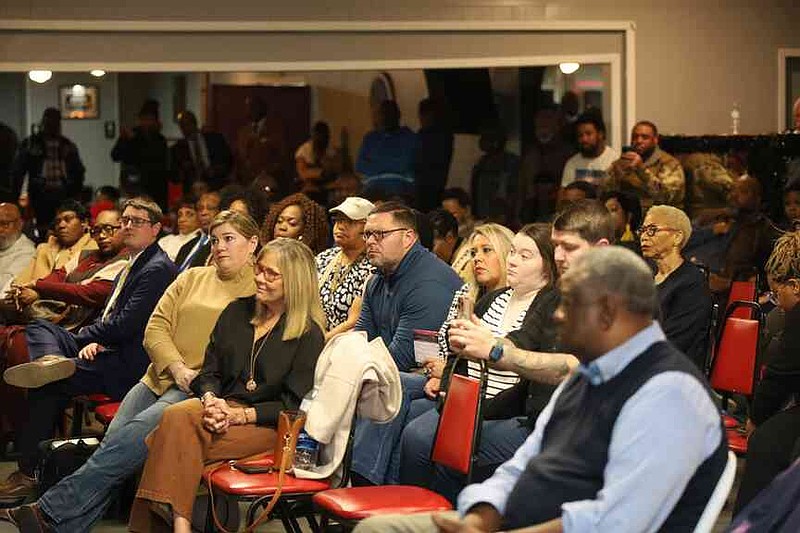
With the 2026 primary season heating up, Jefferson County voters filled the William Townsend Elks Lodge on Tuesday evening to hear directly from a crowded field of candidates vying for the offices of county judge, sheriff and U.S. Senate.
Sponsored by the Pine Bluff Branch of the NAACP and the IBPO Elks of the World, the forum offered residents a chance to support and scrutinize the platforms of both incumbents and challengers in what is shaping up to be a pivotal election cycle for the region.
For the U.S. Senate seat currently held by Sen. Tom Cotton, there are stark differences in policy focus and campaign approach between two key contenders: Lewisville Mayor Ethan Dunbar and Hallie Shoffner, a farmer and small business owner. The discussion focused on economic development, education, agricultural policy and the incumbent’s commitment to Arkansas citizens.
Both candidates presented plans to stimulate the Arkansas economy, with a focus on supporting small businesses and community investment.
Independent reporting for Pine Bluff & Jefferson County since 1879.
Dunbar, who is in his second term as mayor, emphasized the importance of fostering local entrepreneurship, particularly in rural communities. “I think I would start with entrepreneurship,” he stated, and encouraged investment in local businesses and infrastructure. He stressed the need to fight federal cuts to programs that support the working class, noting that “43% of Arkansans are ALICE (Asset Limited, Income Constrained, Employed). “That means they’re going to work every day and still have problems making ends meet,” he said.
Shoffner, a sixth-generation farmer, focused on tax relief for the middle class and a specialized approach to agriculture. “I believe in cutting taxes for the middle class, specifically, families and workers and small businesses,” she said. She also championed a “farm to table” economic model for the state.
“We will feed our economy. We will feed our children and in Pine Bluff, Arkansas, we have the opportunity to be the specialty crop capital of the United States,” she said.
Her plan includes building processing facilities, cold storage and commercial kitchens near farms to create jobs and provide affordable food.
When asked to name the primary issue the incumbent has mishandled, both candidates directed sharp criticism at his allocation of federal resources and apparent detachment from the state.
Dunbar argued that Sen. Cotton does not truly understand the day-to-day struggles of Arkansans because he does not live in the state. “Sen. Tom Cotton doesn’t live in Arkansas, you know, he maintains a residence here just to say he’s from Arkansas, but he lives in Virginia,” Dunbar said.
He connected this lack of residency to a failure of empathy at the national level. “I mean, our most vulnerable citizens suffer for decisions made by someone who doesn’t even live here.”
Shoffner focused her critique on the incumbent’s use of federal funds abroad.
“One thing that we know about Tom Cotton is that he is willing to spend time and resources on any other place than the United States and Arkansas,” she claimed, citing examples such as spending in Venezuela and Argentina. She concluded that the result for Arkansans is higher utility and car repair bills with “absolutely nothing out of Tom Cotton,” suggesting he wants to be the next secretary of war and not the senator from Arkansas.
In the final questions, the candidates presented their distinct plans for supporting farmers and public education.
On agriculture, Shoffner detailed the crisis facing farmers, with bankruptcies “skyrocketing” and one in every three farms projected to close this year. She passionately advocated for diversification, moving away from growing non-food crops like soybeans and toward specialty crops, arguing this will create an “entrepreneurial spirit around agriculture” and combat the state’s food insecurity issue.
Dunbar emphasized the need for federal support for all people who work in agriculture, including migrant workers. “Our farmers need help; we’ve got to help them. But we also have to help those who work the farm, the work that nobody wants to do, that we pay these immigrants to come in on these visas to do,” he noted, while also expressing concern about the working poor and the need to push money back to municipal governments.
Regarding education, Dunbar pledged to reestablish the Department of Education at the federal level to ensure fairness and proper oversight, recalling issues from the 1950s.
“We have to fund our public schools. We have to fund our public schools,” he asserted, opposing the funding cuts that are impacting programs like Head Start.
Shoffner, who has been working with the Arkansas Education Association (the teachers’ union), presented a three-part plan:
Introduce federal legislation to ban the use of public funds for private school enrichment.
Eliminate “right to work” laws to strengthen teachers’ unions and collective bargaining rights.
Restore and strengthen the Department of Education for necessary oversight and data collection.
She emphasized the need to prioritize educators, asking, “If teachers are always putting our students first, why are we not putting our teachers first? Why don’t y’all have a seat at the table?”
Besides advocating for cutting taxes for the middle class, specifically, families and workers and small businesses, she commits to restoring funding to some of the small business entrepreneurial programs that have been cut.
She specifically mentioned the need to restore funding for a program for Black farmers in the Delta that allows them to increase their storage for some of their cash crops, which was cut by the current administration.
As an economic development and entrepreneurship strategy, she proposes an integrated “food farm to table” model that would benefit farmers and small businesses.
Dunbar raised major global concerns. He states that the country’s democracy is “in peril” and warns that “2026 may be the last election” if current trends continue.
He criticized a president who is “consolidating power,” with the coequal branches of government (legislative and judicial), capitulating to the executive branch. He expressesd concern that the president is looking to circumvent the 22nd Amendment (about the two-term limit) and that the Supreme Court is being influenced to rule in a way that undermines the Constitution. He highlighted a potential monumental decision by the Supreme Court on birthright citizenship, which, if overturned, would mean the government gets to choose who is a citizen or not.
He warned that the country is moving toward an “authoritarian government” and is becoming “more authoritarian and aggressive in nature.” He suggested this could lead to destabilizing foreign policies.
Shoffner states that as of the end of the year, her campaign has raised $1 million, which she says is “breaking records for a Democrat running in Arkansas in over a decade.”
In her closing statement, Shoffner covered several aspects of her campaign and vision for Arkansas. She stressed that politics should be “human rather than transactional.” She emphasized the need to visit every community to understand what people need, saying, “You have to know what it’s like to live here right now, which means I have to go with every single community.”
She spoke directly to the Pine Bluff community, stating that they have been “disenfranchised and ignored by the state “because you are a Black and brown community and that has to stop.” She committed to taking the attitude of advocating for every single community into the U.S. Senate.
Dunbar says a senator must fight to save democracy. “As a member of the legislative branch, a Senator must grow a spine and stand up against what’s wrong,” said Dunbar, stating that failure to do so will result in “a dictatorship here in America.”