
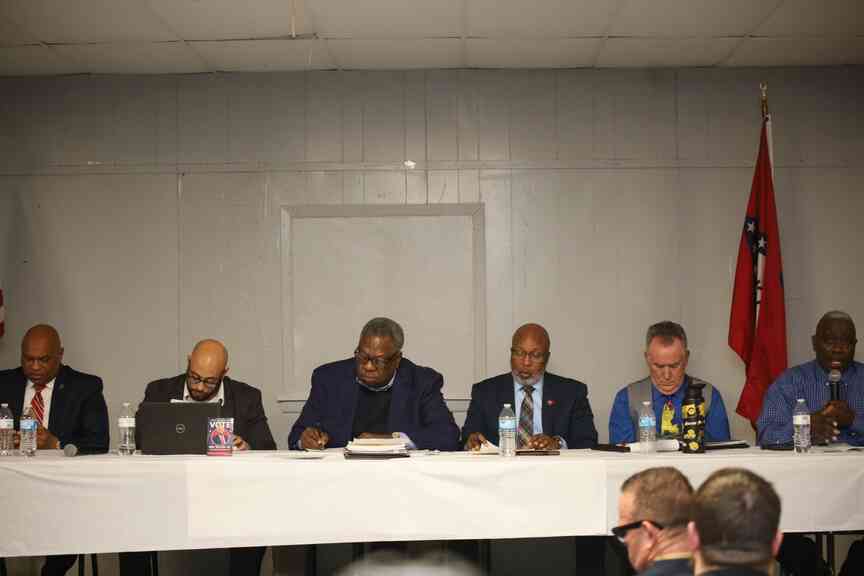
Editor’s note: This is part two of a three-part series.
Six candidates vying for the Jefferson County judge seat outlined sharply different visions for the county’s future at a recent forum, with infrastructure, political gridlock and economic stability emerging as the dominant issues. The candidates, Democrats Jeff Edwards, Michael Turley, Efrem Neely, Eric Walden Jr. and incumbent Gerald Robinson and Republican Nathanial Todd, offered their plans, often criticizing the current state of county government and its lack of collaboration.
The sentiment among the candidates is that the current administration has fostered a divisive atmosphere, leaving essential services and county morale in a state of disrepair.
The most persistent theme of the debate was the intense political gridlock between Robinson and the Quorum Court. Challengers framed the issue as a failure of leadership and ethical practice.
Walden delivered a pointed critique of the nature of the gridlock. “First of all, there was a gridlock, because the Quorum Court didn’t trust the county judge. That’s how there was a gridlock. There was a lack of trusted transparency,” he said. Walden also highlighted employee financial struggles, saying, “Let’s not forget under his administration, county employees’ pay was held twice. Let’s not forget that.”
Independent reporting for Pine Bluff & Jefferson County since 1879.
Edwards called for a fundamental shift in governmental decorum and focus. “Breathing the integrity back to county government … I would stay in my lane and do what I am elected to do,” he said. “The Quorum Court runs a county …The County Judge is supposed to work with the Quorum Court.”
Jefferson County’s roads and bridges was a major focus, with Edwards describing his neighborhood’s roads as looking “like a bomb hit … and they’ve been like that for 30 years.”
Turley shifted the discussion to the underlying economic distress, calling for job creation to combat poverty. “The biggest issue for the county is that we may be 12th in terms of population, but we’re 36th in terms of per capita income,” he said. He advocated for moving people from “meal to meal poverty into the paycheck environment,” stressing that the county government should focus on being a servant to its citizens.
The motivations for seeking office varied, but all candidates stressed a need for change and improved governance. Edwards stated his primary goal is to “bring integrity back to county government” and specifically fix the county’s infrastructure, including roads, bridges and drainage. He also confirmed he is running his own campaign, independent of external backing.
Turley, a former Air Force veteran, law enforcement officer and educator, emphasized the need for transparency, collaboration and a “servant mentality,” viewing officials as servants to the county’s 60,000 residents. His original goal was to establish the county as a logistics support hub.
Neely, a lawyer appointed as a special judge to the Quorum Court by the governor, stressed the need for “cohesion and harmony and understanding of the law,” believing a true leader inspires others to work together toward common goals.
Walden is running to bring “transformation” to county government, improve relationships and put people first, citing his experience managing grants and involvement in the successful GVI initiative to reduce gun crime with youth.
Todd said he would act responsibly and transparently on behalf of the county, in partnership with the Quorum Court and others.
Robinson said he brought the county from “peril” and near bankruptcy to financial stability with $4.2 million in reserves. He is running on his record of leadership, “tough decisions,” new construction and significant economic development projects.
The ongoing political gridlock was a central topic, with candidates offering different prescriptions for restoring harmony and functionality to the county government. Edwards promised to bring integrity back by recognizing the Quorum Court as the body that runs the county, with the judge working in collaboration with them.
Turley suggested prioritizing transparency and collaboration, viewing the position as a job interview and emphasizing that officials must serve the residents rather than engage in power struggles or party politics.
Neely attributed the gridlock to a power struggle and “unethical” interpretations of the law. His solution was to restore harmony by ensuring the county judge oversees meetings, advises the Quorum Court and works in collaboration with all elected officials.
Walden said he believes the gridlock stems from a lack of trust and transparency from the county judge toward the Quorum Court. He said he plans to lead with trust, transparency and collaboration to find solutions, avoiding “vendettas.”
Todd said he prepared for the role by getting the manual from the Arkansas County Judges Association. He plans to share information with citizens about where to find standard operating procedures and best practices, believing this will lead to “empowered citizenship” and holding officials accountable.
Robinson noted that the county judge does not vote in the Quorum Court, which is responsible for the budget. He denied responsibility for delayed employee pay and instead attributed the gridlock to the Quorum Court’s failure to do its job, which he had to address through the courts. Candidates diverged on identifying the county’s single biggest problem, with focus split between infrastructure, economic issues and population decline.
Edwards said the poor condition of the county’s infrastructure, roads and bridges needs to be addressed. He said he would apply his professional experience in maintenance and analysis, including taking core samples to properly assess and create a scope of work for repairs. He also advocates for training younger generations for manual labor careers.
Turley said the low per capita and medium household income stemmed from a lack of job opportunities. He said he wanted to attract the right kinds of jobs for the current population, address educational issues that prevent students from accessing technical classes and use casino revenue to repair and paint roads.
Neely mentioned financial and structural issues and getting the county government to function, focusing on road issues, ensuring payroll consistency, and managing bank loans. He defined the roles and responsibilities of each elected official, particularly noting that the Quorum Court, not the county judge, is responsible for the budget.
Walden presented four major issues: roads and infrastructure, lack of trust and transparency with the county judge, employee retention and morale, and public safety in the jail. According to Walden, for infrastructure, he wants to perform a forensic audit of county contracts and create a Project County Road Committee with members from the education and business communities for a transparent prioritization process.
Robinson mentioned population loss, which has caused the county to drop in classification. He focused on economic development to reverse the trend, citing $2 billion in capital he has already brought in. He noted that only 8% of tax dollars are available for county roads, but his administration had completed almost 200 miles before the gridlock started.
When asked how they would work with city, state and federal officials, including those in Pine Bluff, Neely promised to work with officials “by showing up.” He plans to provide economic leadership by being present and visible at meetings and working with school districts, city mayors and the state legislature to build broken relationships.
Robinson defended his record, particularly on financial stability and economic development, saying he took the county from near bankruptcy with a minimal reserve fund to one with a “$4.2 million total in reserves.”
Robinson closed by listing his accomplishments, including bringing major industrial projects to the county. “I’m already working with representatives. I’m already working with Senators,” he said. “I’m going to continue to be an advocate for jobs, economic development, and I’m going to continue to build.”
The forum was sponsored by the Pine Bluff Branch of the NAACP and the IBPO Elks of the World and moderated by Michael McCray.
Part three of this series will feature the three candidates running for sheriff.