For years, Eugene Sinclair heard about his family’s land in Columbia County — a property steeped in family history. However, the fact that he grew up and lived in Florida and the demands of supervising a residential facility for people with mental health challenges and substance abuse disorders made it difficult to visit the land.
“The land has been in our family for roughly 130 years,” he said. “It was originally purchased by my great-grandparents, formerly enslaved people who became founding members of the Colored Methodist Episcopal Church, later renamed the Christian Methodist Episcopal Church.”
Sinclair’s grandmother insisted that the land must stay in the family because it was an important part of their heritage.
“Everybody left Arkansas, but my grandmother kept paying the taxes until she passed away in 1980,” he said. “She knew it needed to stay in the family.”
The land remained in his grandmother’s name for decades, eventually prompting Sinclair to start conducting legal research to transfer it properly to his mother’s name.
Independent reporting for Pine Bluff & Jefferson County since 1879.
One day Sinclair received a phone call from his sister-in-law who had recently attended an informational session at her church hosted by the University of Arkansas at Pine Bluff’s Keeping it the Family Sustainable Forestry and Land Retention program. After she learned about the program’s goal to help Black forest landowners manage and retain their land, she immediately thought of Sinclair and his family’s land in Arkansas.
“When I first got in touch with the people at UAPB, the land didn’t technically belong to any of us,” he said. “I could not have imagined that this program would be the key to fulfilling my family’s legacy. However, that was the case. The people at the Keeping it in the Family program welcomed me with open arms and began to set me up for success.”
The KIITF team introduced Sinclair to the right legal and forestry resources that allowed him to transfer ownership of the land from his grandmother to his mother and then himself. As he recalls, though this step was important, it was just the beginning of the support he would go on to receive.
“My mother was very relieved once the family land was in our name. However, I wondered how to proceed,” he said. “She told me, ‘You need to go touch your feet on the land.'”
Accompanied by his son, Sinclair set off to Arkansas to visit his family land for the first time. He was picked up by Kandi Williams, KIITF program coordinator, and Joe Friend, UAPB forester.
“They drove us out there, and I just started shaking,” he said. “It was emotional to finally stand on something my family held for generations. I also went to the church my ancestors helped build. My mother was right — actually being there gave me a profound sense of purpose and destiny.”
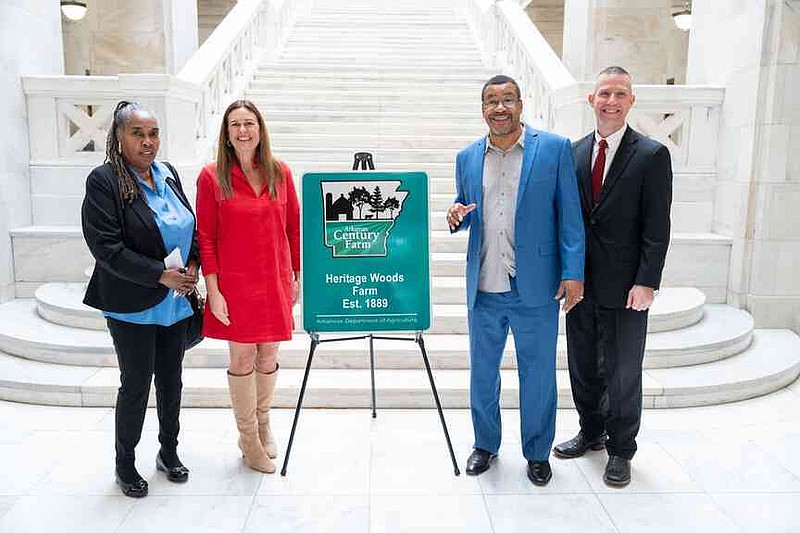
In 2024, his family’s story was recognized through the Arkansas Century Farm program, which honored the generational stewardship and legacy.
“At age 100, my mother got to be part of that special event that recognized our commitment to the land,” he said. “My sister-in-law was also present, as well as members of the Keeping it in the Family team. It’s ironic that’s the name of the program, because they really are like family members at this point.”
Sinclair said finding and befriending the KIITF team is another example of how God allows him to connect with people just like myself — people who love to help.
“I work with people trying to rebuild their lives,” he said. “In their careers, my mother and grandmother helped prisoners. I help people with mental health and addiction. It’s all the same mission — help somebody else.”
ENHANCING THE LAND’S PROFITABILITY AND SUSTAINABILITY
Through his collaboration with KIITF, Sinclair said he received crucial support he would otherwise not have known to seek. First, he received a professional land survey, which gave him exact knowledge of property boundaries, aided by boundary line painting.
“Without a survey, you don’t know what you have,” he said. “KIITF helped me finally understand where my land starts and stops.”
The team helped him implement timber stand improvement, specifically hack-and-squirt herbicide treatment, to remove overgrown competing vegetation that inhibited proper tree growth. Additionally, they helped him implement firebreaks, a critical step landowners can take to prevent wildfires.
NEWFOUND ENTREPRENEURSHIP: STARTING AN AQUAPONICS BUSINESS
During a collaborative webinar organized by UAPB and Prairie View A&M University, Sinclair heard Kamal Gosh, assistant professor of fisheries at UAPB, speak about aquaponics, which sparked a business idea.
“When I heard the KIITF webinar about fish, I said to myself, ‘I can’t raise cows from Florida. I can’t raise chickens. But I can raise fish.'”
Inspired partly by a small, discarded fish tank he found at work, he gradually built a home aquaculture operation with his wife, beginning with pet fish for their grandchildren.
After contacting Gosh and receiving guidance, he transitioned into raising tilapia and mollies commercially.
His business, Heritage Farms, now includes more than 10 aquaculture tanks, a dedicated website with online sales of live fish and continuous breeding cycles and improved tank maintenance systems.
He said aquaponics now serves as a timely alternative income stream, especially useful during periods when timber markets decline.
“My wife has even gotten involved with raising the fish,” Sinclair said. “She talks to the fish like they’re children. If they get too aggressive, she puts them in timeout. We looked it up online, and it turns out that’s exactly what you’re supposed to do — when your fish are too aggressive, just separate them for a while.”
INVOLVING THE NEXT GENERATION
One day Sinclair received word about an upcoming event in Arkansas he wanted to attend. Unfortunately, his schedule would not allow him to take the time to travel from Florida. That’s when his 21-year-old grandson expressed interest in the event.
“I explained the situation to Kandi Williams and Karen Lee, Extension program specialist for UAPB’s Small Farm Program, and they said my grandson could attend the event in my place,” he said. “My grandson is just like me — he went to every table, introduced himself and talked to everybody. He was exactly what they needed. He even had the chance to meet Ethan Dunbar, the mayor of Lewisville, Ark., with whom we are still in touch.”
Sinclair said he is excited about the prospect of his grandson and other family members taking an interest in the future of the land.
“I always tell my family what the next steps are in managing the property, because this isn’t just my project. It’s our legacy,” he said. “In any case, Keeping it in the Family really means something to us. We’re living the name.”
For information on how to get involved with the Keeping it in the Family program, contact Kandi Williams at (870) 571-9428 or williamska@uapb.edu.
Will Hehemann is an extension specialist for communications at the University of Arkansas at Pine Bluff School of Agriculture, Fisheries and Human Sciences.