
At the University of Arkansas at Pine Bluff, a quiet technological revolution is underway, according to Yathish Ramena, Ph.D, director of the university’s Aquaculture and Fisheries Center of Excellence.
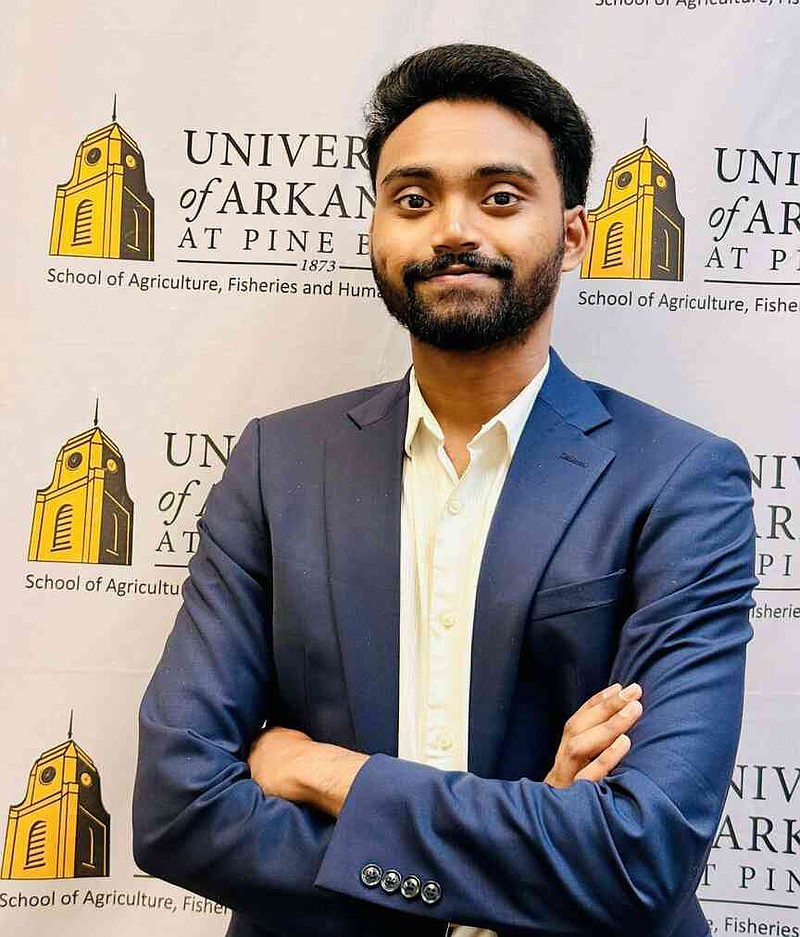
Nitish Kumar Sankurabhukta, a researcher in the Department of Aquaculture and Fisheries, is leading the development of an artificial intelligence platform that could change how farmers measure, manage and protect aquatic life.
The platform, known as “UAPB Aquaculture Computer Vision,” is built on a simple premise — precision technology should not be reserved for large corporations. It requires no proprietary hardware, no subscription fees and no specialized technical training.
“A farmer needs only a smartphone and an internet connection to log into the UAPB webpage,” Ramena said. “Within seconds of uploading a photograph, the system delivers a comprehensive biological and statistical assessment that previously required laboratory equipment, trained technicians and hours of manual labor.”
Independent reporting for Pine Bluff & Jefferson County since 1879.
Ramena credits Robin Ghosh, Ph.D, and Md. Siddique, Ph.D, assistant professors of computer and informational science at Arkansas Tech University, with collaboration on the project.
ENGINEERING INTELLIGENCE BENEATH SIMPLE INTERFACE
While the user experience is intentionally simple, the technology behind it is highly sophisticated, Ramena said. Sankurabhukta designed and built the entire system, from image collection and annotation to model training and cloud deployment.
“At the heart of the platform is a custom-built artificial intelligence model designed specifically for aquaculture,” he said. “Rather than relying on generic image libraries, Mr. Sankurabhukta trained the system using thousands of carefully labeled photographs of Pacific white shrimp. The images were taken under a wide range of lighting conditions, angles and stocking densities to ensure the technology performs reliably in real-world farm environments, not just in controlled laboratory settings.”
The platform also includes specialized models for black tiger shrimp and giant freshwater prawns, allowing farmers to analyze multiple commercially important species within one application.
“When a farmer uploads a photo, the system automatically identifies and counts each animal — even when they overlap or are densely packed,” Ramena said. “It then measures each shrimp individually, tracing the natural curve of the body to calculate accurate length rather than relying on rough box estimates. Using a reference object in the image, the software converts those measurements into precise real-world dimensions.”
From length, the system estimates individual body weight using established growth formulas. It can also assess gut fullness, giving farmers insight into feeding activity and digestive health — information that once required labor-intensive manual sampling. Within seconds, users receive a complete report including total count, individual and average length and weight, size variation, uniformity percentage and easy-to-read distribution charts.
“What once required multiple workers, physical sampling and manual calculations can now be done with a single smartphone photo,” he said. “Behind the scenes, the platform runs on a high-performance cloud-based system that allows fast processing and continuous updates. Improvements are deployed automatically so farmers anywhere in the world always have access to the latest version without installing new software.”
DIRECT ECONOMIC IMPACT FOR AMERICAN FARMERS
Ramena said the U.S. aquaculture industry generates more than $1.5 billion annually, with Arkansas, Mississippi, Alabama, Louisiana and Texas forming its productive core. But producers face rising feed costs, labor shortages, tighter environmental regulations and price pressure from imports. In this environment, precision matters. Stocking density, feeding rates and harvest timing can determine whether a season ends in profit or loss.
“Shrimp stocking has traditionally relied on rough volume estimates that can carry error margins of 25 to 45 percent,” he said. “For farms purchasing millions of post-larvae, those errors translate into real financial loss. Mr. Sankurabhukta’s AI-powered platform replaces estimation with accurate image-based counting, reducing uncertainty from the start of the production cycle.”
Feed accounts for up to 70% of production costs. By providing precise biomass estimates, the system allows farmers to adjust feeding in near real time, reducing waste, improving feed conversion and lowering disease risk. The platform also analyzes size distribution, helping producers target premium market grades where uniformity commands higher prices.
“Labor savings are significant as well,” Ramena said. “Traditional sampling requires multiple workers to net, count and weigh shrimp by hand, a process that stresses animals and increases mortality. With computer vision analysis, a single operator can complete the same assessment in minutes using only a smartphone.”
IMPACT BEYOND THE US
Shrimp farming is a multi-billion-dollar global industry driven largely by small and mid-sized producers across Southeast Asia, Latin America and Sub-Saharan Africa, he said. Many lack access to advanced analytical tools. Unlike commercial AI systems built for large industrial operations, UAPB’s browser-based platform is free and works on any device.
“Thanks to this innovation, a farmer in Asia, Europe or North or South America can upload images and receive a full population assessment within seconds,” Ramena said.
EXPANDING BEYOND SHRIMP
Ramena said Sankurabhukta is developing models for largemouth bass, a key species in U.S. freshwater aquaculture and recreational fisheries. Future expansion includes channel catfish, minnows and golden shiners, species central to Arkansas’s aquaculture economy.
“To support this growth, a GPU-accelerated supercomputing system is being added to the laboratory, allowing faster training on large image datasets and supporting multiple users at once,” he said.
The research extends beyond counting and measuring shrimp. Ongoing work includes AI-based water quality analysis that can interpret standard test kits for ammonia, nitrite, pH, alkalinity and dissolved oxygen. Integrated feeding systems are also in development to combine appetite monitoring with oxygen sensing, helping farmers adjust feeding schedules automatically to reduce waste and stress.
Together, these tools aim to create a unified, data-driven system for growth monitoring, water management and harvest planning.
ACCESSIBLE INNOVATION
“What sets this work apart is its accessibility,” Ramena said. “Developed at the University of Arkansas at Pine Bluff, a historic 1890 land-grant university in the rural South, the platform shows that transformative agricultural AI does not require corporate backing. It requires vision and a commitment to practical solutions.”
Sankurabhukta’s long-term goal is an open-access, multi-species intelligence platform serving farmers of all sizes around the world.
Ramena said the project reflects the university’s mission to deliver research that is impactful, inclusive and globally relevant. He encourages producers, researchers and industry partners to engage with and support the initiative as it continues to expand.
For more information about UAPB’s artificial intelligence research in aquaculture, contact Yathish Ramena at ramenay@uapb.edu.
Will Hehemann is an extension specialist for communications with the University of Arkansas at Pine Bluff School of Agriculture, Fisheries and Human Sciences.