
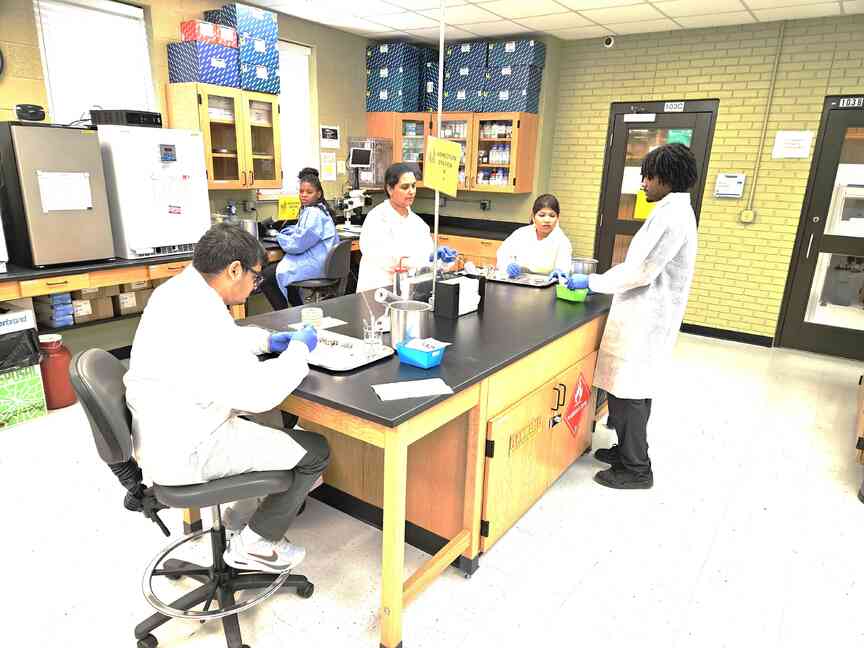
The University of Arkansas at Pine Bluff Aquaculture and Fisheries Department continues to advance the U.S. Department of Agriculture’s Animal and Plant Health Inspection Service (APHIS) certified fish health inspection services and disease diagnostics under the leadership of Director Grace Ramena, according to Bruce McGowan, interim dean and director of UAPB’s School of Agriculture, Fisheries and Human Sciences.
In addition to being director of UAPB’s Fish Health Inspection and Diagnostic Program, Ramena is also an associate professor of fish pathology at UAPB, an American Fisheries Society Fish Health Section-certified aquatic animal health inspector and Arkansas Research Alliance Fellow.
Members of her lab include Kailash Bohara, extension specialist; Zachariah McGowan, extension associate, and Betty Cheriyan and Annik Segree, research associates.
“The team plays a vital role of conducting fish health inspections and disease diagnostics for aquaculture stakeholders in Arkansas and nationwide. They ensure regulatory compliance with World Organization for Animal Health (WOAH) and USDA-APHIS standards,” McGowan said.
The UAPB’s inspection lab is APHIS certified to test WOAH reportable pathogens viral hemorrhagic septicemia (VHS) and spring viremia of carp virus (SVCV), epizootic ulcerative syndrome (EUS), infectious hematopoietic necrosis (IHN), koi herpesvirus disease (KHV) and megalocytivirus pagrus1 (RSIV).
Independent reporting for Pine Bluff & Jefferson County since 1879.
“UAPB has achieved a milestone in advancing fish health inspection services,” according to Ramena. “The university’s fish health inspection lab in Lonoke, Ark., is now the only facility in the state authorized by USDA APHIS to test for viral hemorrhagic septicemia (VHS) and spring viremia of carp virus (SVCV) — two critical pathogens in the aquaculture and baitfish industries. This capability streamlines testing, reduces turnaround times and expedites fish certification for interstate and international movement.”
“These efforts reinforce UAPB’s commitment to fish health and disease prevention while directly supporting farmers in certifying fish benefiting both local baitfish and ornamental fish producers and across the U.S.,” McGowan said. “This advancement will help with timely certifications to meet market demands and shipping regulations.”
“Our team is committed to advancing molecular diagnostics, expanding testing capabilities and conducting translational research funded by the National Institute of Food and Agriculture to support stakeholders,” Ramena said. “These efforts position UAPB as a regional leader in aquatic animal health, integrating research, field support and regulatory diagnostics. The department’s progress aligns with its mission to support sustainable aquaculture, safeguard aquatic animal health and strengthen the economic resilience of Arkansas and the U.S. aquaculture sector.”
Will Hehemann is an extension specialist of communications for the University of Arkansas at Pine Bluff School of Agriculture, Fisheries and Human Sciences.