
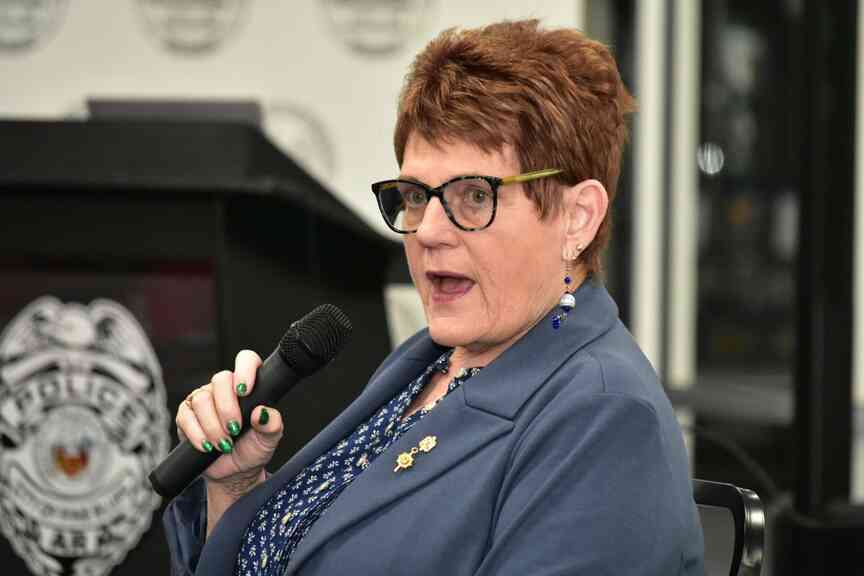
To tackle gun violence in Pine Bluff and Jefferson County, members of Group Violence Intervention are learning about call-ins with would-be offenders as a way to sway them from trouble.
Former Cook County, Ill., Deputy Sheriff Deb Higens returned to Pine Bluff this week as a senior consultant for the National Network for Safe Communities, an organization based at John Jay College in New York that is advising GVI. Since Tuesday, Higens has been training police and sheriff’s deputies, as well as school district leaders, prosecutors, preachers, attorneys and elected officials on how to conduct call-ins.
“It’s a lot of work behind the scenes, and then what happens is that when you have the call-in you have the candidates in the seats, then you get up and you have law enforcement speak, then you have community speak,” said Higens, who led a daylong seminar last March at the Convention Center. “We also give them sandwiches and some food. We take their phones away and we put them in a crate and put them in the front of the room so they don’t feel like anybody is looking at their phone.”
The three-day training, most of which has taken place at the Det. Kevin D. Collins Center, ended Thursday with a peace walk and prayer at Family Church’s Pine Bluff campus at 2309 S. Poplar St.
The call-in is considered a primary tool of GVI for communicating directly with members of active street gangs or groups to reduce violence. It’s an avenue for GVI to deliver its core three-part message: a moral message from the community against violence, an unconditional offer of help, and advance notice about the legal risks their groups face if violence continues.
Independent reporting for Pine Bluff & Jefferson County since 1879.
Active street group members may be mandated to attend a call-in by terms of probation or parole, or face an immediate sanction. They are then instructed to share the GVI message with friends and associates.
“The prosecutors who show up at the call-in are asked to show the possible offenders their legal responsibilities,” Higens said. “If you go to a corner store, your friend gets out, they rob and shoot and kill somebody, you’re accountable as well as them. A lot of our clients don’t understand that, so it’s our responsibility to educate them on what their legal risk is, and then we show them what we can give them to prevent them in that situation.”
Higens suggests the call-ins not be held at a police station because the would-be offenders think they’ll be arrested. She suggests a library, conference room, hospital, fieldhouse or similar structure open to the public.
GVI has focused on reaching troubled juveniles in the past year and curbed homicides involving a person younger than 18. The last homicide to take the life of a minor in Pine Bluff occurred Jan. 12, 2024, when a 16-year-old was gunned down in the area of South Georgia Street and East 25th Avenue.
Pine Bluff Police have confirmed one homicide this year, involving a 56-year-old man in the 1700 block of West 25th Avenue on Jan. 5. Five homicides were confirmed through March 21 in 2024.
“I didn’t accomplish anything. This is the team that accomplished this,” Higens said. “The police are holding the shooting reviews and inviting other departments. They go over each incident and have the most readily available intel based on everyone’s experience with the person we’re reviewing.”
Although the focus of this week’s training has been on violent adults, at least one school official reports she’s seen the benefits of call-ins among troubled youths.
“Being involved in this, this has allowed us to be proactive with our students,” said Kerri McNeal, director of student support and intervention in the Watson Chapel School District. “We’ve been able to identify students. We’ve been able to target them. We’ve been able to do call-ins. I’ve had (Deputy Chief Shirley) Warrior and the team come to the school. Rev. (and GVI Director Kevin) Crumpton has done mediations with some of our kids that are into it. When we have a brewing of a problem, I call them and they come out so they can meet within the school.
“Hopefully this is helping the kids to prevent violence so we can stop it at the school level so they won’t become an adult and have these same issues in the streets.”
McNeal added WCSD Superintendent Keith McGee created a student advisory council to hear from the young people about what they needed to take more ownership of their learning experience.
Earnest Brown Jr., the 11th West Circuit 6th Division judge and GVI governance board member, anticipates local authorities could conduct three to four call-ins throughout the year, each one close to a holiday.
“To keep with the customs, we think it’s still better 1-on-1, but the call-in will be for those who are repeated violators,” Brown said.