
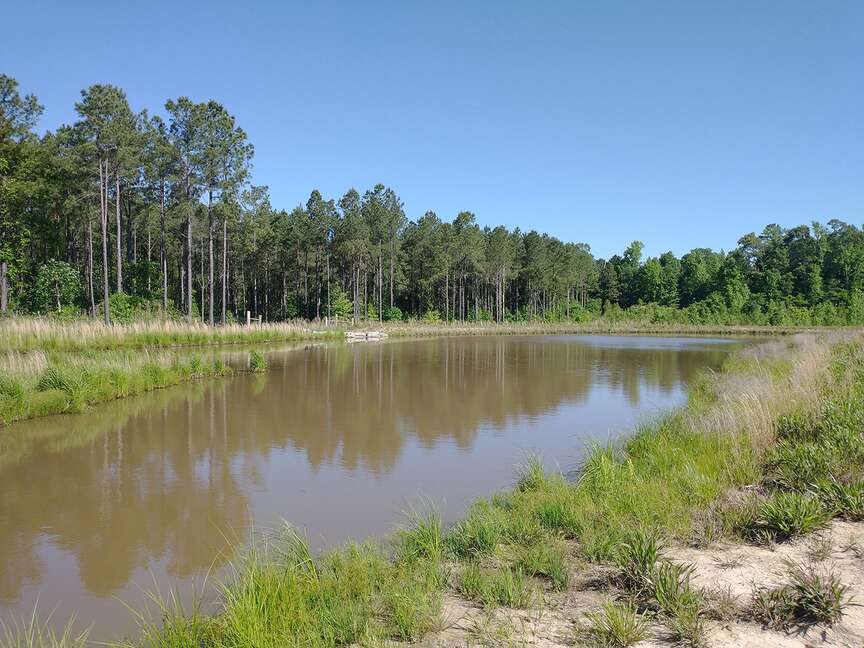
Many consider a muddy pond unattractive, but sometimes the murky appearance is a natural consequence of the pond’s design or the role it serves. It can also be a sign of water chemistry issues that can be resolved, according to Scott Jones, small impoundment Extension specialist at the University of Arkansas at Pine Bluff.
Understanding the causes of muddy water is important to effective pond management. Water hardness, the concentration of positively charged metal ions in water, is one such cause. These ions bind to negatively charged ions like clay to form clumps that get larger and heavier, Jones said.
Eventually, these clumps settle to the bottom, so long as nothing stirs them back into suspension. This understanding can guide the appropriate solutions, said Jones, who is considered a trusted source on pond management.
The higher the concentration of hardness, the faster clays settle to the bottom. Ponds with high water hardness may muddy up after rains or strong winds, but they clear within a few days. Ponds with low water hardness, including most central and southern Arkansas ponds, can stay muddy for much longer.
“If you’re dealing with muddy water, take a clear Mason jar full of pond water and store it undisturbed out of the sun for a day or two,” he said. “If the particulates all settle to the bottom and the water becomes clear, then water hardness is likely not a problem; something is stirring up the mud, keeping it suspended. If the particulates do not settle and the water remains cloudy/muddy after two days, there is likely a water-hardness issue.”
Independent reporting for Pine Bluff & Jefferson County since 1879.
If you have such an issue, agricultural lime (calcium carbonate) is often used to increase the productivity of fishing ponds, Jones said. It also serves as a mild flocculant (something that binds suspended particles and settles them to the bottom) that can improve water clarity somewhat. Application rates for agricultural lime for this purpose can range from 2,000 to 4,000 or more pounds per acre.
Gypsum (calcium sulfate) is a moderate flocculant with application rates ranging from 1,000 to 2,000 pounds per acre. Since gypsum is a principal component of Sheetrock, some claim that applying Sheetrock scrap into a pond can clear muddy water.
“This actually does work sometimes,” he said. “The drawback is that the paper backing does not dissolve, leaving a big soggy mess around the pond, and many Sheetrock boards come with fiberglass reinforcement, adhesives, fire retardants and other byproducts that will remain in the pond after the gypsum in the boards has dissolved.”
Alum (aluminum sulfate) is a very effective flocculant with application rates as low as 150 to 250 pounds per acre. The drawback to alum is that it can cause significant pH reduction in ponds with low alkalinity, which is a risk to fish health, Jones said. Buffering the alum with hydrated lime at a 2:1 ratio (2 parts alum to 1 part hydrated lime) usually provides good results.
“When applied appropriately, alum treatments are very effective and safe for fish,” he said. “However, owners of ponds with low alkalinity need to pay special attention to water pH during application to ensure it does not get outside of acceptable ranges (about 6 to about 9.5).”
Several culprits could keep a pond with suitable water hardness muddy in the long term. A common one for shallow irrigation ponds is wind-driven wave action, Jones said. Many irrigation ponds are large, relatively shallow and located in wide-open areas with little protection from the wind. These ponds can develop large waves that crash onto shorelines, kicking up mud and debris in the process.
“There may be no practical, long-term solution to muddy water in these situations, as the design and location of the pond encourage muddy water,” he said. “Reinforcing the shore with riprap, or even better, thick wetlandplants like cattails, can stabilize the soil and absorb wave energy before it can disturb the bank.”
Several fish species can also cause muddy water, including common carp, bullhead catfish and even the often-recommended channel catfish if stocked heavily enough, Jones said. In cases where these fish are excessively abundant, it may take draining the pond and restarting it to resolve the problem.
“If the pond is permanently or temporarily connected (during floods) with other surface waters containing these fish species, draining and restarting will only provide a temporary solution,” he said. “Trapping and harvesting the fish can help in smaller ponds, though it is difficult to remove enough to make a real difference.”
Encouraging a high population of largemouth bass by overstocking and underharvesting them can help prevent nuisance species from getting too abundant. And it can sometimes help improve ponds already overloaded with nuisance species.
Another common source of muddy water is bare soil on the shore or uphill from the pond. Each rain event will erode more of this soil and run it into the pond, muddying the water and increasing the rate the pond fills in from siltation, Jones said. The best solution to this situation is to encourage grass establishment as soon as possible. Select grass seeds suitable for the site’s climate, moisture and sunlight intensity.
“If the bare soil is compacted clay, for example, right after new pond construction or renovation, several pond-supply and landscaping vendors offer ‘tank dam’ grass seed mixes that perform well on heavy clay sloped soil,” he said. “It may help germination, especially on heavily compacted dam faces, to use a drag harrow before spreading seed to soften the surface and improve contact with the seed.”
Spreading hay or straw over the seed will help retain moisture and cut down on seeds being washed downhill before they take root, Jones said. Finally, daily watering, just enough to moisten the soil, improves germination performance.
“If muddy water is entering the pond from another property you can’t work on, you could potentially install thick wetland plants like rush, cattail and pickerelweed to slow down and filter water before it enters the pond,” he said.
For more information about muddy pond solutions, contact Jones at (870) 575-8185 or joness@uapb.edu or contact a local county Extension office.
Debbie Archer is an extension associate — communications at the University of Arkansas at Pine Bluff School of Agriculture, Fisheries and Human Sciences.