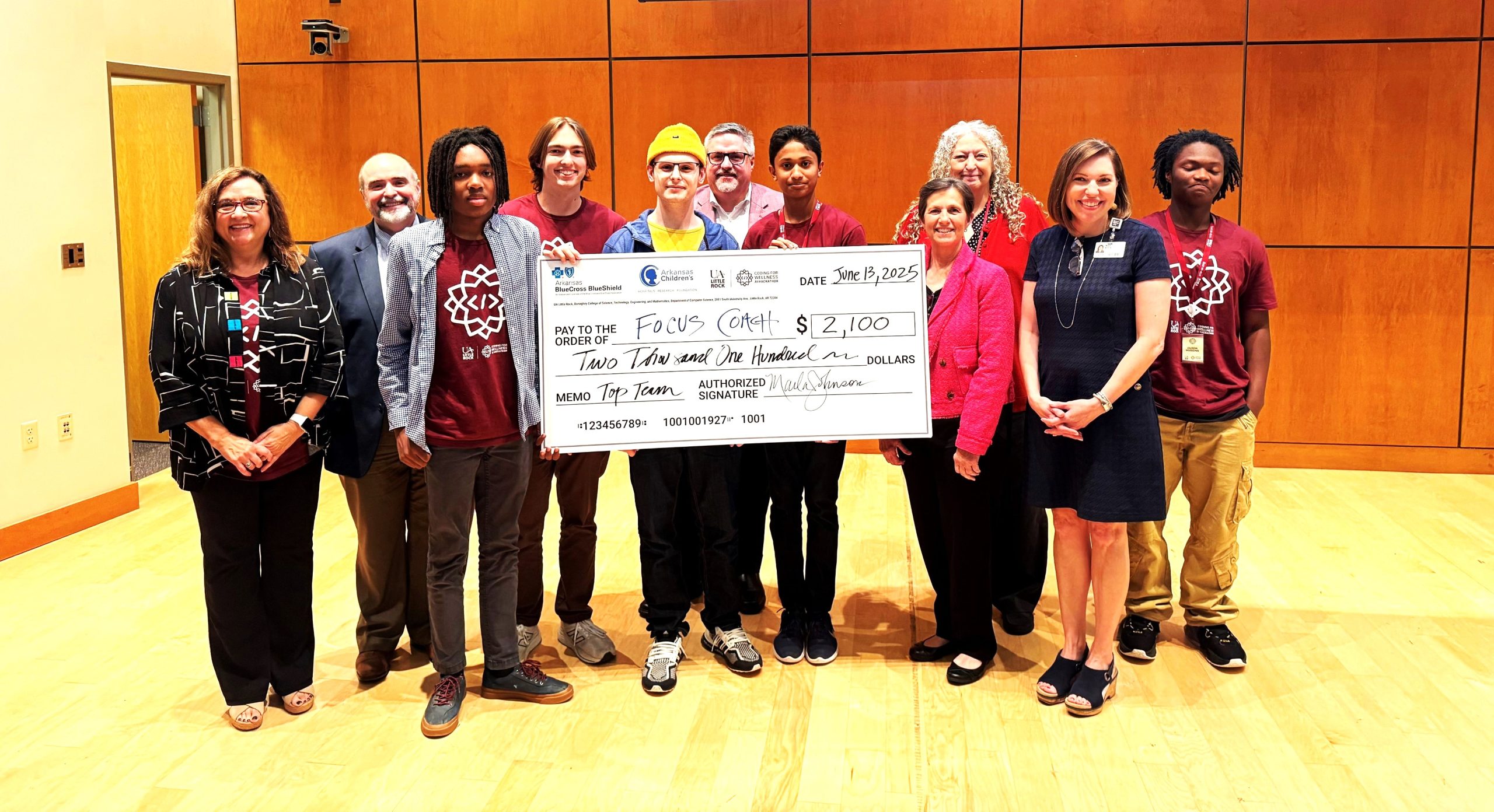
More than 30 high school, college and graduate students came together at the University of Arkansas at Little Rock for the university’s first AI and Mental Health Hackathon, creating innovative tech solutions aimed at improving mental health care.
“These students showed incredible creativity, collaboration and courage,” said Marla Johnson, UALR’s tech-entrepreneur-in-residence and hackathon organizer. “They tackled tough problems with real empathy and built AI tools that could truly make a difference in people’s lives. This is what the future of mental health care and technology looks like.”
The event, held June 9-13, gathered students from across Arkansas to develop artificial intelligence tools that address pressing mental health challenges. Participants teamed up to design AI-driven applications focused on topics such as anxiety, emotional expression, attention management and wellness accessibility.
A local student who participated in the hackathon was James Dempsey of Pine Bluff, a student at UALR who was part of the Focus Coach team, which won the pitch competition.
Independent reporting for Pine Bluff & Jefferson County since 1879.
The Focus Coach team received a prize of $2,000 that was split among the team members. Many also earned NVIDIA AI certifications, including coursework on retrieval-augmented generation and agentic AI.
The hackathon’s participants split into teams to create rapid prototypes for one of five projects:
Focus Coach is a web-based assistant that helps users combat distraction and boost productivity through real-time monitoring and mindfulness techniques.
Rapid Route is a scheduling and triage solution based on a challenge by the Central Arkansas Veterans Healthcare System. It is aimed at getting patients matched with care faster based on urgency.
Happy Capy used a Duolingo-style format to help teens with social anxiety practice social interactions.
Story Buddy used AI-generated narratives to help students explore emotional challenges through a choose-your-own-adventure format.
Teen2Teen Connect, based on a challenge from the Arkansas Crisis Center, built a chatbot that provides anonymous peer-based support for teens.
Participants attended morning training sessions covering topics such as AI tools for rapid prototyping, prompt engineering and regulatory and ethical considerations. The hackathon also emphasized student well-being alongside innovation. Participants enjoyed daily mental health breaks, including art therapy and a drumming circle.
Teams presented their projects in a pitch competition to a panel of judges from Arkansas Children’s Hospital, Arkansas Blue Cross and Blue Shield, the Central Arkansas Veterans Healthcare System and the University of Arkansas for Medical Sciences.
UALR is exploring ways to support continued development of the projects and plans are already underway for next year’s event. Those who are interested in learning more about the hackathon can contact Johnson at mkjohnson@ualr.edu.
Angie Faller is news director at the University of Arkansas at Little Rock Communications and Marketing.