
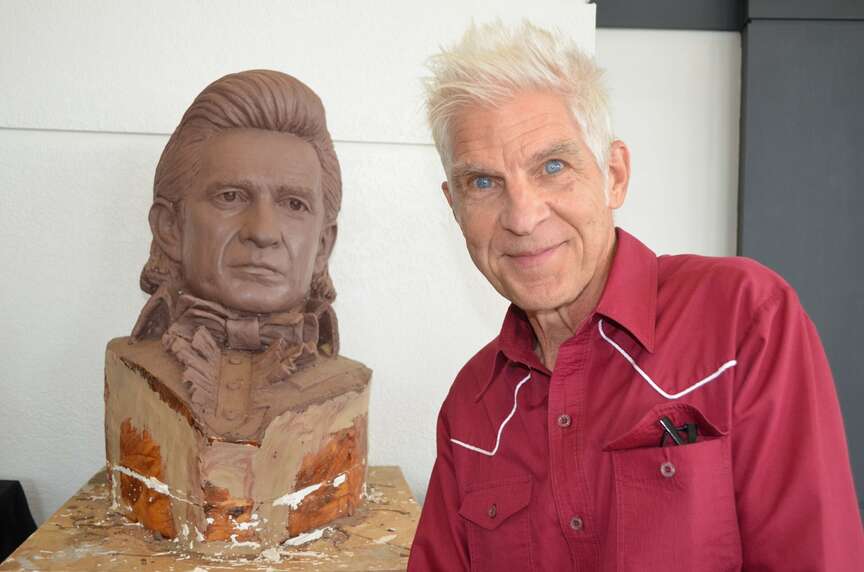
World-renowned Arkansas native and country music star Johnny Cash was born one of seven children in Cleveland County on Feb. 26, 1932, on the Rivers Farm, a dozen miles north of Kingsland.
Besides going on to become one of the largest selling artists in the history of the music business, he was also an ordained minister. And despite mistakes he made in life, he said, “It was love of God that not only made a survivor out of me but a sustainer as well.” Proof of that comes from the many people who say they were “born again because of Johnny Cash.”
When Cash was 3, his family moved away from Kingsland to resettle in Dyess (in Mississippi County) as part of a New Deal Federal government program established to assist 500 specially selected farm families in acquiring their own homestead in the Arkansas Delta.
Each family was provided a WPA-built frame house ranging from three to five rooms depending upon how many children they had. The 40-acre farmstead included a chicken coup, outhouse, smokehouse and a 35-foot deep well with a hand pump. Families were also provided a milk cow, 30 to 40 chickens, a mule and a pair of pigs. The Cash family moved into their new home in 1935. It was 1945 before electricity finally came to the area.
Cash’s brother Jack, who perished in a sawmill accident in Dyess while they were still boys, always said God intended for him to be a preacher and for Johnny to be a singer. Like many others who rose to fame in the music industry, Cash made his first public performance in church.
Independent reporting for Pine Bluff & Jefferson County since 1879.
At age 12 he sang “Uncloudy Day” accompanied by his mother on piano in the Dyess Baptist Church. He and mother Carrie Cash recreated that moment during a 1968 gospel music special on his popular weekly television series, “The Johnny Cash Show.”
He came from a long line of Baptist ministers and faith was deeply ingrained in him from the earliest age. A historical marker placed on the Cleveland County Courthouse Square reads, “Johnny Cash’s grandfather, Rev. William Henry Cash and great-Grandfather, Rev. John Hubbard Woodson Overton, were well-known Baptist circuit riders who served as ministers for many churches in this region.
In 1872 they helped organize the Friendship Baptist Association, which would grow to 35 churches in five counties by 1900. On occasions, Johnny Cash would use the alias “William Overton,” a name he proudly put together from their names. Johnny Cash himself was an ordained minister and appeared around the world with the Rev. Billy Graham on his crusades. Cash received his ordination from Christian International College of Phoenix, Ariz., in 1977.
The summer of 2024 has been a busy time for Cash’s continuing legacy. On June 3, in honor of the tiny burg of 447 people being the birthplace of “the man in black,” the U.S. House of Representatives voted to rename the local postal facility as the “Kingsland/Johnny Cash Post Office.”
On July 23, the old Kingsland Post Office, situated a block west of the current post office, was added to the Arkansas Register of Historic Places. The structure figured prominently in a famous May 1959 photograph of rising country stars Johnny Cash and Johnny Horton who were visiting Kingsland at the time. The photograph shows the pair sitting on the steps in front of the building. Plans are in the works for it to become the Johnny Cash Birthplace Museum.
Another important development for Cleveland County is the anticipated return of the Nudie Cohen-designed suit worn by Cash during his 1976 bi-centennial concert in Rison’s Wildcat football stadium. One of three black, western style Nudie Rodeo suits festooned with embroidered stars, eagles and American flag has been on loan to the Johnny Cash/Dyess Heritage Museum since it opened in 2014. Upon return, it will be displayed at the Cleveland County Courthouse in Rison where it stood on display prior to loan. It is expected that with the opening of the Johnny Cash Birthplace Museum, the famous suit will find its permanent home in Kingsland.
Other important developments in the Cash legacy happening this summer included the June 28 debut of the fifth posthumously released “Songwriter” album. This is Cash’s 72nd studio record and features a dozen previously unheard original compositions.
A final honor being bestowed on Kingsland’s native son comes in the form of placing his sculpture in Washington, D.C.’s National Statuary Hall on Sept. 27.
This summer, a celebration marking the 10 year anniversary of the Historic Dyess Colony: Johnny Cash Boyhood Home restoration was held at Arkansas State University. The concert performance was billed as “The Sunken Lands Songwriting Circle” and featured Rosanne Cash with husband John Leventhal along with John Hiatt and Brandy Carter trading songs in an intimate format.
Kevin Kresse is the Little Rock-based artist who created the larger than life image of Cash to be placed in the Capitol. Kresse recently discussed the subject of his work.
“When I was coming up with a pose, the (Martin D-35) guitar slung over his shoulder was an iconic look. But when you’re describing a person in a single image, every detail and stroke matters. Everyone knows John had his problems. He was up front about that and also that it was his faith that saw him through,” he said.
Some people weren’t aware he was a preacher.
“A lot of people don’t know he was an ordained minister. That’s because he wasn’t out for that type of recognition, but was just doing his best to live his faith every day. He didn’t use faith to justify an agenda. Johnny was more about letting his actions speak his faith rather than preaching a point of view others should adhere to,” Kresse said.
To represent that, Kresse described the statue.
“Instead of holding the Bible out in front of him, it’s close to his side as if a part of him,” he said.
Since receiving the statuary commission, numerous people have told Kresse their own personal Johnny Cash stories.
“Each one is another example of his kindness and generosity,” he said.
The 2022 feature documentary, “Johnny Cash: The Redemption of an American Icon,” covers his life from growing up in Dyess to his death on Sept. 12, 2003, at age 71. The film was produced by Cash historian Mark Stielper, who has been compiling Cash history for 47 years and appeared extensively in the movie. Stielper also wrote the 2023 book, “Johnny Cash: The Life in Lyrics,” which addresses 125 Cash compositions and the stories behind them.
In an Aug. 26 conversation, he explained how Marty Stuart and his wife Connie Smith lived next door to Johnny in Hendersonville, Tenn. At Connie Smith’s urging, Cash attended Jimmy Snow’s (Hank Snow’s son) Evangel Temple Church in 1971. Cash answered an altar call and was saved that day. A year later he was baptized by Snow in Old Hickory Lake at Hendersonville.
“The ’70s were a difficult period for him due to his renewed faith not being commercially well received,” Stielper said. “In ’74 and ’75 he really began spending more time in the word and with Dr. Billy Graham. He didn’t publicize his ’77 ordination to the world because he didn’t want it to be a spectacle. In 1986, Johnny wrote, ‘The Man in White,’ which was a biographical novel about St. Paul.”
Stielper explained how Cash closely identified with Paul in how they each had experienced darkness before an awakening in their life, striving thereafter to stay in the light.
“All his life he was a man who believed and always wanted to be better. That gorgeous, beautiful piece of work by Kevin Kresse isn’t being placed in our nation’s capitol because he sang ‘A Boy Named Sue.’ There are no other performers in Statuary Hall. He is there because of his humanity. Whether he had a Bible in his hand or just living his life, he always strove to be and do better,” Stielper said.
Stielper became emotional during the interview.
“This is not a pop star singing the National Anthem,” he said. “This is the very fabric, culture and foundation of the United States. It’s the Constitution, the people’s house, the Congress! I was there when Johnny was inducted into the Gospel Music Hall of Fame and present for him receiving the National Medal of Arts. This is greater than all that. In four weeks and a day that room will be filled with joy and tears because this is honoring a true American that represents the best of Arkansas and humanity. They say you’re stronger for having fallen and gotten back up than never having fallen at all. He wasn’t perfect which makes him the perfect person to be there.”
When asked near the end of his days, what he thought happens when we die, Cash pondered carefully before his answer, “We all hope to go to heaven.”
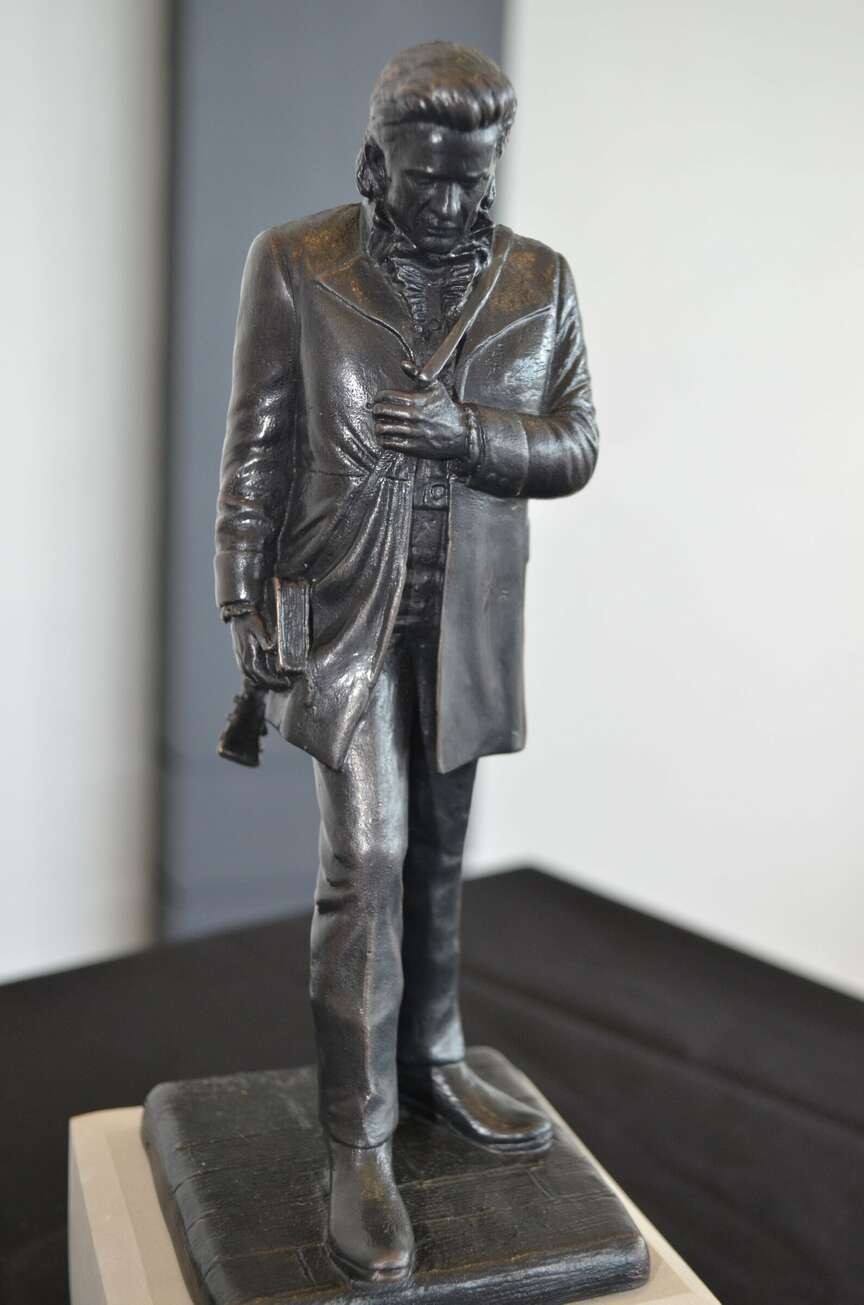 A miniature is shown of the larger-than-life Johnny Cash sculpture that’s headed for the National Statuary Hall to help represent Arkansas in the U.S. Capitol Building. (Special to The Commercial/Richard Ledbetter)
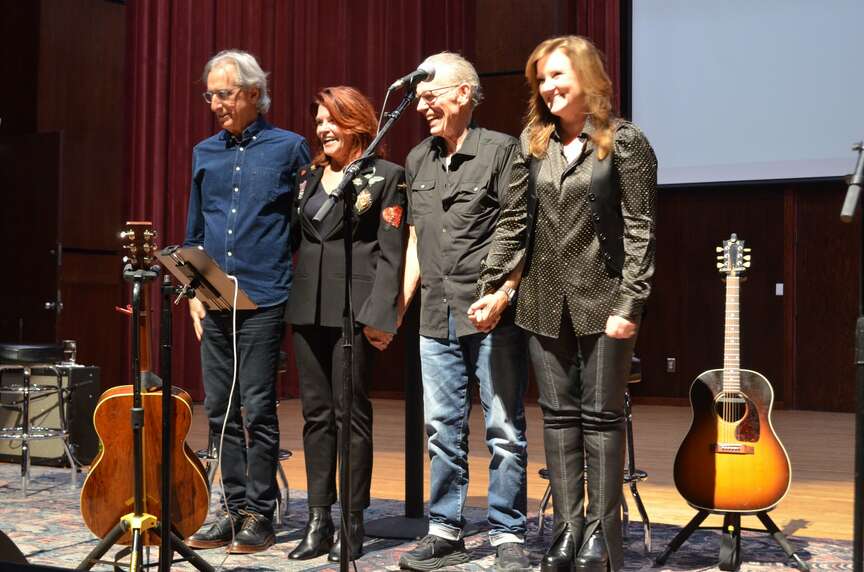 On Aug. 24, the Sunken Lands Songwriting Circle concert at Arkansas State University celebrated 10 years since the restoration of the Historic Dyess Colony: Johnny Cash’s Boyhood Home. Performers were John Leventhal (left) Rosanne Cash, John Hiatt and Brandy Carter. (Special to The Commercial/Richard Ledbetter)
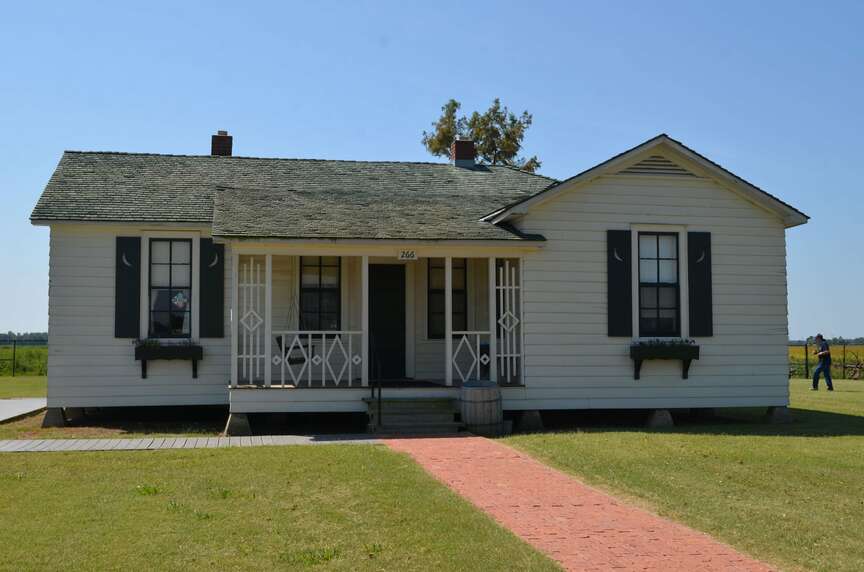 Although it sat abandoned for decades, the Johnny Cash boyhood home in Dyess survived from construction in 1935 until restoration in 2014 because no one wanted to be the person who tore down Cash’s home. (Special to The Commercial/Richard Ledbetter)
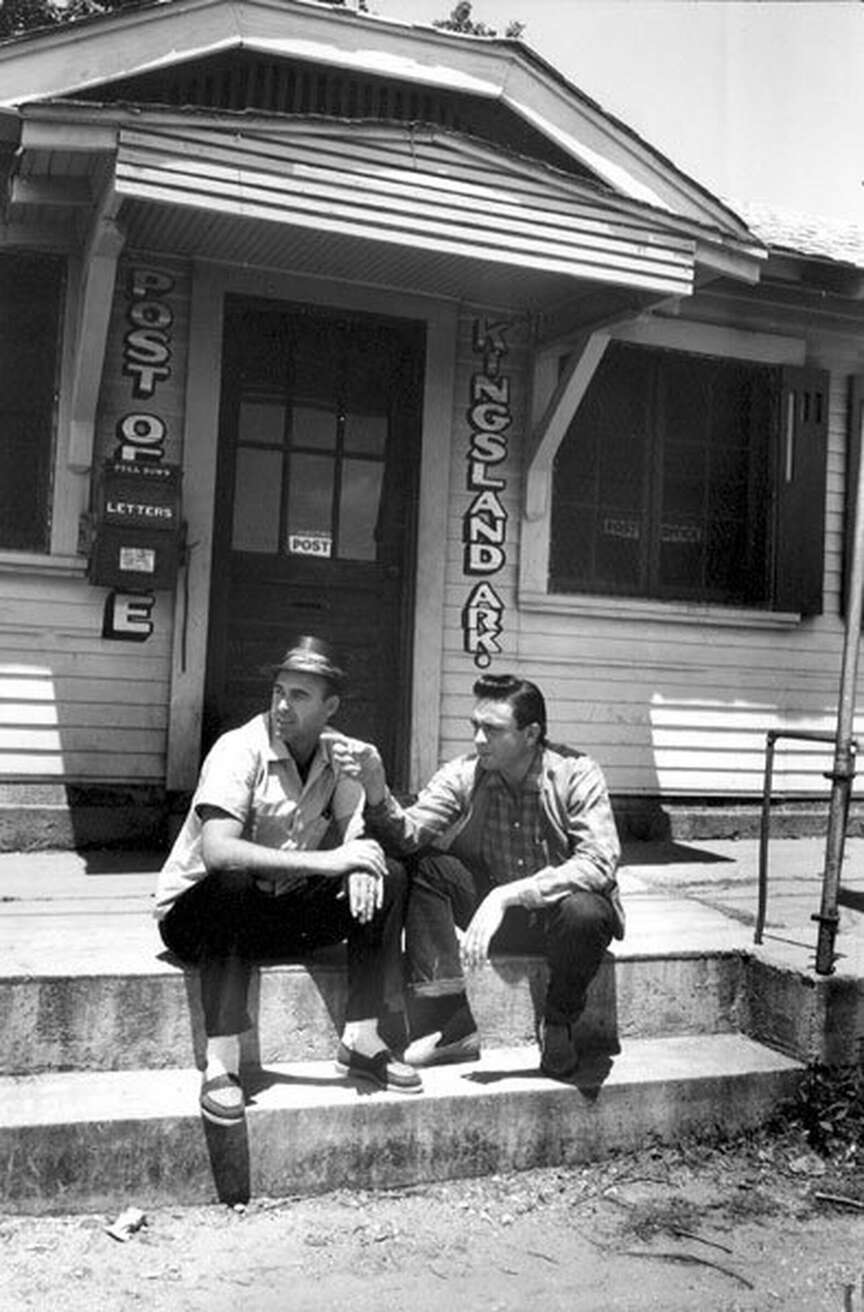 Pictured on the front steps of the old Kingsland Post Office in 1959 are country music stars Johnny Horton (left) and Johnny Cash. The structure was added to the Arkansas Register of Historic Places on June 3 and is planned as the future home of the Johnny Cash Birthplace Museum. (Special to The Commercial)