
Situated in their own river valley, commuters from Pine Bluff to communities east of the Arkansas River and even east of the Mississippi River hope never to see a catastrophe like the one that resulted in the collapse of the Francis Scott Key Bridge in Baltimore early Tuesday.
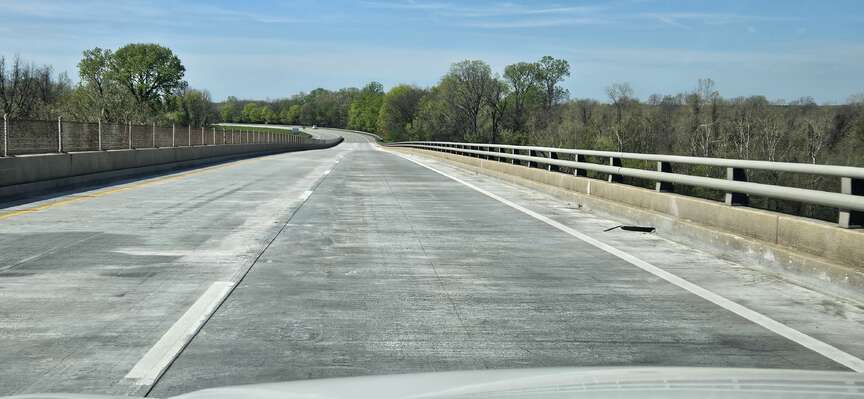
Two bridges help drivers cross the Arkansas River. One that is part of U.S. 79 goes over Sheppard Island and another, which is part of U.S. 79B, links the University of Arkansas at Pine Bluff to communities in northeast Jefferson County.
The 79B bridge is also a gateway toward Memphis, the largest city that borders Arkansas and is about a 2.5-hour drive from Pine Bluff. It has opened up commercial, educational and tourism opportunities between the port cities for decades.
“We definitely get shipments related to farming. Fertilizers and stuff are handled through our ports,” said Allison Thompson, president and CEO of the Economic Development Alliance of Jefferson County. “We also get the wire that comes in for Kiswire (a steel product manufacturer with an office at Jefferson Industrial Park). Some of the things that go outbound would be wood pellets. But inbound, it’s the ingredients for different companies in the region, not just the town. They come in these barges in bulk.”
The vessels that navigate the Arkansas River are considerably smaller than the almost 1,000-foot-long ship flagged out of Singapore that lost power early Tuesday and struck the Key Bridge, according to Andy Nanneman, who supervises the Heavy Bridge Maintenance Program for the Arkansas Department of Transportation. The ship, known as the Dali, drifted toward the bridge at a speed of about 8 knots, or 9.2 nautical mph, according to NBC News.
Independent reporting for Pine Bluff & Jefferson County since 1879.
All 22 crew members on the ship were accounted for, but the collision caused the bridge to collapse, and six people are presumed dead as a result, according to multiple reports. The bodies of two men said to be construction workers have been recovered.
“The vessel that collided with and collapsed the Francis Scott Key Bridge is considerably more sizable than vessels that use Arkansas’ navigable waterways,” Nanneman said. “I am not familiar with the Baltimore bridge, but from the video it does not appear to have pier protection cells or fenders nor to be designed for vessel impact.”
The bridges over Arkansas’ navigable waterways are managed by the Arkansas Department of Transportation. Nanneman said the bridges are either designed to resist impact from a vessel collision or have protection devices like steel cells filled with rock or fender systems.
The Interstate 40 bridge, also known as the Hernando de Soto Bridge, links West Memphis to Memphis over the Mississippi River. Nanneman said that structure has large concrete piers and sizable pile footings to offer protection.
“This design is inherently more robust than substructure units that were impacted and failed in Baltimore,” he said.
The I-40 bridge, however, was shut down May 11, 2021, when a partially fractured tie girder was discovered during a routine inspection, according to a report from the transportation department. The fracture likely resulted from weld repairs made during fabrication of the bridge in the 1970s.
After approximately $10 million in repairs, eastbound lanes were reopened July 31, 2021, and the westbound lanes three days later.
Jay Townsend, chief of public affairs for the U.S. Army Corps of Engineers Little Rock District, said a 15-barge tow is likely the largest-size vessel one will find on the river system. That, he said, is the equivalent of 700 18-wheelers.
The Dali carried a gross tonnage of 95,128, according to a June 2023 inspection of the ship reported by Equasis made available by NBC News.
“What that vessel was capable of is containerized shipping,” Townsend said. “On the Arkansas River, we typically have open hoppers and we ship things like agriculture, aggregate steel, petroleum, things of that nature.”
Townsend said a bridge over the Arkansas River that is placed on top of a lock and dam such as Murray in Little Rock or Toad Suck west of Conway are then inspected by the Corps.
“Those bridges are also not piered, meaning that their pillars aren’t going down to the rivers, necessarily, or attached to our structures, so they’re much higher,” Townsend said.
The Corps also sets speed limits on the upstream and downstream approaches of Arkansas’ 13 locks and dams, Townsend said. At some of those structures, mariners are expected to come to a full stop before approaching them.
Thompson said she has not noticed any shipping delays resulting from the Key Bridge collapse, adding that the shipments that come to Pine Bluff do so through Louisiana ports, up the Mississippi River to the Arkansas.
Baltimore is the largest auto port in the United States and is part of a global supply chain for automobiles, according to a report from John Hopkins University. Other news reports said auto companies were hurrying to divert other ships carrying vehicles and heading to Baltimore to other ports. The disruption could go on for years, officials have said.
Ford Trotter, head of Trotter Ford and Trotter Toyota in Pine Bluff, said he was unclear on whether the disaster would have any effect on his dealerships.
“It just happened a couple of days ago. At this point, we have been given no guidance,” Trotter said Thursday. “I assume there will be a price increase because they will have to turn to more expensive methods of transporting vehicles. I don’t think it will amount to much; I hope it doesn’t. But I don’t have an answer right now because it’s too soon.”
At Smart Chevrolet, salesman James Calvin said the dealership was not expecting a slowdown in deliveries.
“We get our cars by truck,” he said. “They go from the factory in Detroit to 18-wheelers to the dealership.”
Townsend said the Corps of Engineers, Department of Transportation and the U.S. Coast Guard work closely together to monitor traffic and take care of the structures and infrastructure along the river system.
“It really is a team effort among the three of us,” he said. “If an accident were to happen at one of our locks and dams, we would take the lead. If an accident happened on the open river, it’s going to be the Coast Guard. If an accident happens on one of the bridges, it’s going to be ArDOT. It takes all three of us to manage the system.”
Commercial Editor Byron Tate contributed to this article.
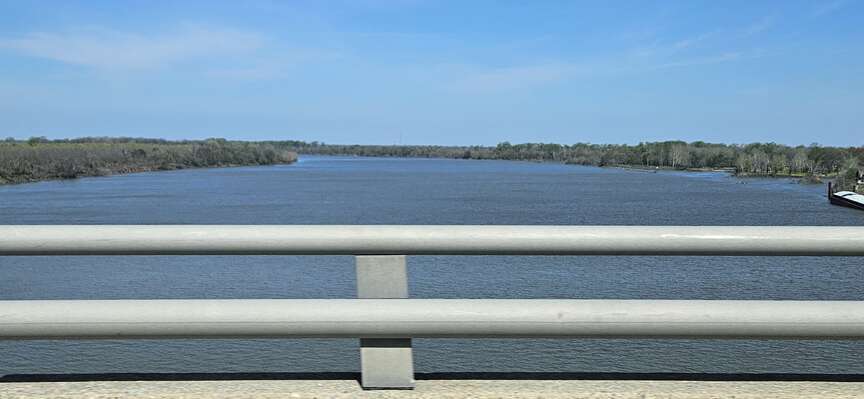 The Mississippi River facing north is visible over the U.S. 79B bridge. (Pine Bluff Commercial/I.C. Murrell)