
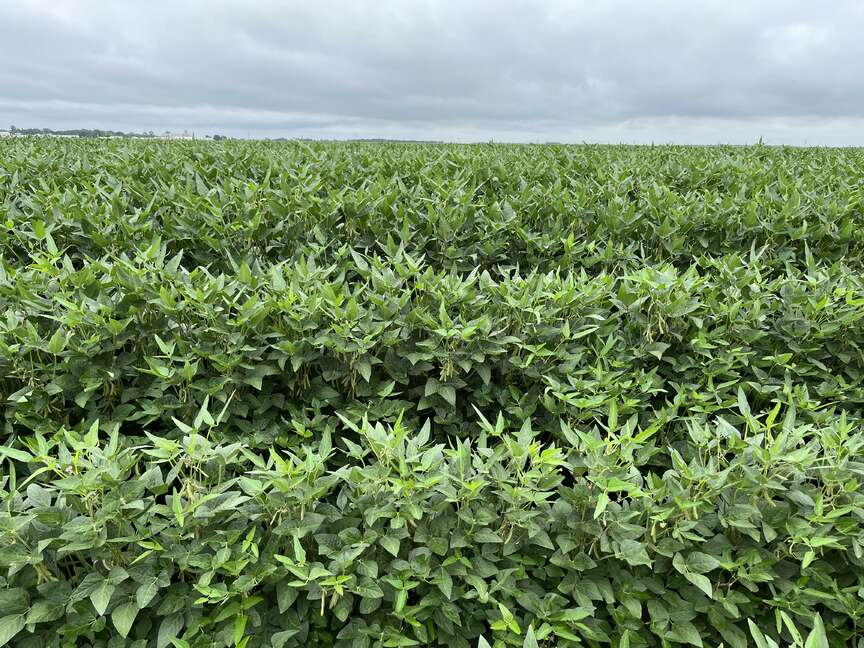
Soybean farmers keep breaking yield records, for a few reasons, but more beans don’t necessarily equate to happy bean counters.
On top of a nearly 2% yield increase, Arkansas farmers planted 4% more soybeans in 2024. The yield average was 55 bushels per acre on 3.02 million acres, up 70,000 acres from 2023. Arkansas produced 166 million bushels of soybeans in 2024, according to the latest “Crop Production” report from the National Agricultural Statistics Service.
“The USDA projection of 55 bushels is in line with what I’ve seen,” said Jeremy Ross, professor and extension soybean agronomist for the University of Arkansas System Division of Agriculture. “Even though it’s a little better than last year, farmers are still hurting because commodity prices have declined, and the expenses are still higher.”
While 2023 soybean prices offered up to $12.80 per bushel, 2024 prices dived and hovered around $10. As with anything in economics, it is a supply and demand issue, but with a twist. Corn prices were still low earlier in 2024, about $4 a bushel, so many farmers planted soybeans in hopes of a profit, or as Ross said, “to not lose more money.”
“Brazil is also producing more soybeans, and we grew more soybeans than last year,” Ross added. “Equipment prices are up. Inputs are up. Everything is inflated.”
Independent reporting for Pine Bluff & Jefferson County since 1879.
CHALLENGE ACCEPTED
Although every growing year is slightly different due to the weather, Ross said several baseline factors contribute to record-breaking yields for Arkansas soybean farmers. One of them is a contest that began in 1999 and served as an incentive to learn new research-based management practices and try out a few new things.
The Grow for the Green Soybean Yield Challenge is administered by the Arkansas Soybean Association and sponsored by the Arkansas Soybean Promotion Board, with crop management assistance provided by the Division of Agriculture’s outreach arm, the Cooperative Extension Service.
The highest yield in the contest’s first year in 1999 was 76.73 bushels per acre. By 2003, the winning count was 83 bushels. Then, in 2007, the 90-bushel barrier was broken. In 2011, five farmers produced more than 90 bushels per acre, and just a few years later, a couple of farmers reached the 100-bushel-per-acre mark, including Matt Miles in Desha County with 108.7 bushels.
“This year, we had eight new farmers break 100, and close to 40 farmers have broken 100 bushels an acre since the contest began,” Ross said. “Most of their production methods are coming from our recommendations. But based on the information provided to me and the association, there’s nothing dramatic causing the yields. It has a lot to do with planting early, and timely applications.
“A lot of these guys are really particular with their management practices. They’re on time with everything,” Ross said. “Timeliness is big. If you’re a week off of fertility, or fungicide or herbicide, and weeds get out of hand, you can hurt your yields.”
Among the particulars of management practices for top-yielding soybean producers are seeding rates, planting depth and foliar feed — nutrients sprayed on the plants, some of which have micronutrients like copper, boron, sulfur and iron.
SOIL AND GENETICS
Although management is a deciding factor, yield expectations may vary depending on soil type and drainage. Ross said the first record breakers were on old cotton ground with high fertility and good water infiltration. Chapter five of the Arkansas Soybean Production Handbook, co-written by Ross, noted that soil-associated yield limitations like poor drainage and excessive drainage are “potentially greater yield-limiting factors than soil fertility.”
Ross said that soybean genetics have also played a part in improving yields, with varieties better adapted to the environment with “defensive packages” for nematodes, disease and drought tolerance.
PLANTING EARLIER
In just the past few years, Ross said he has noticed more farmers coming around to the idea of planting earlier — at the end of February or early March instead of April or May.
“There’s been a big push to plant a month earlier than 10 years ago because we have data showing it leads up to 10 percentage points better production,” Ross said. “It takes farmers proving it to themselves on a few acres.”
Early planting, made possible by a shift in rain and temperature patterns, may assist in avoiding late-season insect problems and possibly outrun some hotter temperatures in July, Ross said. An earlier harvest has also allowed early planters to prepare their fields for the following season when the ground is dry in the fall.
DROUGHT AND STORMS
Although the weather at the beginning of the season went well for soybean growers this year, June and July were very dry, and August pushed it to drought conditions.
Three tropical storms birthed by hurricanes also moved over Arkansas this summer. Row crops were mostly unaffected by Tropical Storm Beryl in early July, but two storms in September — Francine and Helene — did some damage.
Some soybean farmers took a hit on quality since they could not get out in the field to harvest the crop in time. Ross estimates that 1% to 2% of the state’s crop was affected by storm quality issues. But for the few who did get hit, they got walloped.
“For them, it was a perfect storm scenario where the beans that couldn’t be harvested because of Francine went through harsh conditions,” Ross said. “Beans sat out longer than they should have because they couldn’t get to them. It was significant and detrimental.”
He ranked the quality issues second to the 2018 harvest when harvest season rains led to lower-quality harvested beans.
When a wide-scale harvest was possible in 2024, farmers brought it in within about a week.
But the No. 1 thing in 2024, Ross said, was commodity prices averaging $2 per bushel less than 2023, which were already lower than the previous year.
“They’re struggling just to cover costs,” Ross said. “It’s going to be a hard winter because a lot of farmers are making decisions to carry debt to next year even though we set a record in soybeans.”
To learn more about the Division of Agriculture research, visit uaex.uada.edu.
John Lovett is with the University of Arkansas System Division of Agriculture.