
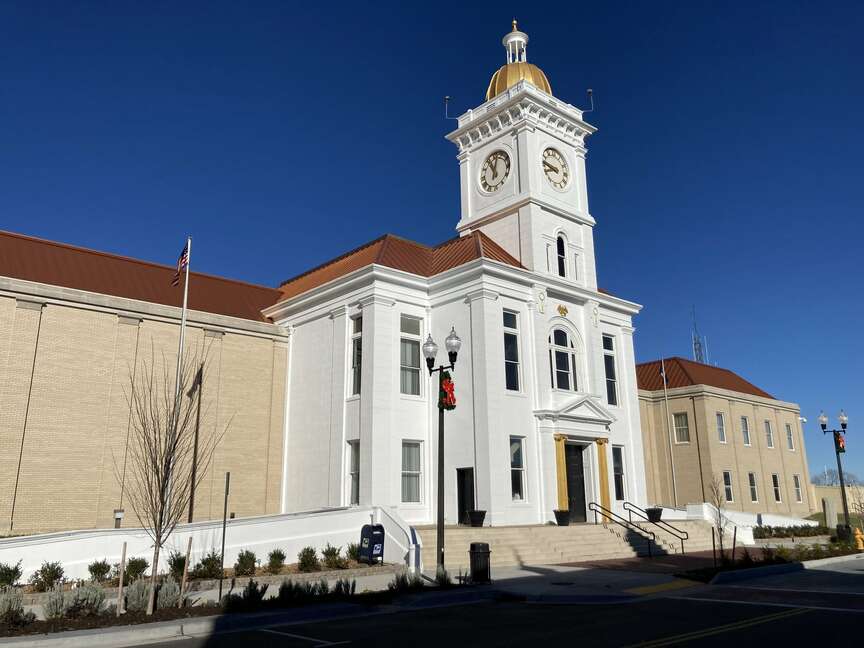
A special judge in 11th West Circuit Court has ruled in favor of Jefferson County Judge Gerald Robinson in a 17-month case against all 13 justices of the peace over the validity of meetings without an active ordinance on the rules of procedure.
Special judge Randy Wright wrote his ruling Dec. 26 and filed it in Circuit Court on Monday. The ruling was handed down nine days after a hearing was held in the Second Division.
Represented by John E. Tull III and Glenn Larkin, Robinson filed a complaint July 14, 2023, that the Quorum Court, which comprises the 13 justices, had not complied with state law requiring “conduct of the Quorum Court to enable the operation of the Quorum (C)ourt as the Legislative body for Jefferson County.”
Wright found that the Quorum Court violated Section 14-14-904 of Arkansas law, which states the justices “shall assemble and organize as a county quorum court body on the first regular meeting date after the beginning of the justices’ term in office …” and that “the Quorum court of each county shall determine at the first regular meeting its rules of procedure … .”
The county has operated without rules of procedure since the start of 2023, which was often led to clashing agendas from Robinson’s office and the county clerk’s office and kept many operations of the Quorum Court – including invoice payments – on hold.
Independent reporting for Pine Bluff & Jefferson County since 1879.
“Yes, I’m very appreciative of the ruling,” Robinson said Monday. “I knew that the law was going to be the factor. We felt that we were right from the beginning. That’s why I filed the suit, and it’s rewarding to know I stood the test and I relied on the law and that we felt all the time there were violations on their part and that this had to be done. It’s unfortunate Jefferson County had to suffer through having to go to court. It’s unfortunate Jefferson County suffered from the activities of these eight justices. It’s really hurt this county and put us behind, but hey, standing on what’s right and standing on the law is what we did, and it was ruled in our favor, so I’m very happy about that.”
All 13 justices were named because they could not be sued separately, Robinson clarified, but without naming anyone he pointed to eight of them who often clashed with him over procedures. The other five – Ted Harden, Patricia Royal Johnson, Roy Agee, Dr. Conley F. Byrd and Danny Holcomb – stood on the side of the law and withstood criticism and attacks from the other justices and other county officials, Robinson remarked.
Robinson’s legal team presented video evidence from a June 26, 2023, meeting that shows the Quorum Court failed to pass the procedure ordinance. Wright writes the meeting displayed “utter chaos and discourse,” resulting in a failed attempt to pass the ordinance.
“…(T)he justices of (the) peace present failed to follow basic procedure by attempting to waive formal reading of a proposed ordinance for purposes of placing the ordinance on second and third reading, and thereby allowing for the vote of the ordinance at the June 26, 2023, meeting,” Wright writes. “At the time of the vote on the suspension of the rules there were only 7 members present in the body of Jefferson County Quorum court. The Court finds Arkansas law is clear that to suspend the rules of formal reading of the ordinance requires a 2/3 majority vote of approval by the Quorum Court as a whole, which would have required 9 members present and voting. The Court finds that the procedural ordinance, Ordinance 2023-5, was not properly presented and was not properly approved or enacted.”
Defense attorney Kimberly Dale represented the justices, with recent District 5 representative Franklin seated at the defense table during the hearing. Franklin, a common outspoken opponent of Robinson on several issues, lost his re-election bid last March and his term expired last Wednesday.
The defendants argued Robinson could have vetoed Ordinance 2023-5 if necessary but shouldn’t have had an issue with the ordinance by not doing so. Wright ruled no veto was necessary, since the ordinance was not properly passed.
Wright also rejected the defendants’ request for a writ of mandamus requiring Robinson “to adhere and act as presiding officer over all special and regular meetings of the Quorum Court;” attend meetings set by the Quorum Court; “fulfill and administer ordinances passed by the Quorum Court;” preside over the Quorum Court without a vote; and not make motions or participate in debate unless solicited by justices to do so. Wright points to state law which calls for Robinson to preside over the Quorum Court without a vote but with the power to veto.
“The Court finds the Petition does not meet its burden of proof that the Plaintiff/Petitioner had not complied with the duties mandates by Arkansas law,” Wright writes.
A message seeking comment was left for Dale.
Robinson was awarded costs and attorney fees.