
The nation’s cotton industry is holding its collective breath as the Sept. 30 contract negotiations deadline creeps closer to keep East Coast and Gulf of Mexico ports open.
“U.S. cotton growers are very much dependent on a fully functioning export market,” said Scott Stiles, an extension economics program associate for the University of Arkansas System Division of Agriculture. “For the 2024-25 marketing year, the U.S. Department of Agriculture projects that exports will account for 86% of U.S. cotton demand.”
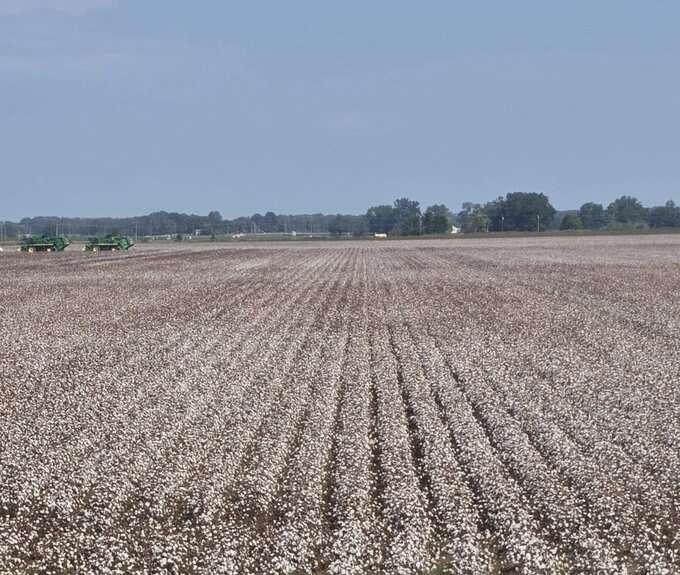
Cotton harvesting has begun across the Cotton Belt and is about 7% complete in Arkansas, according to the Crop Report from National Agricultural Statistics Service on Monday.
The 85,000-member International Longshoremen’s Association has said it would go on strike on Oct. 1 if a new contract is not reached. A strike would bring to a halt any cargo-handling operations at ports along the U.S. East and Gulf coasts, including the ports of Houston and New Orleans. Should negotiations fail, this would be the first strike against East and Gulf coast ports since 1977.
The National Cotton Council joined 177 other organizations in a letter to President Joe Biden urging the United States Maritime Alliance and ILA to keep talking for as long as needed to prevent a work stoppage. The letter also urges the Biden administration “to utilize every authority at its disposal to ensure the continuing flow of goods and avoid undue harm to American consumers and the nation’s economy.”
Independent reporting for Pine Bluff & Jefferson County since 1879.
The potential port strike would not affect operations on the West Coast, where port workers are represented by a different union, which reached a contract last year.
WEST COAST HANDLES MOST COTTON
According to the USDA, “five ports handle 92% of U.S. cotton exports,” Stiles said. “These percentages will vary year-to-year depending on who’s buying the most cotton.”
Looking at a five-year average, Los Angeles/Long Beach handled the most cotton at 41%. Savannah, Ga., was second at 30%; followed by Houston at 14%; Charleston, S.C., at 4%; and Norfolk, Va., at 3%.
The Port of Laredo, Texas, which has one rail bridge and four vehicle bridges, handles about 5% of U.S. cotton exports, “but that would be cotton moving by rail and truck into Mexico,” Stiles said.
Savannah has gained a larger share of the cotton exports, with about 25% a decade ago to 37% in the 2023-24 marketing year, Stiles said.
“In recent years, U.S. cotton sales to Pakistan have increased and the country was the second largest buyer of U.S. cotton last year,” he said. “Turkey was the fourth-largest buyer. The East Coast ports have been the preferred origins for U.S. cotton moving to these two destinations.”
TOP MARKETS
“Over the past five years, the top five export markets for U.S. cotton have been China, Vietnam, Pakistan, Turkey and Bangladesh,” Stiles said.
Los Angeles/Long Beach handles cotton that’s largely going to China, Vietnam, Pakistan, India and Indonesia; primarily southeast Asia.
Consistently, the top destination for cotton moving out of Houston, Savannah, Norfolk and Charleston is either Turkey or Pakistan, with lower volumes going to China, Vietnam, Bangladesh and other Asian buyers.
Some cotton is exported to Central America, through New Orleans and Mobile, Ala.
“Each of those ports account for 1% of total cotton exports,” Stiles said.
A port strike would affect more than cotton.
The U.S. Department of Agriculture’s Federal Grain Inspection Services said 57% of U.S. soybean exports and 47% of corn exports have been shipped out of New Orleans in the current marketing year. The Mississippi River is also important for the movement of fertilizer. Industry sources estimate about 33% of urea and diammonium phosphate moves up the Mississippi River from the Gulf of Mexico.
To learn more about Division of Agriculture research, visit the Arkansas Agricultural Experiment Station website: https://aaes.uada.edu.
Mary Hightower is with the University of Arkansas System Division of Agriculture.