
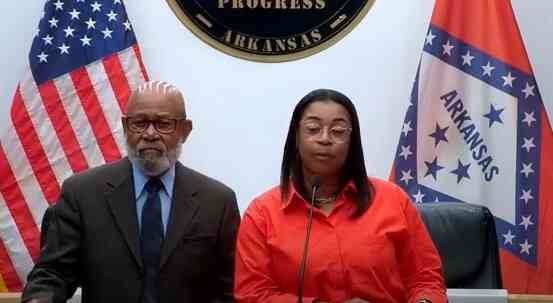
At a recent news conference, the city of Pine Bluff unveiled a highly anticipated report from the Transition Advisory Board that aims to provide a comprehensive road map for the city’s future.
Pine Bluff Mayor Vivian Flowers opened the news conference by expressing gratitude to all involved in the effort. “Good evening, everyone,” she said. “We are here to hear from two incredibly strong public servants who have given of themselves to lead the transition for our city.”
Flowers acknowledged the effort of the 10 committees involved in the planning, emphasizing that their work “not only consisted of meeting and talking and discussing but really leading community conversations, putting that information together along with conducting surveys and focus groups.”
Latasha Randall, a banking professional and volunteer, took to the podium to present the report alongside Dr. Calvin Johnson.
Independent reporting for Pine Bluff & Jefferson County since 1879.
“We are honored to submit this report, which reflects the dedication, insights and collaborative spirit of Pine Bluff residents who are deeply invested in our city,” Randall said. She highlighted the extensive examination of “the current state of city government, infrastructure, public service and community engagement across Pine Bluff.”
The final report, “The Mayor’s Mandate: The People’s Plan for the City of Progress,” detailed a comprehensive set of recommendations across various sectors of city governance. The report, compiled by community leaders and residents, outlines key issues and proposes solutions aimed at revitalizing Pine Bluff.
[DOCUMENT: Read the full 112-page report » pbcommercial.com/421mandate/]
A breakdown of some of the committee reports includes:
Budget and Finance: The Budget and Finance Committee identified issues relating to limited access to financial data, oversight in purchasing, unfunded liabilities and public awareness of the budget process. Recommendations include increased finance department involvement in expenditures, establishing a procurement officer, developing a community awareness program, addressing unfunded liabilities and encouraging resident participation in budgeting.
Economic Development & Infrastructure: This committee focused on workforce development, housing initiatives, business opportunities and infrastructure improvements. Key issues included a poorly skilled workforce, insufficient housing development, underutilization of assets like the Port of Pine Bluff and a lack of coordinated development strategies. Recommendations range from comprehensive workforce training and housing development initiatives to revitalizing the Economic and Community Development Department and restructuring the Street Department into a Transportation Department.
Education and Workforce: The Education and Workforce Committee highlighted gaps in educational access, industry partnerships, family engagement and educator development. Recommendations include evaluating existing programs, collaborating with educational institutions, engaging employers, promoting family support and enhancing educational outcomes. The committee also suggested a model linking education from pre-K through 12th grade to colleges and careers.
Faith and Community Engagement: This committee aimed to foster collaboration between the city and faith-based organizations. Key issues included community disconnection, negative public perception of Pine Bluff, limited resources for community development, lack of a resource guide and lack of a formal engagement structure. The primary recommendation is to establish a faith-based legislative liaison program to connect faith communities with policymakers.
Government Transformation: The Government Transformation subcommittee focused on modernizing city government. Issues identified included outdated digital infrastructure, procurement inefficiencies, communication gaps, administrative redundancies and limited technology adoption. Recommendations include modernizing the city website, establishing a procurement officer and a city webmaster, forming a technology task force, improving employee training, appointing a city communications officer, streamlining blight management and reviewing city boards and commissions.
Public Safety: The Public Safety Committee addressed concerns within the police and fire departments, public trust and crime rates. Issues included inadequate staffing, ineffective recruitment and retention, low institutional knowledge, policy inconsistencies and a disproportionate number of supervisors. Recommendations focus on prioritizing recruitment and retention, establishing a knowledge retention program, aligning policy with ordinances, adopting an anti-blight strategy, establishing a transparent data management system and rebalancing supervisory ratios.
Flowers addressed the next steps, stating, “The first thing that we’re going to do is publicize it widely,” noting that the report is available on the city website. She encouraged attendees to “text it to friends, family, colleagues” and share it on social media.
Flowers acknowledged that many recommendations confirmed existing plans, while others were “very creative ideas that may take some time to implement.” She mentioned the need to “sift through that” and have discussions among the administration, team leaders, city council and boards and commission leaders.
Regarding further public discussions, Flowers said that “most people in this room haven’t read the whole plan.” She suggested giving people time to “digest it, to read it, to access it, to share it, to have conversations at your own kitchen tables.”
She noted past community engagement efforts and expressed the intention to move toward implementation. “Now I think rather than having, you know, one big conversation about the whole document, I think what’s going to happen is there will be an opportunity as we prioritize how to implement this,” she said. Flowers said she envisioned presenting specific recommendations to relevant commissions. She emphasized that implementation would require collaboration with leaders within and outside the city. “It can’t happen with just the mayor’s office saying, ‘OK, here are 40 things and we’re going to start on them, you know, next week.'”
Flowers reiterated the administration’s three priorities when asked about priority recommendations: “youth investment, public safety and economic development with a focus on infrastructure and tourism.”