
The Pine Bluff City Council convened for its first meeting of the new year, advancing two ordinances, one regulating the use of artificial intelligence (AI) by non-uniformed employees and another strengthening rules for public speakers.
The first ordinance, an amendment to Section 1.2 of the Non-uniformed Employee Handbook, is designed to regulate the use of AI in the workplace. The measure is being adopted in compliance with Arkansas’s Act 848 of 2025, which mandates that all public entities, including municipalities, establish a policy for the authorized use of AI and automated decision tools.
Employees are permitted to use AI and automated decision-making tools, such as ChatGPT and Microsoft Copilot, according to the ordinance, to enhance the efficiency, accuracy, and service delivery of city operations. The policy strictly mandates that all consequential decisions involving AI tools must be reviewed and finalized by a human employee or authorized designee, prohibiting the tools from making autonomous decisions.
Employees are barred from using AI to lobby an elected official on a personal opinion if the employee is not a registered lobbyist for the city, express personal political opinions to elected officials, unless it is within the scope of their job duties, or upon request, and engage in illegal activities or intentionally override the city’s security and system integrity.
The ordinance includes a critical section on protecting personal information, stating that employees must never input personally identifiable information (PII) into AI tools. This includes full names, social security numbers, medical records, home addresses and employee ID numbers.
Independent reporting for Pine Bluff & Jefferson County since 1879.
Violations of the policy may lead to disciplinary action, including termination. All city employees will be required to complete training on the AI policy before using AI for city business.
The second measure, an ordinance amending Section 2-57, Division 2, of Chapter Two of the Code of Ordinances, aims to strengthen the rules of decorum for speakers during the public comment periods.
The City Council acknowledged that while they are eager to hear from the public, the opportunity to speak is a privilege, not a right. The rationale for the ordinance points to a recent increase in “loud, vociferous, disrespectful, contemptuous, disruptive, disorderly, and unnecessary behavior,” which has raised safety concerns.
The ordinance lists 11 prohibited acts, including:
Using obscene, profane, threatening, disrespectful, defamatory, or contemptuous words against others present.
Speaking in an excessively loud voice, yelling, or screaming.
Interrupting, arguing with, or attempting to speak over the mayor or chair.
Tossing or throwing papers, confetti, or any object.
Threatening physical violence against any person.
Refusing to terminate remarks when the allotted time has expired.
The ordinance clarifies that it does not prohibit remarks that are “merely critical in nature and made in a reasonable voice volume.”
A speaker who violates these rules may be excluded from the meeting and prohibited from reentry, arrested or cited for any violation of the Arkansas Criminal Code and barred from speaking during the next four subsequent council meetings.
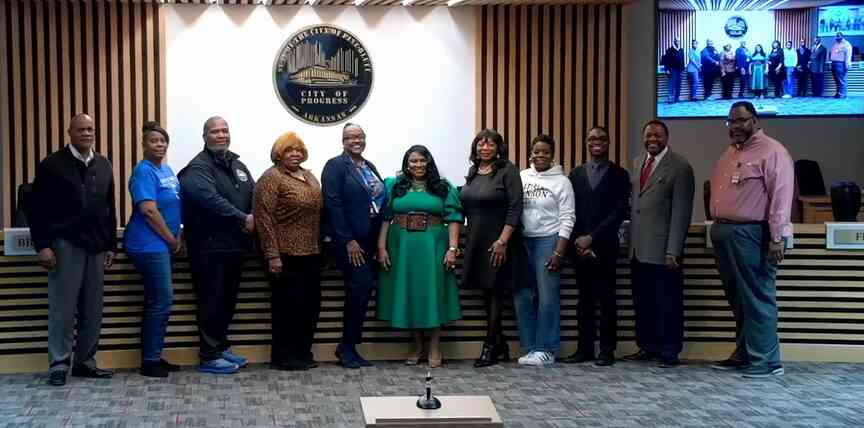
The highlight of the meeting was the unanimous passage of a resolution to celebrate the life and extraordinary career of Bessie Smith-Lancelin upon her retirement from Southeast Arkansas Behavioral Health Services, effective Dec. 31, after 51 years of service.
The resolution detailed her numerous accomplishments, including her tenure as director of clinical services and interim co-president of the agency from 2020 through 2022. Notably, she was recognized as the first Black woman to serve as director of a federally funded alcohol treatment center in Arkansas.
Her dedication to behavioral health and community betterment extends to her role on the Arkansas Board of Licensing Drug and Alcohol Abuse Counselors, where she previously served as president and currently sits as an appointee.
During her remarks, Smith-Lancelin, a lifelong resident and graduate of the University of Arkansas at Pine Bluff and the University of Arkansas at Little Rock, expressed her gratitude to the mayor and city council. She spoke about her work helping people who “can’t help themselves,” including time spent working in prisons, jails, and people’s homes. She is also an active member of Delta Sigma Theta Sorority, Inc., and has been recognized as a “Living Legend in Arkansas” by the State Gospel Music Committee.