
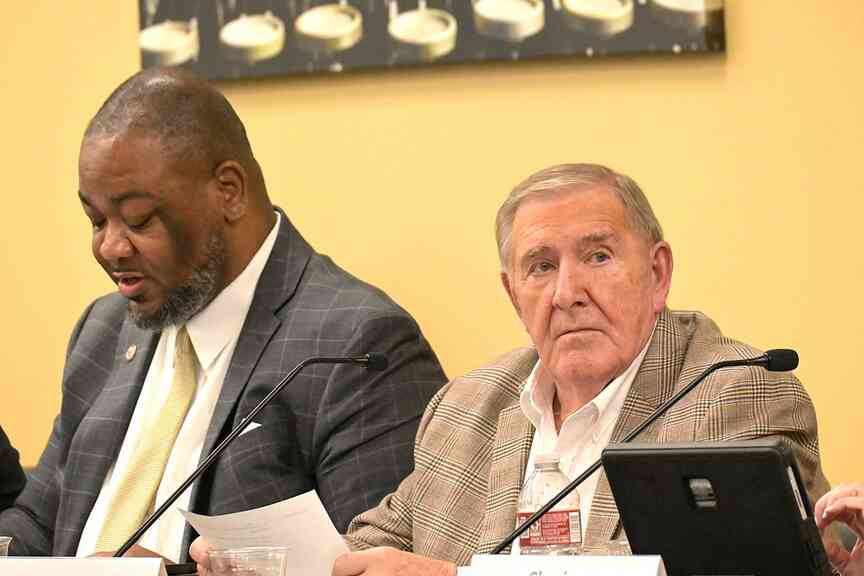
Southeast Arkansas College hosted the Arkansas Workforce Development Board’s first meeting of the year Wednesday.
The board is a governor-appointed panel that convenes state, regional and local workforce systems to promote economic growth through improving employment, training and education programs. The 25-member panel typically meets quarterly in different locations across Arkansas.
“We like to get outside our boundaries in Little Rock, and we wanted to come down to Pine Bluff because we understand wonderful things are happening here,” board Chairman Thomas Anderson Jr. said. “(SEARK President Tyrone) Jackson and his staff have been fantastic.”
The two-hour meeting saw more presentations than action items, but it was held on the heels of major industry-related news for Arkansas. The state last month was awarded a four-year, $35.8 million cooperative agreement from the U.S. Department of Labor to lead a nationwide expansion of registered apprenticeship programs in advanced manufacturing through the American Manufacturing Apprenticeship Incentive Fund.
The Arkansas Department of Commerce is the national administrator of the fund, which will support apprenticeships across key advanced manufacturing sectors, according to a news release from Gov. Sarah Huckabee Sanders’ office. The fund will provide $3,500 per apprentice to each sponsor upon successful completion of a 90-day probationary period.
Independent reporting for Pine Bluff & Jefferson County since 1879.
“It’s definitely a big opportunity for us here in the state,” said Cody Waits, executive director of Workforce Connections for the state Commerce Department. “I think it says a lot about our workforce development system within Commerce and Workforce Development, (and) Workforce Connections.”
The department was recently reorganized into three divisions: Arkansas Workforce Connections; Reemployment, which administers the state’s unemployment insurance program; and Workforce Policy and Innovation.
Waits said employers interested in the manufacturing fund should visit arkansasosd.com/mfgfund. He said applications begin Jan. 28.
Waits also updated the board on another pilot program from Sanders to help 100 individuals transition from prison to the workforce.
The program, he said, takes a whole-of-government approach with the Corrections, Workforce Connections and Commerce departments and teams with the University of Arkansas-Pulaski Technical College to offer a general education diploma, career-readiness certificate and Future Fit manufacturing production training.
“Our team at Commerce has been working to identify employers at a statewide level that these individuals can interview with and ultimately gain employment with post-release,” Waits said, adding the first cohort will complete training by early February.
Cheri Hughes, regional manager of ACT Work Ready Communities, said in another presentation that the number of businesses in Arkansas that recognizes the program created by the college testing company has doubled in the past five years. Individual performance on the ACT WorkKeys, which is an examination for the National Career Readiness Certificate, helps counties earn certification as a Work Ready Community. All 10 southeast Arkansas counties have been certified.
“We’ve held sessions around the state in training and recruited economic development organizations, workforce boards, high schools and postsecondary, and the regional planning districts,” Hughes said. “The job center supervisors, they’ve been very instrumental in helping to rally these folks for these counties to engage. And then we train them on what a Work Ready Community is, the benefits of it, the WorkKeys Assessments and NCRC and becoming a nationally certified and recognized community, and how that can help them with both retention and attraction.”