
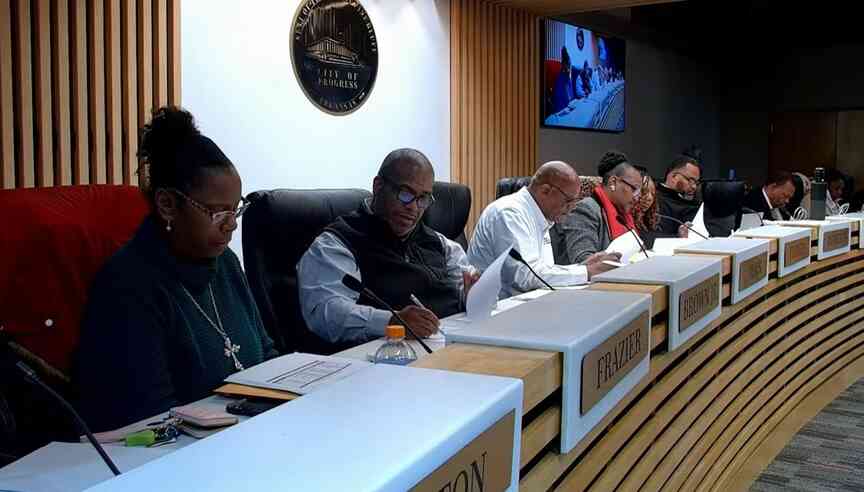
The Pine Bluff City Council convened Monday to review a 30-day progress report from its new trash service provider, CARDS, and to take action on several significant ordinances and resolutions, including a measure to propose a new 1% sales and use tax to voters.
A pair of ordinances concerning a new temporary sales tax dominated the ordinances and resolutions review. They were introduced for a first reading.
The first ordinance provides for a new 1% local sales and use tax for a period of 10 years, starting July 1, 2026, and ending June 30, 2036. The revenue is earmarked for general purposes of city government. A key provision in the ordinance requires a biennial forensic audit of the tax expenditures, performed by an independent firm.
The second ordinance officially calls for a special election on March 3, 2026, for citizens to vote on the new tax.
The council unanimously approved two resolutions related to the city’s Group Violence Intervention (GVI) program, ensuring the initiative will continue into 2026. Both resolutions waived competitive bidding, with the council finding it “impractical, inefficient, and detrimental to the goal of combating crime.”
Independent reporting for Pine Bluff & Jefferson County since 1879.
The first resolution authorized an agreement with the University of Arkansas at Little Rock (UALR) to continue implementing the GVI program through Dec. 31, 2026, while another resolution authorized a third-year contract with the National Network for Safe Communities (NNSC) at John Jay College for $65,000 for consultation services. The motion to adopt the resolution was passed with an emergency clause.
Council Member Steven Mays raised a question about the funding source for both GVI contracts, as they are being paid for using 2025 carryover funds. Pine Bluff Mayor Vivian Flowers clarified the nature of the expenditure, explaining that this was a one-time expenditure.
All other ordinances were heard for a second reading, covering the abolishment of the Urban Renewal Agency, police department personnel classification changes, and disciplinary appeal procedures for uniform employees.
Cody Endel, regional municipal manager for CARDS, presented a 30-day look-back on the company’s new solid waste contract, emphasizing a successful transition and decreased service-related calls.
Endel highlighted a significant investment in local operations, including hiring 23 full-time members locally, five of whom previously worked for the former hauler, Waste Management. The company is currently operating a fleet of 15 trucks to service the city.
The most notable progress was reported in customer service calls. Endel stated that call volume has been steadily declining: “So call volume has decreased steadily each week, showing increased customer familiarity with routes and fewer service day questions,” he said.
The secondary call driver, containers from the previous provider, is actively being addressed. Endel noted that CARDs has received approval to remove and dispose of the old containers and is working with the city on a plan to execute the cleanup. He expressed excitement for the plan, calling the old containers a “key call volume drivers.”