
The city of Pine Bluff is in the midst of a possible transition regarding its trash services, trying to move from long-standing provider Waste Management of Arkansas Inc., otherwise known as WM, to CARDS Holdings LLC.
This change, effective Nov. 1 if passed, follows a period of intense public frustration and council debate over persistent issues with trash collection. A resolution supporting a contract with CARDS failed 5-2 in a special meeting Thursday, but Mayor Vivian Flowers indicated another meeting would be called Monday.
For years, residents have voiced widespread complaints about missed pickups, unaddressed concerns and a lack of accountability from the previous provider. In a June 2024 city council meeting, all council members during that time had their own complaints about WM, seeking resolutions, including finding a different provider.
During Thursday’s special-called city council meeting, some of those same council members voted against the measure to go into a contract with CARDS. Voting in favor of the resolution were Glen Brown Jr. and Yvonne Denton. Steven Mays Sr., Lloyd Holcomb Jr., Bruce Lockett and William Fells III voted against the resolution. LaTisha Brunson abstained, resulting in an automatic “no” vote. Lanette Frazier, while present via Zoom, could not vote due to new protocols where council members must vote in person.
On Thursday, Flowers reminded those council members of the June 2024 meeting where Kevin Pennington, a Pine Bluff resident, highlighted his experience with missed pickups and difficulties in obtaining refunds, stating his trash had not been picked up for eight weeks.
Independent reporting for Pine Bluff & Jefferson County since 1879.
Another resident on Olive Street shared his commercial pickup had been missed for eight weeks. Council members and residents alike expressed exasperation, with some landlords noting they pay more than $5,000 a month for dumpster services and still face issues with overflowing dumpsters, leading to tenants complaining and maintenance staff having to transport trash to other locations.
Flowers said the sentiment among many is that WM has been operating with a “monopoly” in the area, leading to a lack of incentive for improved service. Concerns were raised that the company was making more money by doing a poor job, as it didn’t have to buy diesel or trucks.
Residents also reported difficulties reaching WM, with one individual stating they had to call out of state to get a representative from WM to address local issues. Despite complaints, some residents report not receiving promised credits on their bills and having to endure long phone waits.
The city initiated a competitive bidding process under Flowers’ administration to address these long-standing problems and establish new standards for service and accountability, noting the previous contract was 35 years old and had never undergone a competitive review.
The request for proposal outlined specific requirements, including new containers and trucks no older than four years, standardized brush and bulk collection times, a consolidated billing process through the water company and a 4% cap on annual consumer price index increases. A critical provision in the proposal was a 24-hour resolution period for complaints, expecting efficiency with newer equipment and routes.
However, WM’s proposal raised several concerns among some council members. Flowers highlighted that WM submitted “five pages of exceptions” to the proposal, in contrast to other bidders who had “no exceptions” or only a few minor ones. These exceptions included proposals to keep old containers and trucks, a desire to bill on their own rather than through a consolidated water bill, and an offered 8% increase in consumer price index, double the desired cap. Most notably, WM requested up to 15 business days to rectify problems, a significant deviation from the city’s desired 24-hour resolution period. Flowers also pointed out that WM’s alternative proposal, despite offering a lower rate, lacked the “protections of the fines that would be in place if there was any breach of contract.”
CARDS, on the other hand, proposed “brand new trucks, brand new service equipment, brand new commercial containers and brand new residential carts,” aligning with the proposal’s requirements. While its initial proposal was higher at $19.39 per household compared to WM’s alternate bid of $15.85, CARDS argued that WM’s bid was not an “apples to apples” comparison given their exceptions.
Jason Fitzgerald, vice president of business development for CARDS, asserted that if comparing “apples to apples,” WM’s bid was “actually $6 higher than us for those same services.” He proudly stated CARDS has deployed “over 50,000 carts in the city of Springdale in about 30 days,” demonstrating its capacity for transition.
Flowers expressed strong offense at WM’s alternate bid of $15.85, viewing it not as a genuine cost saving, but as an insult that implied WM could have been offering a lower rate all along without improving service.
Flowers felt the lower rate came without the crucial changes and improvements outlined in the proposal, such as new containers, newer trucks, standardized collection times and accountability measures and faster complaint resolution.
“By offering a lower price without these new terms, WM seemed to be saying, ‘Forget all that stuff you have … Let’s keep things how they are,'” said Flowers, who felt this was seen as disrespectful to the competitive process and the city’s defined needs.
Her core concern was that accepting the lower alternate bid would mean continuing with the “same old, same old” service model that caused numerous complaints in the past, without the contractual teeth to enforce better performance. She emphasized the alternate bid from WM came “with none of those changes,” meaning “the protections of the fines that would be in place if there was any breach of contract would not exist.” This would leave the city vulnerable to the same issues that led to initiating the Request for Proposal process in the first place.
Flowers raised several key issues regarding WM’s exceptions to the Request for Proposal, primarily focusing on how these exceptions deviated from the city’s desired standards. The issues include:
The mayor emphasized WM submitted “five pages of exceptions,” in stark contrast to other bidding companies that had “no exceptions” or only “a page of two or three exceptions.” Flowers felt the extensive list suggested an unwillingness to fully comply with the city’s outlined requirements.
The city sought a “standard set collection, time and period for these resources,” to avoid the previous issues of residents waiting long periods after calling for pickup. Flowers noted that WM’s exceptions indicated “the carts were a problem,” suggesting their proposal did not align with this simplified approach.
The city stipulated a 24-hour resolution period for complaints, expecting efficiency with newer equipment and routes. Flowers highlighted a significant deviation, stating that WM “asks for up to 15 days to rectify problems.”
Council Member Brown, echoing the mayor’s sentiments, specifically pointed out WM’s exception regarding TVs, asking, “You have things in here, you don’t even want to pick up TV, why?” WM responded that these items go to the solid waste district, but the initial exception from the proposal was a point of contention.
Flowers and Brown also highlighted exceptions related to services for elderly or special needs individuals, noting WM had an exception regarding collection if it was “100 feet from the door,” whereas other companies had no problem with providing such services.
Flowers also indicated that despite WM’s efforts to improve customer service, its exceptions regarding complaint resolution and the need for a local number being a recent development suggested a lack of proactive engagement in meeting the city’s desired service levels earlier in their long-standing relationship.
Responding to accusations of numerous exceptions to the proposal request, Jamie Vernon, representing WM, explained that most were “clarifications, a contract language related to damages and summary of liquidated damages,” and not outright rejections. He also highlighted improvements made by WM since past issues, including bringing in “rental trucks” and “new trucks,” and establishing a “local phone number local website for the city of Pine Bluff, where it’s answered here locally.”
Vernon said WM is now providing “reports to the city” to inform it of complaints coming into its local customer service.
Brown challenged Vernon, asserting the exceptions were not simple clarifications. He further questioned why WM was “offering a better rate, but what type of quality are we getting?” if its exceptions meant a deviation from the desired services.
The new contract with CARDS stipulates exclusive residential and commercial waste collection, with services commencing on Nov. 1. This includes weekly collection of acceptable waste using contractor-supplied 96-gallon poly carts, once-a-week brush and bulky material collection, and provisions for unusual accumulation and disaster debris collection. CARDS will also provide one new 96-gallon poly cart to each residential unit and replace damaged carts at no additional charge.
Lockett expressed loyalty to WM, stating it had been a “great partner.” However, others questioned why WM hadn’t been more proactive in meeting the city’s needs earlier.
“I just got to be honest and take one for the team. Since I’ve been a council member, Waste Management has been a great partner,” Lockett said. “My view is that I dance with people who dance with me.”
Lockett said any time he called Vernon personally on behalf of his constituents, the employees worked hard to solve the problem.
Frazier voiced strong reservations about CARDS via Zoom. She expressed concern about moving “from one next thing to the worst thing” and CARDS’ reported practice of buying out trash service companies to make its company bigger after doing research online about that company.
Flowers countered these concerns by stating the negative reviews regarding CARDS were primarily from “issues in Missouri associated with acquisition … coupled with the fact that before I even asked about the issue, we dug in very deeply in all this during the interview. We could see, and it was made clear that those issues have been and are being rectified.”
Brunson echoed the sentiment of being “torn” due to the long-standing relationship with WM, but also questioned why WM had not been more proactive in meeting the city’s needs earlier. She also expressed significant concern about employee welfare if the contract switched. She recognized WM has “ramped up” its service in response to issues.
Council Member Fells expressed significant concern over the apparent lack of a clear contingency plan from CARDS. The exchange focused on the smoothness of the transition and potential delays in the rollout of new equipment.
Fells directly questioned CARDS about potential delays in “rollouts with the trucks” and what contingencies would be in place if every customer did not have a new container by Nov. 1.
However, Fitzgerald resisted providing a specific contingency plan. He stated he doesn’t “typically live in that hypothetical world” and that the company’s intent is “not to fail.” Fitzgerald emphasized that its proposed transition plan, outlined in their proposal request packet, detailed how the company would ensure a smooth process and that penalties were associated with not meeting its obligations.
Fells, however, reiterated his concern.
“The contingency plan you’re asking for is for us to fail, and that’s not our intent to fail. We will have every cart, every container delivered,” Fitzgerald said.
The lack of a detailed backup plan from CARDS left Fells with reservations, suggesting this issue may remain a point of discussion as the city considers its waste management future.
Flowers, sponsoring the resolution for a new waste management contract, highlighted the extensive process undertaken to draft the request for proposal, emphasizing the city’s desire for new standards and protections.
“We said that we wanted new containers,” she stated, noting existing issues with old or damaged containers. She also mentioned the city’s requirement for “trucks, no older than four years old,” based on their standard life expectancy.
A critical point of contention arose when Flowers revealed the discrepancy in responses to these requirements. “Out of the four companies that submitted proposals,” she explained, “only one of those companies, our current company, came back with exceptions. It wasn’t a few exceptions. It was five pages of exceptions.”
She contrasted this with other companies, who “had no incentive to tool and had absolutely no exceptions,” or only a “page of two or three exceptions.”
Flowers plans to resubmit the resolution for Monday’s meeting, allowing council members to propose their own resolutions to support their company of choice in the interim. City Attorney Althea Scott noted that, given the resolution’s failure and per city ordinance, the council must now consider the trash service company that ranked second in the scoring process, which was Green for Life. WM ranked third.
“What’s in the contract?” Flowers asked. “That’s what is going to be permanent to what this city is able to do to ensure that quality service and accountability are our top priorities.”
Flowers reiterated her strong stance on the exceptions, emphasizing that they undermine the protections the city sought for its residents.
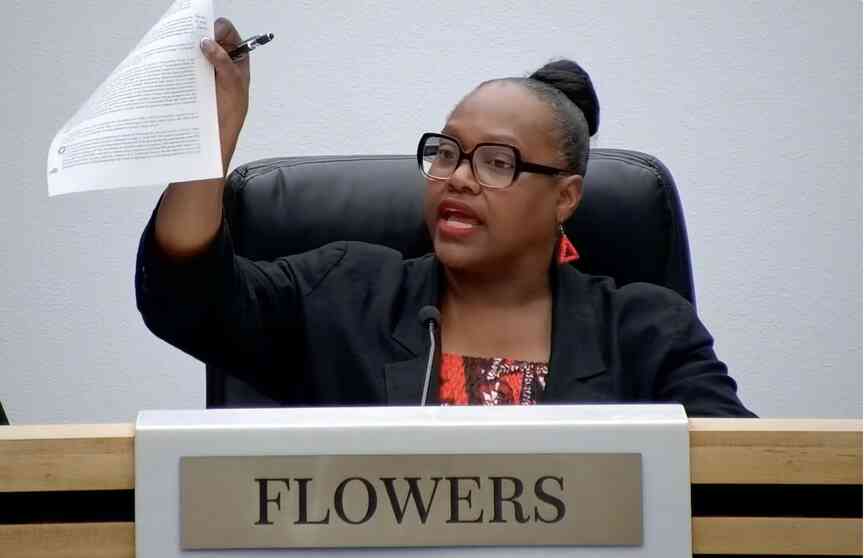
“If you go back to the contract, if we lay out the things that we need to protect our people … WM looked like this, page one, two, three, four, I believe it is page five,” she said, referencing the extensive list while holding the papers up. “I’m very clear … because this is not about me supporting CARDS. This is not about who supports Jamie and Waste Management or Jason. This is about me making a decision to support y’all.”