
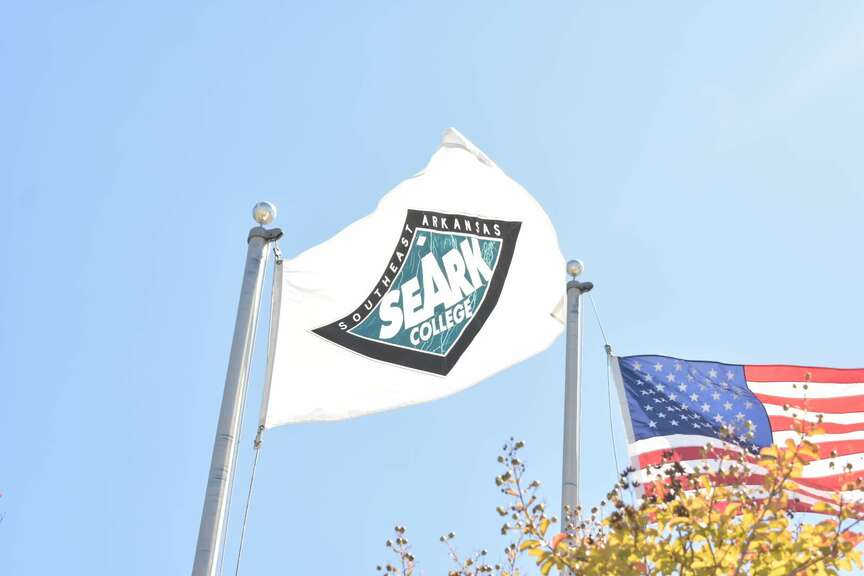
The Higher Learning Commission has placed Southeast Arkansas College on probation through June 2026, citing the two-year institution for violating three accreditation requirements.
The commission said it took action against SEARK on June 27. A letter from the commission dated July 2 was sent to SEARK President Tyrone Jackson and a statement announcing the probation was posted July 3 on the commission’s website. The commission requires SEARK to disclose its status when referring to its HLC accreditation and submit drafts of its disclosures to an HLC staff liaison before posting.
The probation means for students that, in most cases, credits from SEARK for transfer or admission to a higher degree program will continue to be accepted, according to the commission’s public disclosure notice.
“All colleges and universities define their own transfer and admission policies,” according to the HLC.
The commission concluded that SEARK was out of compliance with:
Independent reporting for Pine Bluff & Jefferson County since 1879.
“Persistence, retention and completion outcomes” (Criterion 4, Core Component 4C);
“Effective governance and administrative structures” (Criterion 5, Core Component 5A);
And “Systematic and integrated planning and improvement” (Criterion 5, Core Component 5C).
The findings followed an onsite midterm visit during the accreditation process by a team from the Chicago-based commission during the tenure of then-SEARK President Steven Bloomberg, now the chancellor of the Kern Community College District in California. Bloomberg left SEARK in February.
“I’m disappointed in the outcome from the Higher Learning Commission particularly because SEARK submitted several hundred pages of information refuting the findings,” Bloomberg said Friday. “When the initial report was written, SEARK had a chance to respond to it and attend an in-person hearing. There was a 300-page document outlining the responses to the Higher Learning Commission’s concerns.
“To that end, that’s why I say I’m disappointed. The college more than demonstrated it met all the criteria and provided more than enough evidence.”
Phone messages were left for SEARK Board Chairman Shauwn Howell and Jackson, who began his presidency at the college July 1.
Bloomberg said the HLC sent an initial report to the college indicating that there were “a couple of areas” in which the college was not compliant.
“SEARK sent a 300-plus page report with tons of backup documents,” Bloomberg said. “I can’t say the panel looked at all the evidence.”
Core Component 4C, according to the letter, states that “the institution pursues educational improvement through goals and strategies that improve retention, persistence and completion rates in its degree and certificate programs.” HLC President Barbara Gellman-Danley, in her letter to Jackson, credited SEARK with making strides “in defining goals for student retention, persistence and completion over the past few years and has started to share some data with faculty and staff,” but said the college “must sustain these activities over time, which will take ongoing effort and cultural change.”
SEARK has started to include retention, persistence and completion data in its recently instituted biennial program reviews, but “must now use this data effectively to make demonstrable improvements,” Gellman-Danley wrote.
To meet Core Component 5A, “through its administrative structures and collaborative processes, the institution’s leadership demonstrates that it is effective and enables the institution to fulfill its mission,” according to the letter. SEARK recently established some institutional committees to become more transparent in its practices, “but more time is needed to ensure these recent practices are sustained and effective,” Gellman-Danley wrote.
SEARK must use a recently developed enrollment management plan to make informed decisions in planning and budgeting, according to the letter.
“The Institution’s resources, structures and processes are not yet a part of the Institution’s culture for planning and budgeting,” Gellman-Danley wrote. “This results in a lack of consistency that leads to reactive decisions, rather than proactively planning and allocating revenues for future challenges and opportunities.”
Core Component 5C states that “the institution engages in systematic and integrated planning and improvement.” Gellman-Danley wrote that “Systematic and integrated planning is still an area of development for the Institution and is not yet at a level of maturity to demonstrate effective alignment of operations and institutional goals and objectives.”
SEARK’s strategic plan, she also wrote, does not reflect systematic goals integrated into a defined planning process. Rather, she continued, it’s a set of categorized “key initiatives” that appear to be “individual, discrete actions the institution has committed to complete.”
“The Institution does not sufficiently measure milestones or benchmarks to evaluate progress in achieving objectives,” Gellman-Danley said. “The Institution does not have a practical, systematic, well-deployed approach in place for data and information selection, collection, alignment and tracking to support overall organizational performance.”
SEARK was said to meet two core components under Criterion 4, but with concerns:
Core Component 4A: “The institution ensures the quality of its educational offerings.” SEARK needs additional time to demonstrate a regularized process that produces data used in institutional decision-making, Gellman-Danley wrote.
Core Component 4B: “The institution engages in ongoing assessment of student learning as part of its commitment to the educational outcomes of its students.” SEARK needs to put into operation its processes for assessment, data analysis and reporting timelines and expectations for assessment activities to demonstrate sustainability and effectiveness, Gellman-Danley wrote.
SEARK must host a comprehensive evaluation no later than December 2025. The HLC board of trustees will determine in June 2026 whether SEARK has shown it’s in compliance with HLC requirements and probation can be removed.
SEARK also has until Aug. 31 to file a Provisional Plan with the HLC for review and approval by the Institutional Actions Council. As a result of probation, SEARK is ineligible for the HLC’s Notification Program for Additional Locations for three years after the removal of probation, even if other requirements for the program are met.
Bloomberg said he still cares very much for SEARK and its staff who worked on the accreditation progress, but he said he was concerned that nothing said on the college’s behalf mattered to the commission. He also said SEARK has addressed the issues outlined by the HLC.
“For me, it’s disappointing in my opinion when the college unequivocally displayed all that material,” he said. “The college went above and beyond. I’m disappointed the HLC didn’t take the information as they should have. The document prepared by the visiting team, there were errors. This team didn’t do the due diligence necessary.
“Somebody needs to say something about this process because it was flawed.”