
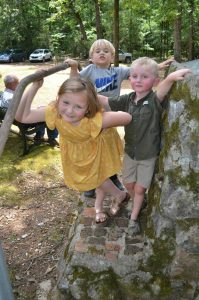
Turning off the two-lane blacktop onto a red clay road, one finds the old Pine Bluff/Camden Road built in 1832. Well off the beaten path and tucked in among a large expanse of piney woods, the sound of traffic is faint if heard at all. Once a year for nearly a century and a half, the additional sounds of family conversation, laughter and the joyous noise of children playing echo through the hollows of Salt Branch Creek.
Midday June 2, the parking lot next to the historic Marks Family Cemetery was filled with automobiles bearing license plates from four states.
Marks/Barnett Family Association President Robert Kresko from Missouri addressed the 50-plus Marks descendants at the annual event, welcoming them with thanks for the good turnout. Considering a mere 12 folks were able to make it in 2022 and only 28 last year, the upswing in numbers was an encouraging sign.
Mary Jo Westbrook, who helps compose the quarterly family newsletter, gave a financial report and description of recent improvements made to the cemetery grounds.
“So many reunions have dwindled and fallen by the wayside,” Westbrook said. “We’re glad we’ve been able to keep our family coming together year after year and are hoping for a return to the hundred plus attendance for our 150th reunion in 2026.”
She concluded her comments with a few moments to remember family members who have gone to join the ancestors since their last gathering.
Pat Rhine Brown (daughter of the famous Dr. Rhine of Thornton) served as longtime secretary of the Marks/Barnett Family Association. She recently passed away at age 96 on April 30. Her son Tommy Brown shared a humorous conversation he held with his mom a few months back.
She was torn between being buried in Fordyce’s Oakland Cemetery along with her sisters, mother and father or put to rest next to her husband in Pine Bluff. He suggested maybe she could be shared between the two burial grounds. She asked him, “Which way would you divide me, down the middle or top and bottom?” Then she added, “If you split me down the middle you’ll need two full length caskets, whereas if you cut me in two you can save money with two child size packages.”
Robert Kresko gave a brief blessing over the food before everyone sat down to a potluck luncheon.
The original Marks ancestors who first settled in the region were John Harvie Marks and Hastings Marks. John Harvie was born in Georgia in 1808 while elder brother Hastings was born in 1795. Following the War of 1812, in which Hastings saw active combat as a Georgia militiaman in the Creek Indian War of 1813, the pair moved their families from Georgia to Montgomery, Ala. From there, John Harvie came to Arkansas in 1834 where he acquired large landholdings across south-central Arkansas.
From his vast swath of ground, he donated 30 acres upon which the city of Warren was established in 1841. Using horses and mules along with slave labor, he began damming Salt Branch to develop several mill ponds and numerous watermills to provide cotton ginning, lumber and grain milling for the new settlers of the territory. Once the manufacturing facilities were well begun, Hastings followed his younger brother to their new home. They now lie at rest in the historic cemetery.
Many other significant early settlers lie beneath the ancient cedars towering over the grounds. Another pair of brothers who helped tame the early Arkansas wilds were Thomas W. Chowning, born 1848, and John B. Chowning, born 1846. They operated a ferry on the Saline River north of Kingsland on what was then the Pine Bluff/Princeton Military Road.
A stroll or horseback ride over the surrounding forest in any direction from the Marks Cemetery is filled with buck and doe deer, speckled fawns, hawks, rabbits and squirrels. Besides the abundant wildlife, there are the remnants of millponds, the dim remains of old wagon roads, abandoned wells and lost gravesites.
They were all witness to an eventful spring day on April 25, 1864, when the Battle of Marks Mills erupted on the very spot. Along the hiking trails put in and maintained by Edgar Colvin are various maps, plaques, markers and replica artillery pieces commemorating that terrible day.
Colvin explained how mounted Confederate cavalry raced considerable distance to intercept and capture 240 Union military supply wagons.
“This is the same road that the Union forces were using en route from Camden to Pine Bluff. Confederates threw up a breastwork of split rail fence across the road to halt the wagon train near the John Harvie Marks residence,” Colvin said.
“One old gentleman who was there told my wife’s grandmother about his first-hand account of the battle. He was behind the barricade with his rifle when the first wagon came around the bend. ‘My orders were to shoot the lead team,’ he told her, ‘That was the hardest order I ever received in my years of service.’ The soldier couldn’t bring himself to kill those beautiful, innocent mules. He shot the driver instead.” Colvin said. “The driver died instantly from a severe head wound. My wife’s grandmother told how she witnessed his death from the porch of their home.”
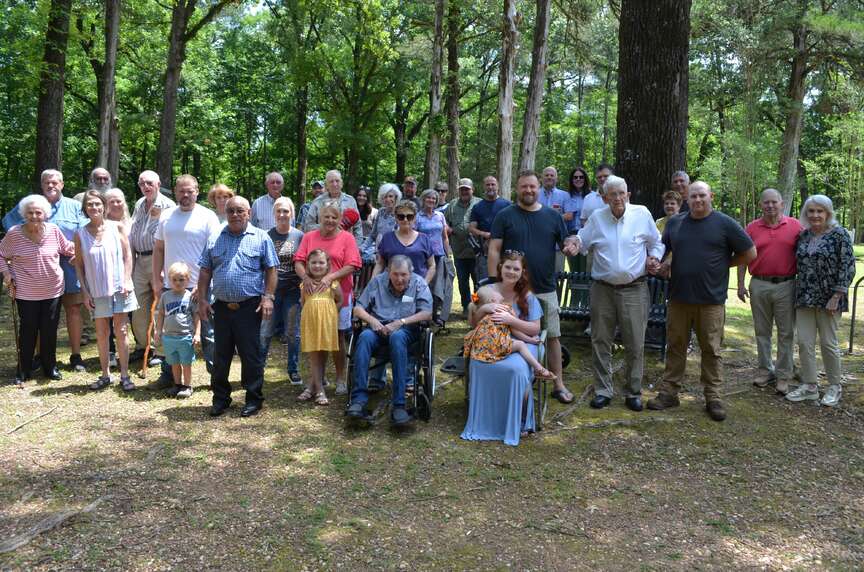 Fifty plus Marks/Barnett descendants were on hand June 2 for the annual family gathering at historic Marks Cemetery. (Special to The Commercial/Richard Ledbetter)
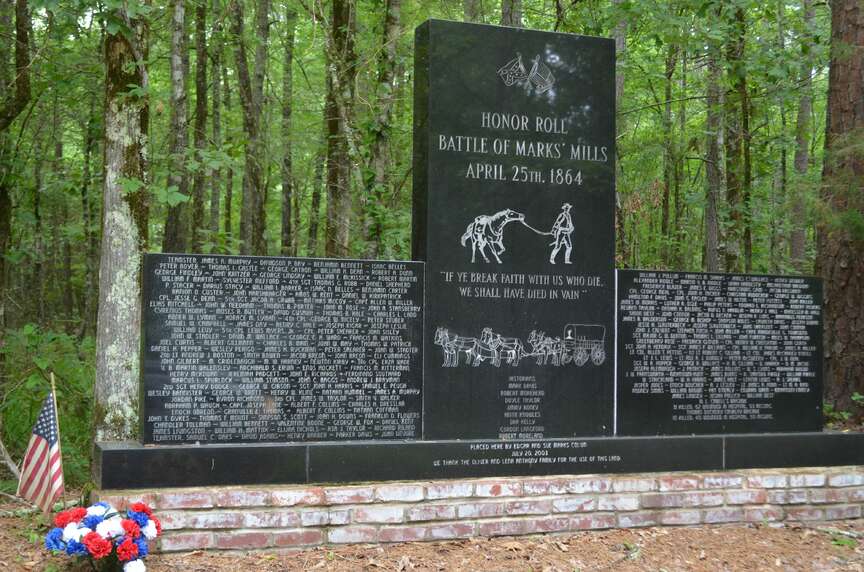 9248: The Battle of Marks Mills Roll of Honor monument displays a partial list of names of fallen soldiers from both sides of the conflict. (Special to The Commercial/Richard Ledbetter)