
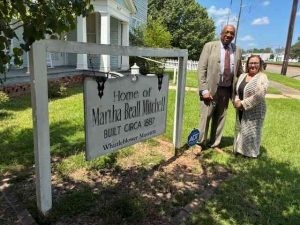
The Pine Bluff Commercial recently hosted a segment of “The Newsroom,” featuring prominent figures in the whistleblower community, Bob Abbott, a businessman and entrepreneur known for his support of kidney research and whistleblowers, and Michael McCray, co-founder of the Whistleblower Summit and cultural development specialist for the Pine Bluff. The discussion centered on the upcoming Whistleblower Summit in Little Rock and the historical significance of whistleblowers, particularly Martha Mitchell.
Byron Tate, editor of The Commercial, opened the segment, introducing Abbott as a “whistleblower fan” and McCray as a “recovering whistleblower.” The conversation quickly delved into Abbott’s long-standing relationship with the concept of whistleblowers, particularly his ownership of the Martha Mitchell house.
Abbott recounted how he became interested in whistleblowers through Martha Mitchell.
He emphasized Mitchell’s groundbreaking role and believes that highlighting Martha Mitchell would be a great asset for Pine Bluff, as she is the only whistleblower with an expressway and a museum named after her.
McCray added to the discussion, highlighting the shift in how Martha Mitchell is perceived. He explained that the term “whistleblower” wasn’t commonly used during Mitchell’s time, as it originated primarily after the Watergate scandal. “From my perspective, in my experience, she’s lived more of a whistleblower experience than any whistleblower that I know,” he said. “She’s the prototypical whistleblower.”
He commended Abbott’s efforts in preserving Mitchell’s legacy, particularly in the face of attempts to “erase Martha from history.”
Tate posed the question about how Martha Mitchell might be treated in today’s political climate. Abbott acknowledged the changing times.
“I just really don’t know, we live in different times,” he said. He recalled Mitchell’s initial support for the Nixon administration and her eventual disillusionment when she discovered inconsistencies in their narrative. Abbott shared those stories, reflecting on the backlash Mitchell faced.
McCray emphasized that whistleblowers are never truly “revered,” noting the intense challenges they face. He pointed out that while no administration fully embraces whistleblowers, the current climate presents unique difficulties. “There is a certain level of vindictiveness in the current administration; there, it scares off a lot of people,” he explained.
The upcoming Whistleblower Summit will be a hybrid event, taking place on July 29th on Capitol Hill and July 30th at the Clinton Library in Little Rock, coinciding with National Whistleblower Appreciation Day and the birthday of Martha Mitchell.
The discussion also touched on the historical foundation of whistleblowing in the United States. McCray cited the first whistleblower law passed on July 30, 1778, by the Continental Congress, which states, “it’s the duty of every American citizen to report to Congress the government malfeasance, at first opportunity.”
Regarding the Martha Mitchell house, Abbott was optimistic for the house’s future.
McCray sees the Martha Mitchell house as a unique tourism asset for Pine Bluff, emphasizing that Arkansas is the only state with related tourism infrastructure.
The Whistleblower Summit will be a 10-day event, featuring two days of live, in-person events and a film festival. Films will be playing online from July 25th to August 3rd. The kickoff reception for the summit will be held at the Martha Mitchell house on the evening of July 29th, open to the community. Registration is required but free.
The panel discussions will include representatives from NGOs, such as the National Association to Stop Guardianship Abuse (NASGA) and the Government Accountability Project. Locally, Chris Jones, who ran for governor, will participate, speaking about the First Amendment alongside Pulitzer Prize winner Katie Kate Woodson from the Washington Post. Jimmy Cunningham will discuss tourism assets related to Martha Mitchell.
McCray shared his journey as a whistleblower, stemming from discovering “$40 million worth of waste, fraud, and abuse” while working with the Clinton administration. He explained that whistleblowing often begins by simply “asking the wrong question at the wrong time.” He noted that while 95% of whistleblowers do not win their cases, the summit aims to change the culture around whistleblowing, making it “less toxic to be a whistleblower.”