
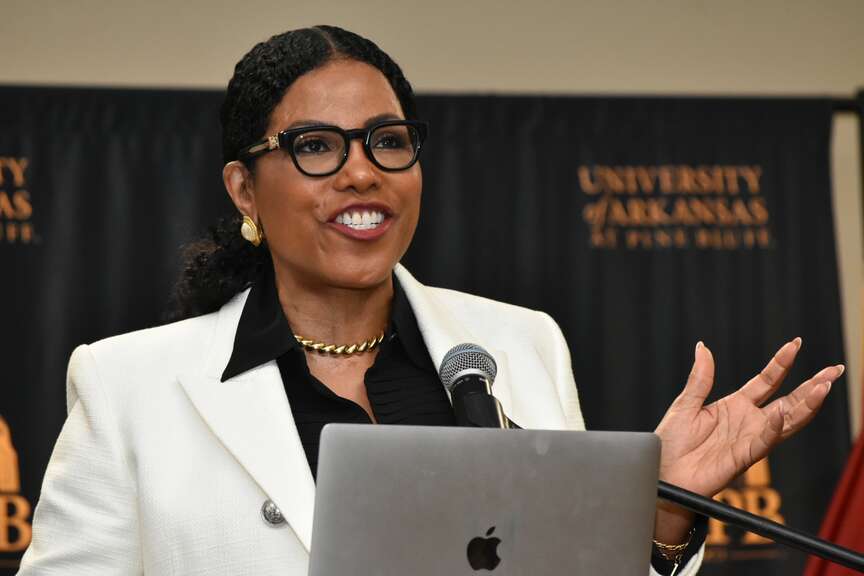
Commemorating Black History Month allows Black people to own their own power, Dr. Ilyasah Shabazz said in reciting a saying from the man who founded what started as Negro History Week.
“He said in the 1950s, ‘The biggest race is to see who will control the minds of young people,'” Shabazz said before a full STEM Conference Center ballroom. “And, so, I say to you young people, recognize and own your power.”
The third of civil rights leader Malcolm X’s six daughters was the keynote speaker at the University of Arkansas at Pine Bluff’s Black History Month celebration Friday. Malcolm X, born Malcolm Little, was assassinated Feb. 21, 1965, at age 39 in New York, taking 21 shots to his body, according to Shabazz.
(The three men originally convicted of the murder were eventually paroled after being sentenced to life in prison. Two have been exonerated after it was reportedly discovered key evidence was withheld during trial.)
Shabazz announced the 59th anniversary of the assassination will be covered in a live event Wednesday on YouTube and Facebook. She chairs the board of the Malcolm X & Dr. Betty Shabazz Memorial and Educational Center in the same location where he was assassinated.
Independent reporting for Pine Bluff & Jefferson County since 1879.
The 62-year-old also recalled the time when her father was killed.
“My mother, pregnant, placed her entire body over my three sisters and me to protect us from gunfire and to make sure we would not see the terror before our eyes,” Shabazz said. “Just one week prior, they lay together in bed, asleep as husband and wife, when a fire bomb was thrown in the nursery of our home where my sisters and I slept as babies.”
Betty Shabazz, who was 10 years younger than Malcolm, never gave into bitterness or despair despite his killing although she had every right to, Ilyasah Shabazz said. All six girls — Betty Shabazz gave birth to twins after Malcolm’s death — attended private schools.
“I was taught the oneness of God and the goodness of humanity,” Ilyasah Shabazz said, reflecting on her days at a Vermont summer camp and adding she learned about important contributions of the African diaspora, women and Islam to the world.
“We never had to rely on others to determine our self-worth,” she reflected. “… With this strong foundation, I’m able to see you as a reflection of me and me as a reflection of you. I’m able to love you as much as I love myself, because if we don’t know how to love ourselves, we can never love anyone else properly.”
The Malcolm that was studied is not the one others came to know in his truth, Shabazz emphasized. She credited her mother, who died in 1997, with accurately safeguarding his legacy for future generations and told the audience of Malcolm’s love for her, his smile and affection for jazz.
“As she kept her husband’s essence, his love, values and humanity, going in our household, she did not want us, his daughters, to suffer from the sudden absence of his physical presence and love,” she said. “And, though, he was physically absent — compassion — my mother made sure her husband remained present in our household conversations for as long as I can remember.”
A miniseries that aired on ABC and the National Geographic Channel this month, “Genius: MLK/X,” documents Malcolm’s and Martin Luther King Jr.’s lives. Shabazz has produced the PBS documentary “Prince Among Slaves” and has a television series in the works titled “The Awakening of Malcolm X,” based on her latest publication.
Shabazz’s address at UAPB was a historical moment, retired educator Mattie Collins remarked.
“I am proud of what her dad did as far as our Black history is concerned,” Collins said. “He and Dr. King are, to me, heroes to the African American family in this country.”
Shabazz empowered attendees to hold onto hope, recalling a message from her father that hope is brighter for the younger generation and those who prepare for it.
She used the story of poet Charlotte Forten to illustrate the importance of Black history. Forten, who died in 1914 at age 76, was an abolitionist, teacher and diarist who documented the anti-slavery movement of the 19th century, and she was one of the first Black graduates of what is now Salem [Mass.] State University.
Forten described her college days as the happiest of her life, Shabazz said, but it was during a period of slavery.
“It was the law of the land,” she said. “Even as a free person, you’d risk being sold into this type of madness, this type of existence. I often say it is our responsibility to tell the truths of those who were targeted, trafficked, held in bondaged, raped, sodomized, tortured. … It is our responsibility to tell the story because if we don’t, then we’ll be reduced as nameless and faceless slaves.
“But when we understand that we made these significant contributions in spite of that terror, had it not been for these contributions of our enslaved foreparents, not one American today would have the opportunity to call the leader of the free world, the land of milk and honey, their own. So, we owe it to our ancestors to control that narrative.”
Collins attended with Dr. Tywanna Smith, an author and sports consultant originally from West Memphis.
“It was so powerful to hear the firsthand account of her experience through her father’s assassination and some other things her mother did to keep his legacy alive. It was very inspirational,” Smith said.
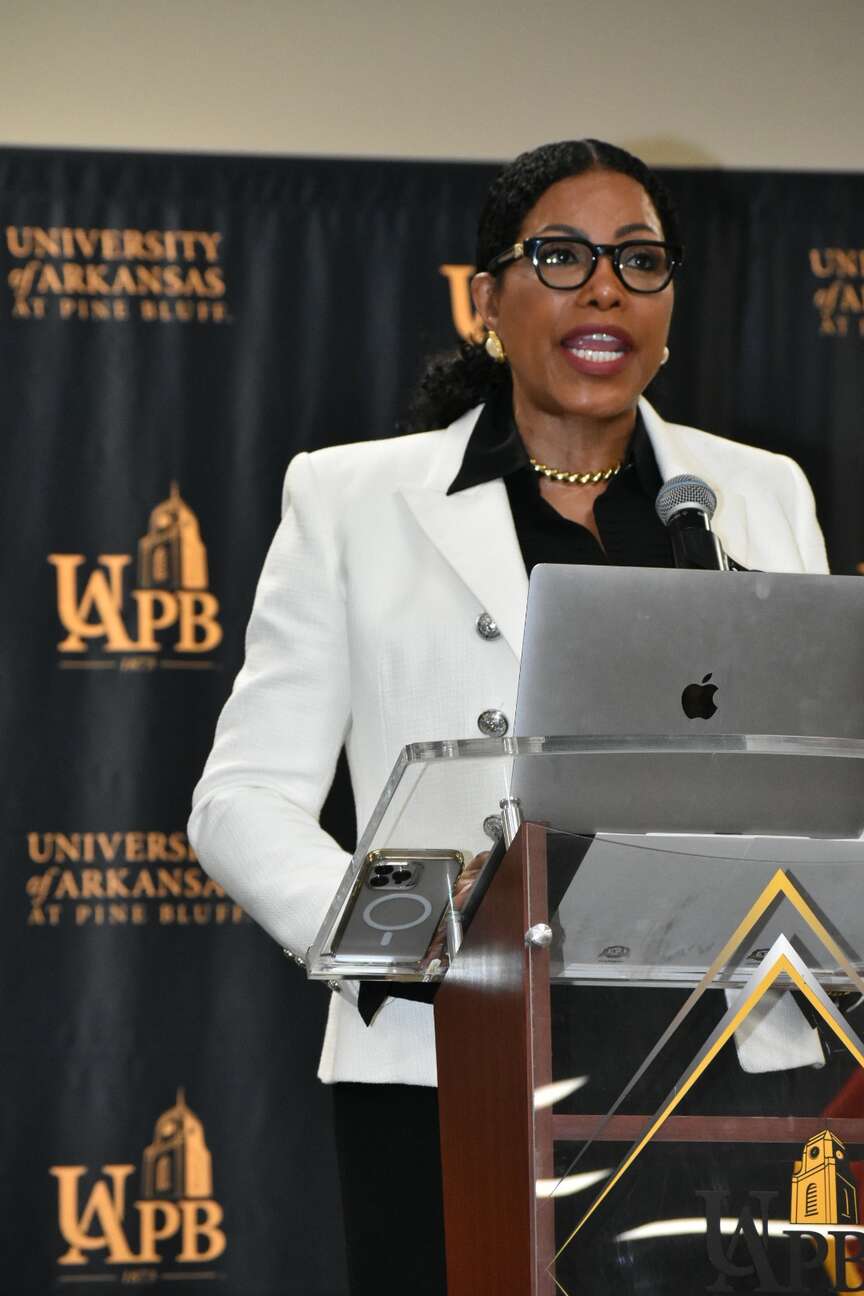 Others’ understanding of slain civil rights leader Malcolm X is different from how Dr. Ilyasah Shabazz, one of his six daughters, came to know him, she tells attendees at UAPB. (Pine Bluff Commercial/I.C. Murrell)