
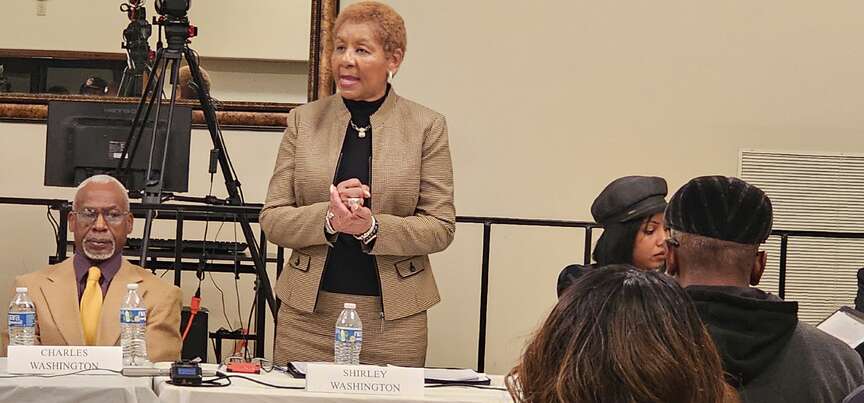
Public trust and accountability were key topics addressed as the questions and answers continued as part of the NAACP mayoral candidate forum held last week.
Mayoral candidates included John Fenley, who will run during the November election, and Democrats who will be on the March primary ballot: Sam Glover, state Rep. Vivian Flowers, Charles Washington, incumbent Mayor Shirley Washington, Joni Alexander-Robinson and Steven Mays.
Beginning with a question about supporting an audit of city operations and addressing concerns and advocating for transparency, Fenley gave his outsider perspective as a Utah native. According to Fenley, there is a need for transparency to prevent evidence-hiding in city government.
Glover stressed the importance of educating constituents and holding City Council members accountable. Glover said there are measures already in place, adding that he didn’t see the need for an additional audit. Instead, he advocated for citizens to use the Freedom of Information Act as a way to hold City Council members accountable.
Independent reporting for Pine Bluff & Jefferson County since 1879.
Expanding on the Freedom of Information Act, Flowers said that as a state legislator, she passed one of the first bills requiring government entities to include audio and video recordings of meetings.
Flowers also called for better adherence to existing transparency measures and making information easily accessible to the public.
Government spending should be transparent and accessible to citizens, and citizens should be able to access information about government finances easily, according to Charles Washington.
Shirley Washington, the mayor, said the city’s budget is available online and open to the public and she will maintain the level of public trust established over the last seven years while she’s been in office.
Alexander-Robinson listed ways to improve the city’s transparency. According to Alexander-Robinson, she would make the internal auditor an autonomous position reporting to both the mayor and City Council. She said she would address every concern about city corruption and address the lack of transparency on a public platform, adding that she would implement ticketing systems as a way to track and address citizen concerns.
Mays talked about “the terrible streets and potholes.”
Their views on Go Forward Pine Bluff was perhaps one of the most anticipated questions as the candidates expressed if they were for or against the measure and would support its return to the ballot if a third attempt was made to get a Go Forward-supported tax passed.
Glover said divisions have been created in Pine Bluff and his faith would not allow him to go against anyone. He said the tax was voted down by the people and the city must move forward, but he said he wouldn’t be for or against any entity, adding that he is “for Pine Bluff.”
Flowers made it clear that she opposed GFPB but will support a transparent and accountable tax where public-private partners are not involved in city business.
Charles Washington said he wasn’t familiar with all that GFPB does and would like to evaluate their progress and see where and how the tax dollars were spent. He said if it benefits the city, he would support it.
The mayor said she did embrace GFPB’s initiatives for city development and was not ashamed of it. She said the people have voted now twice not to renew the Go Forward-supported tax and that GFPB is now a thing of the past. Ready to move on, Washington discussed her initiative for city development and emphasized the importance of collaboration and seeking input from various community members.
The initiative aims to move the city forward and create positive partnerships. The mayor said partnerships were made due to GFPB and will continue, she said, noting that cooperative relationships led to a $1 million check from the Walton Foundation.
Alexander-Robinson told the citizens that they should understand the tax dollars’ purpose and the direct services of the city’s departments, adding that she would not ask for an additional tax until the current tax dollars are spent correctly.
Mays complimented Alexander-Robinson on her answer and said he was always against GFPB.
Fenley, too, said he was against GFPB. He said taxes paid for services need to be used properly and there needs to be more clarity about how money is being spent.
Another anticipated question dealt with the alleged embezzlement of approximately $700,000 from Urban Renewal Agency and hundreds of thousands more that was improperly spent in the Parks & Recreation Department, according to state auditors.
Flowers was the first to address the concern and spoke about the efficient utilization of tax money. Flowers said tax money should be spent efficiently to help people in need and investing in audits can restore public trust and address controversies.
Charles Washington expressed the need to ensure transparency and accountability in public spending.
With these discrepancies happening under Mayor Washington’s term, she addressed the improper procurement procedures and said she implemented new procedures to prevent improper procurement.
She also said the “state legislature found no violations and cleared us” and that “transparency is our priority.”
Alexander-Robinson identified internal control issues and said the current procedures are not effective in catching issues. With the need to identify internal control issues to prevent future problems, Alexander-Robinson said it was time to take action and address these issues, saying that she would have a forensic audit during the transition of administration.
Mays said the forensic audit was necessary to investigate financial irregularities.
Fenley expressed his concerns about financial mismanagement and policy issues in the city and said there was a need to investigate records and track money movement to uncover the truth, emphasizing accountability and transparency in public spending.
Glover focused on transparency and community engagement and said executive management in municipal positions should focus on connecting with the community. He said all financial information should be transparent and accessible to the public and transparency and community engagement are essential for a stable and thriving community.
Addressing misinformation about the missing money in the Parks & Recreation Department under his leadership, Glover clarified that there was no missing money issue and that the audit finding was related to a contract he signed.
With a rebuttal, Alexander-Robinson said Glover signed a $500,000 contract and the attest line where the city clerk was supposed to sign was signed by Glover’s secretary resulting in an internal oversight. Alexander-Robinson emphasized the need for improved internal controls to prevent such errors in the future.
The mayor offered a rebuttal discussion of the audit findings, stating that it was the city that found and reported the problem. According to Shirley Washington, when it was noticed that golf carts were at Harbor Oaks they began looking into the matter, discovering Glover’s unauthorized signature and his secretary’s.
Flowers, who was a legislator during the state audit committee, said she received a lot of calls during and after the audit findings were addressed by the legislative audit committee. According to Flowers, their role is oversight, and “the audit committee doesn’t clear or unclear anything.” According to Flowers, they look at the issues and decide if more information is needed or if there is a need to provide information to the prosecutor. Flowers made it clear that they “don’t clear anyone.”
Moving on to projects rendered by GFPB compared to the Delta Rhythm and Bayous proposed project, candidates were asked if they would support Delta Rhythm and Bayous.
Charles Washington had concerns about the project’s viability and revenue generation but said he would support it.
Shirley Washington said she supported the project from the beginning and even though the project funding is uncertain, efforts will be made to secure it. Washington said community partnerships are crucial for the project’s success, stating the importance of collaboration and shared values.
Alexander-Robinson also expressed her support but pointed out how the current city council has not been cooperative in supporting the initiative and giving the project the money that the council initially voted to do. She also expressed the lack of accountability from the city council when it came to GFPB’s projects and said the council should have held them to the same standards they are holding the organizers of the Delta Rhythm and Bayous projects.
Mays said the vision for the project is good but there are too many hands trying to move and persuade the council, stating that those same people should run for office. Receiving laughter from the crowd, Mays repeated his statement while encouraging the Delta Rhythms and Bayous project to continue.
Discussing the planning and design of the project, Fenley shared his thoughts, emphasizing the importance of creating vibrant and active public spaces. He suggested avoiding dead spaces and incorporating features encouraging people to walk and interact.
He also highlighted the need to consider the cultural context and specific needs of the community when designing public spaces.
Glover said the downtown aspect of the project would be good for the city but questioned the economic impact and how it would compare to other cultural districts like those in Selma, Ala.
He said the entire plan needs to be evaluated to make sure it is viable.
Flowers said not only does she support it, but she would find every way to expand it because the project set a new standard for working with partners. It ensures data availability, community process and city council approval, she said.
The city’s infrastructure assessment and improvements were discussed as the mayor spoke about conducting assessments of street department equipment and infrastructure.
She also addressed flooding issues with allocated funds and the need to collaborate with engineers, as well as branding parks and improving roads as part of infrastructure development.
Alexander-Robinson discussed government efficiency and the need to improve infrastructure and inventory. Mays said the potholes were a problem as he receives calls all the time and something needed to be done to improve the streets.
The city lacks proper infrastructure, including narrow roads, no sidewalks and litter, according to Fenley. His vision for improvement involves cleaning the ditches, installing storm drains, widening roads and adding sidewalks. His goal is to create a community where people can interact and know their neighbors.
Glover said he had the actual management project experience and said every park received upgrades and capital improvements that happened under his leadership as parks director.
Flowers spoke about the importance of infrastructure development, especially at the airport ,while highlighting the decline in population and the corresponding decrease in the budget for the street department. She said prioritizing and funding projects is essential.
Charles Washington questioned whether the street department’s equipment was capable of improving the infrastructure.
Part three continues with more discussion from the candidates and closing statements.