
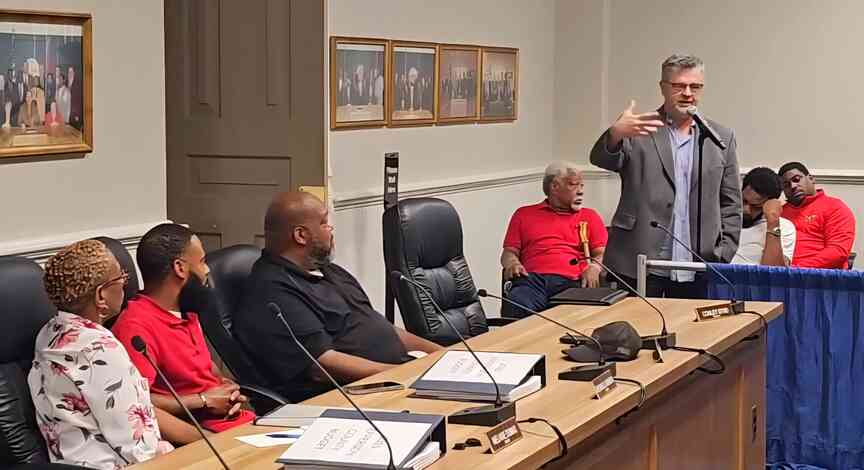
The Jefferson County Quorum Court met Wednesday to address a pressing legal matter: the reinstatement of a lawsuit against seven of its members.
Special Circuit Judge Randy Wright issued the latest ruling June 20, one week after he dismissed the case filed by Garland Trice, Pamela Barnes Earnest, Bruce Carman, Victor Johnson, Glenda Daniels and Eric Mitchell. The plaintiffs, represented by Little Rock attorney Jay Paul Coleman, requested the dismissal be denied because the defendants — Alfred Carroll Sr., Reginald Adams, Reginald Johnson, Margarette Williams, Melanie Johnson Dumas, Cedric Jackson and Brenda Bishop Gaddy — suggested no action was taken when Coleman filed an answer to the JPs’ motion to dismiss the suit.
Wednesday’s meeting, which saw the justices discussing the path forward, ultimately resulted in a motion to retain legal counsel for the ongoing civil case. Following a detailed discussion, Dumas made a motion to retain attorney Bobby McAlister to represent them in the civil division case No. 35CV-25-391. The motion was seconded and, after a roll call vote, was carried.
McAlister was invited to address the Quorum Court regarding potential legal representation. McAlister, of The Baxter Law Firm, PLLC, revealed his prior awareness of the situation.
“I was somewhat aware of the situation in Jefferson County, thankfully, not just from news reports … but because I also represent your county assessor in a similar lawsuit,” he stated, highlighting a related case that provided him with insight. He expressed optimism about the Quorum Court’s position.
Independent reporting for Pine Bluff & Jefferson County since 1879.
“I do feel pretty good about your situation based on the law and research that I had done in responding to the other lawsuit,” he said.
The meeting began with the selection of a temporary chair, Carroll, as Jefferson County Judge Gerald Robinson was absent. Also absent were justices Roy Agee, Conley Byrd, Jimmy Fisher, Ted Harden, Cedric Jackson and Patricia Johnson.
The core of the discussion centered on the lawsuit, which had previously been dismissed but was recently reinstated by Wright. Carroll provided a backdrop to the situation, explaining that the lawsuit, filed by “some constituents,” had been thrown out “just a couple of weeks ago” only to be reinstated days later. The understanding was that the judge’s office was “not aware that the plaintiff’s attorney had filed a response” to the Quorum Court’s initial response, leading to the case being reopened.
Coleman filed the motion to vacate the judgment on June 17.
The plaintiffs once again are seeking to have the justices of the peace removed from office. They claim in the suit, originally filed April 15, the JPs committed malfeasance by attempting to pass ordinances without Robinson’s approval and that the JPs are having the county disburse funds “in their favor” without Robinson’s approval.
During the question-and-answer session, Reginald Johnson voiced a common public concern about the lawsuit’s reinstatement.
“I think that the public is somewhat confused because they all thought, as we did at one time, that the suit was dropped. Can you give me any type of insight so they can understand that?” he asked.
McAlister explained the judge’s reinstatement order indicated a “piece of confusion on his part” regarding inactivity in the case.
When asked about his willingness to represent the Quorum Court, McAlister enthusiastically responded, “Oh, absolutely. As long as you guys are committed to doing this right, I have very firmly held opinions about the way government needs to be run. And the number one piece of those opinions is service, transparency, and willingness to answer questions and explain things.”
He also acknowledged the financial concerns raised by Reginald Johnson, who noted the difficulty in obtaining judicial approval for legal representation.
“We’ve had major issues on getting the judge to sign off on us to be represented … and it’s a narrative that’s been put out there that it’s illegal for us to be represented,” he said.
McAlister affirmed his willingness to work on fees, adding, “I’m walking into this knowing that every step along the way is probably going to be a little bit of a fight.”
Adams questioned the legal basis for the perceived inability to secure representation. “Is there any statute that says that we’re not supposed to be represented?” he asked. McAlister clarified his interpretation of the code.
“As I read the code, you guys have the authority to hire a specialized counsel for certain pieces of work. … It’s my opinion, my belief that you guys have the authority to hire specialized counsel for certain situations,” he said.
The discussion also touched on the expected communication and collaboration between the Quorum Court and their potential attorney. McAlister emphasized clear and truthful communication.
“If I ask you to do something, and that something is legal, ethical and founded upon either good strategy … I expect what I tell you to do,” he said. “The bottom line, I’m 60 years old, and I don’t have time to play games.”
McAlister also stressed adherence to Arkansas’ Freedom of Information and sunshine laws, explaining that all communications and work would be accessible.
“Anything that I share with you guys, any communication I have with you guys over email, or anything like that is accessible under freedom of information,” he said. He clarified that for decisions requiring a majority vote, a properly noticed meeting would be necessary.
McAlister noted “technical defects” and “a lot of missing items” in the pro se response. According to Carroll, the JPs were representing themselves and received guidance on how to respond from individuals who had experience in the matter.
“Whomever you choose to fix that, it needs to get fixed and you need to try to get rid of this case,” McAlister said, stressing the urgency of the case. He advised the Quorum Court would be in a “much better position if you had a technically correct response, that had a lot more law and a lot more meat to it.”
The meeting concluded with further discussions about the technical defects and the need for legal counsel to rectify it. While an appropriation for legal services was reportedly included in the budget, the possibility of needing a more specific ordinance for the retention was raised and will be reviewed by the chief deputy prosecutor.