
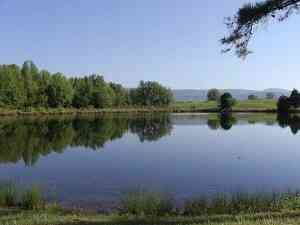
Growing large fish in ponds usually begins by first growing tiny plankton. Plankton is a broad term that includes very small plants and animals that suspend in water lacking the ability to swim against its currents, said Scott Jones, small impoundment extension specialist at the University of Arkansas at Pine Bluff.
“Phytoplankton are plants that heavily influence dissolved oxygen, carbon dioxide and other chemical cycles in the pond. Zooplankton are animals that feed on phytoplankton, bacteria, detritus and other zooplankton,” Jones said. “Almost all fish eat various species and sizes of plankton as they grow from their larval state to fingerling sizes; some continue eating plankton as their primary diet their whole lives. Without this critical link in the food chain, ponds struggle to produce fish to their full potential.”
With thousands of species of the two main forms of plankton, there are varieties that will survive in almost any aquatic system. The healthiest communities are found in waters with stable chemistry and balanced fertility, he said. For much of central and southern Arkansas, that type of aquatic environment may require supplemental applications of agricultural limestone to achieve.
“Much of this region has acidic soil and soft water in which plankton do not so easily thrive,” Jones said. “The liming rate depends on soil chemistry and can be evaluated through the Extension soil testing service.”
Next is a ready supply of the macronutrients nitrogen and phosphorous. Liming helps liberate these nutrients that can be chemically bonded to mud in acidic conditions, but some ponds require additional fertilization to stimulate the first plankton bloom, he said. Fertilizers are given a three-number rating based on the ratio of nutrients contained in the product.
Independent reporting for Pine Bluff & Jefferson County since 1879.
“The nitrogen, phosphorous and potassium — or ‘NPK’ — number, is provided in most fertilizer products. For new ponds, 4 to 6 pounds per acre per application of 10-50-0, or similar, powdered fertilizer should provide good results,” Jones said. “Apply three treatments spaced two weeks apart in spring to establish the bloom. Wait until water is at least 60°F consistently before making your first application.”
Once the bloom has established, pond owners should monitor its density using a “Secchi disk.” These tools can be purchased or built at home, he said. Ideal bloom density produces 18 to 24 inches of visibility on a Secchi disk. When the water clears to at least 24 inches of visibility, it is time again to fertilize. It may be two to four or more weeks between needing fertilization after the initial bloom is established.
Most ponds do not require continuous fertilization. Fertilizers should only be used regularly by owners who intend to grow trophy sized fish or plan to have frequent and heavy fish harvests.
“Absolutely do not use fertilizer in ponds that already have existing weed problems, are muddy or already have blooms producing less than 24 inches of visibility,” Jones said. “If a bloom becomes so dense that it produces less than 12 inches of visibility for several weeks, it may be necessary to take action. Oxygen problems or toxic plankton species can develop if this condition persists. Algaecide and nutrient binding products can help thin out blooms that get too thick.”
The final component plankton need is sunlight. Ponds entirely secluded by tree cover, or those that are consistently very muddy, will not grow plankton well. Removing, or at least reducing trees around the pond, may be needed if they completely block the sun, he said.
“Trees larger than about 6 inches in diameter should be left alone if they are growing on the dam as killing them could compromise the dam’s integrity,” Jones said. “For muddy ponds, the source of muddiness must be identified and corrected before plankton and fish can thrive.”
Plankton blooms are important to the pond ecosystem. They produce the majority of oxygen needed by fish; they are the main food source for many small fish and almost all larval stages of fish; and they can suppress some aquatic weeds if the bloom is established before the weeds begin growing, he said.
“Following the proper steps to establish a healthy bloom can reduce management effort and boost fish production,” Jones said. “That said, one should only begin a fertilization program if you can make use of the extra fish production and can maintain the added fertility. Fishery crashes are likely if a fertilization program is abandoned after it begins.”
For more information about managing pond plankton blooms, contact Scott Jones at (870) 575-8185 or joness@uapb.edu.
Debbie Archer is an Extension Associate for Communications at the University of Arkansas at Pine Bluff School of Agriculture, Fisheries and Human Sciences.