
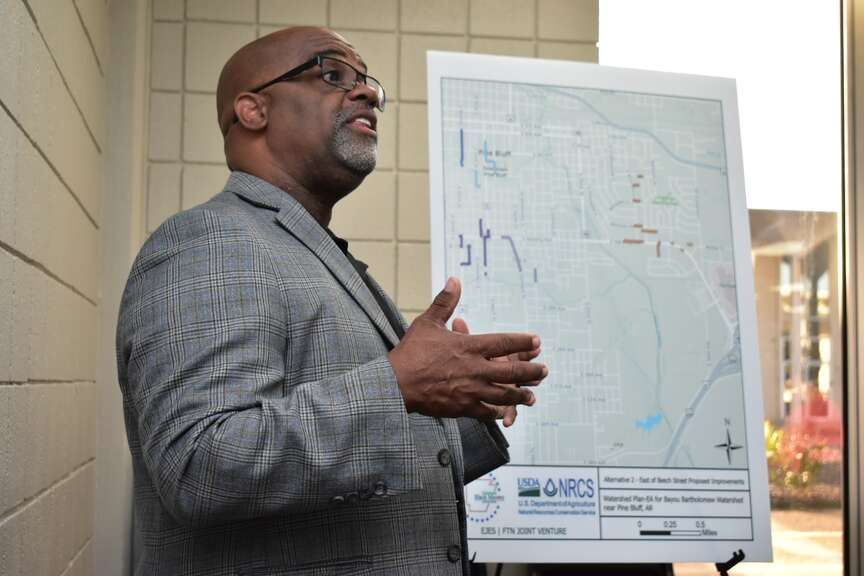
Pine Bluff-area residents affected by flooding in recent years are asked to submit comments on watershed plans to engineers by Oct. 8.
Edwin Jones, one of the engineers for the Bayou Bartholomew and Caney Bayou watershed projects, led a public comment forum Tuesday evening at the Det. Kevin D. Collins Center at the Pine Bluff Civic Center. About 20 residents and city officials gathered to share their input on the project, which will head to the design phase by the first quarter of 2025 and is expected to last 18 months before a construction phase estimated to last anywhere from three to six years.
Jones and his EJES Inc. team of Dallas is teaming with Olsson FTN of Little Rock on the Pine Bluff projects. Pine Bluff is one of 14 cities in south and east Arkansas granted federal funding to build new watersheds in a project managed by the Arkansas Black Mayors Association.
Pine Bluff’s allocation has grown from $32 million to $50 million toward what he estimated to be up to $200 million of watershed needs for the city, Jones said. Lower lands in and around the city tend to withstand excessive flooding, and drainage on streets is often slow during severe wet-weather events.
The City Council is expected to pass a resolution to accept the projects at Monday’s regular meeting, a necessary step toward designing of the watersheds, according to ABMA Executive Director Frank Bateman.
Independent reporting for Pine Bluff & Jefferson County since 1879.
Jones stressed the projects will not be able to prevent flooding in Pine Bluff entirely.
“When we talk about solutions, there’s an economic and social benefit to this,” he said, adding engineers and city officials considered high-flooding areas and those with the greatest need in selecting those of the highest priority. “We have to consider, how do we spend the money and how do we make sense of it?”
Ten areas are proposed to be served under the Caney Bayou project, which is expected to cost $29.3 million of the federal allocation: North Huntington Street, South Golden Lions, the intersection of U.S. 65 and Arkansas 365, the University of Arkansas at Pine Bluff, south of Townsend Park, West 14th Avenue, the intersection of U.S. 79 and Arkansas 190, north of Townsend Park, south of Lake Saracen and south of West Barraque Street.
The Bayou Bartholomew project is projected to address 18 areas, costing more than $25.5 million. That will exceed the federal allocation, for which city officials can request more once the projects begin, Jones said.
The 18 areas include: East Eighth Avenue, West Eighth Avenue, West Ninth Avenue, West 13th-17th avenues, West 10th-13th avenues, South Catalpa Street, South Camden Road, east of Belmont Drive, west of Belmont Drive, East Harding Avenue, South Pine Street, West 18th-24th avenues, South Elm Street to South Locust Street, Old Warren Road, north of West 73rd Avenue (Deer Run), Celia Road, north of Arkansas 190 and South Hazel Street.
“We will know how much of a problem can be fixed during the design phase,” Jones said. “You’re still going to see some flooding. This will not solve 100 percent of the problem.”
Fielding a question from Mayor Shirley Washington, Jones stated the cleaning of drainage areas is not part of the projects, but those who work on them will make sure citizens refrain from littering.
Comments on the Caney Bayou Plan may be sent to EJES by reaching Seyoum Asamenaw at Aseyoum@ejes.com or calling (469) 562-3652, or mailed and postmarked by Oct. 8 to Seyoum Asamenaw, PE, 12801 N. Central Expy. Ste. 700, Dallas, TX 75243 (RE: Caney Bayou Plan-EA).
Comments on the Bayou Bartholomew Plan may be sent to Olsoon-FTN by reaching Philip Massirer at pmassirer@olsson.com or calling (501) 837-1523, or mailed and postmarked by Oct. 8 to Philip Massirer, 3 Ironwood Cir., Ste. 220, Little Rock, AR 72211 (RE: Bayou Bartholomew Plan-EA).
Jones stressed that starting the projects is crucial given the upcoming change in White House administration.
“Let’s not play about these watersheds. Let’s take care of this city,” he said.