
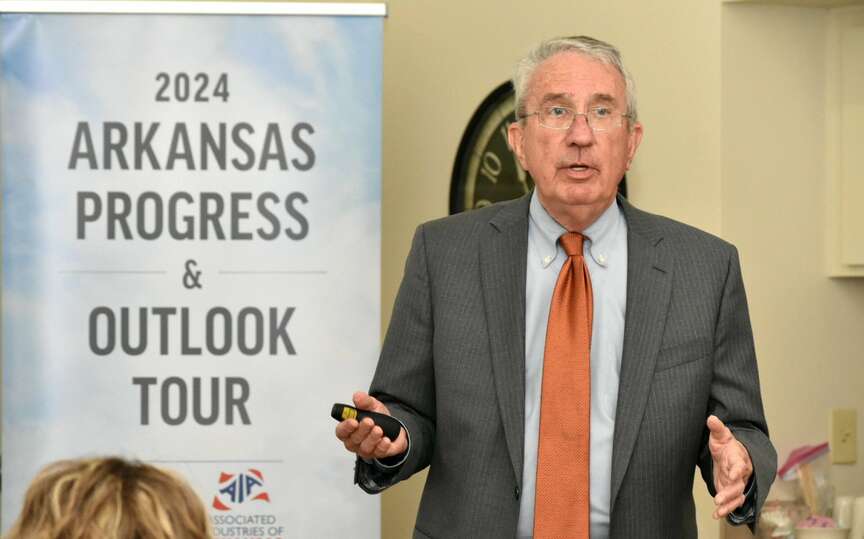
Monday’s Arkansas Progress and Outlook Tour stop in Pine Bluff revealed some upward trends in the statewide economy, along with some harsh realities of the workforce landscape locally.
A survey recently commissioned by the Arkansas State Chamber of Commerce ranked Arkansas the 15th-most economically competitive state in the union and third-best for recently legislated tax changes, according to data revealed by Randy Zook, president and CEO of the State Chamber. The organization partners with the Associated Industries of Arkansas partner to organize the tour of at least 15 stops across the state, with business leaders and local chamber members gathering for the third stop, held inside the Jefferson County Alliance and Chamber office on Main Street.
The average unemployment insurance cost per employee, Zook revealed, has decreased by 84% since 2012, from $417.60 to $68.60. The unemployment insurance trust fund is at $924.7 million. Data also revealed the total annual cost savings as a result of recent income and corporate tax reported is upward of $1.271 billion.
“I think the reason is, people understand we got out of whack, out of step with the touchstones. That’s who we really compete with — Texas, Louisiana, Mississippi, Missouri, Oklahoma,” Zook said. “It doesn’t really matter what’s going on a whole lot in Utah. The people aren’t looking at Utah and Arkansas. They’re looking at Mississippi and Arkansas, Texas and Arkansas. So, we have to be competitive with those states.”
Arkansas plays host to recently established industries such as U.S. Steel in Blytheville, and broke ground on a $63 million missile manufacturing facility in East Camden. While the country’s first gas-to-liquid plant, valued at $3.5 billion, is planned near Redfield, the state is focusing efforts on extracting lithium to aid a part of the state that has been sinking in population in recent years.
Independent reporting for Pine Bluff & Jefferson County since 1879.
A geologic formation called the Smackover Formation runs from the Florida panhandle to east Texas, and much of it is in Arkansas. Several companies, Zook said, already extract the brine from the formation to refine it into bromine and other chemicals.
“There’s also a lithium element in that brine,” Zook said. “It’s going to be a big deal.”
Every county south and east of a line between Blytheville and Texarkana has declined in population in recent years, Zook said, but he suggested the lithium product will be important for a burgeoning electrified vehicle market.
Zook grew up in McGehee, a southeast Arkansas town where agriculture is still king, and not far from the state’s timberland region. Taking care of the industries that are already in this region, he said, will be key to a long-desired economic turnaround.
“Make sure we’re doing everything possible to help them get the people they need with the skills they need, so that’s a big deal,” he said. “The better job we do with that, the more we will attract other people.”
Helping people to start businesses will be important as well, Zook suggested. He named several jobs in home improvement that are in search of workers.
“It’s all kinds of need here. We’ve just got to get people prepared here to do that kind of work,” Zook said. “Agriculture in southeast Arkansas and timber in south Arkansas are bigger than ever. It doesn’t take as many people because of more productivity through capital investment and better equipment.”
Quality health care in southeast Arkansas remains a large concern, as residents in rural communities trek to either Pine Bluff or Monticello for treatment their local doctors cannot provide.
“We definitely have patients who are in need of quality health care, and I’m hoping we can get to where maybe we can recruit additional physicians to provide that level of care that patients need,” said Dr. Tochi Amagwula-Keeton, a Pine Bluff obstetrician-gynecologist originally from Houston. “Obviously, economic development in this region is going to be something that draws from all sectors, including the health care sector.”
Amagwula-Keeton teaches anatomy of physiology at the University of Arkansas at Pine Bluff, and she’s noticed students are unaware of what jobs are available in the local health care sector.
“It all starts with education. We need to educate people about what they can do to help, what is needed and what it takes to get to that level and show them that there is more than what they see that is in rural Arkansas,” she said.
She and her husband, Julius Keeton, have lived in Pine Bluff since 2016. Julius, a Texarkana native, is an architect and contractor who is starting his own HVAC company and also runs a food truck.
“Definitely with HVAC, whether it’s a window unit, a split system or whatever it is, everyone’s trying to stay cool in the summertime and stay warm in the wintertime,” Julius Keeton said. “Despite the number of companies we have, the number of personnel is not enough to cover the whole state. Go to anybody in any point of what’s called the AC season, they’re booked out in advance. They’re steady turning down calls. There’s always a need for HVAC. I touched on the dilapidation of homes across the region, so there’s always a need for food. There’s definitely a need for construction. So, I think there’s plenty of opportunities for people out here.”
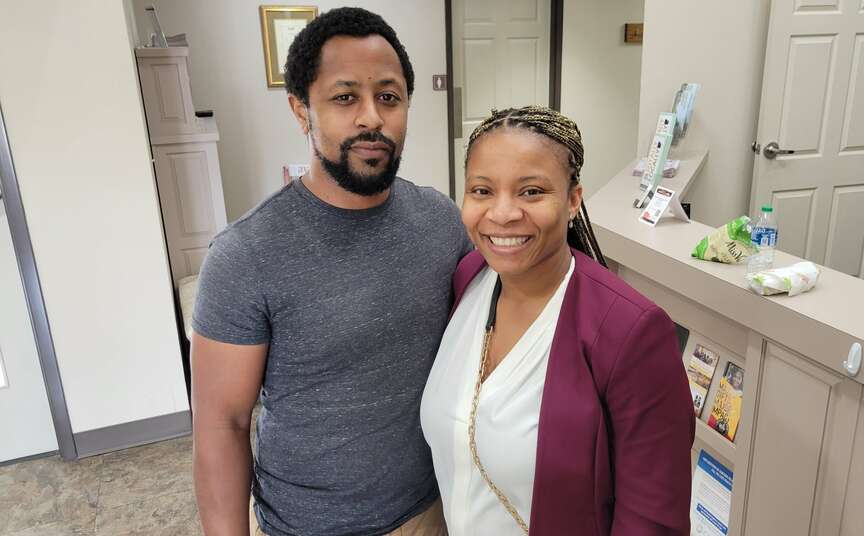 Julius Keeton and his wife, Tochi Amagwula-Keeton, attended the Arkansas Progress & Outlook Tour stop Monday at the Jefferson County Alliance and Chamber office. (Pine Bluff Commercial/I.C. Murrell)