
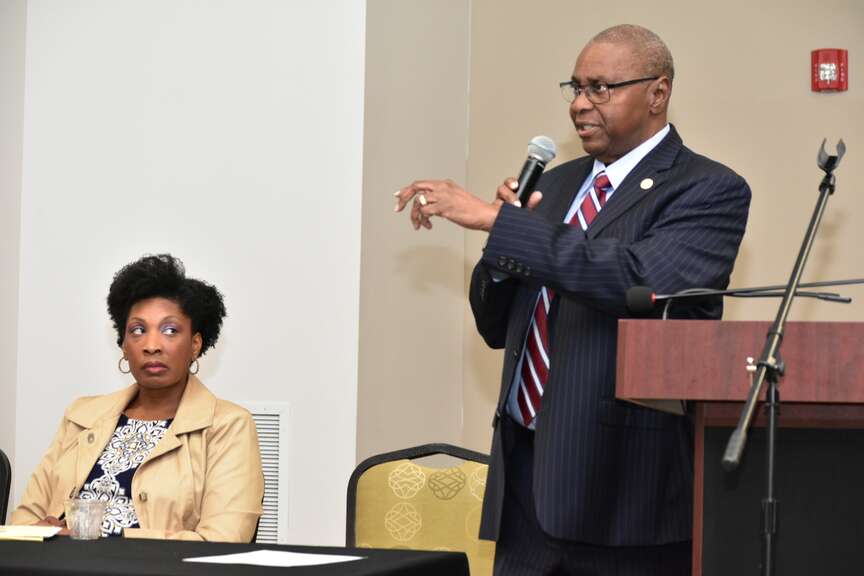
The issue of food deserts dominated the Arkansas Legislative Black Caucus’ first post-election town-hall meeting at the University of Arkansas at Pine Bluff’s STEM Conference Center on Thursday evening.
Members of the caucus talked for about an hour and gathered comments from UAPB staff and students about pressing needs that could be addressed during the 95th General Assembly, which begins Jan. 13.
Some food deserts exist on the north side of town, where the university is located. Student Government Association President Caleb Williams pointed out it’s hard for some students who have no means of transportation to get healthy food outside of cafeteria hours. The SGA, however, works to let students know where to access an on-campus food pantry in which non-perishable items are stored.
Senator-elect Jamie Scott, D-Little Rock, who is finishing her third term as District 72 representative, challenged the SGA to write a grant for a refrigerator to store perishable items that are otherwise healthy items students can use.
SGA executive vice president Aareyon Wallace issued his own challenge to those in the campus community and those who could potentially donate to the food pantry — motivate, educate and advocate. He said such donations can be made to the university’s STEM building.
Independent reporting for Pine Bluff & Jefferson County since 1879.
“If we can do those three things, motivating people to want to give to it, motivating others to want to educate others on what a food pantry teams and the benefits of it — there’s no stigma — and then advocating that we get the resources and a steady supply of resources, not just a one-time, $5,000 grant when the state has a billion-dollar surplus, I think what needs to happen is our priorities, as a state legislature, needs to be on the things that are hindering the growth of our community,” Wallace said. “And if you have multiple food deserts in all 75 counties, we need legislation to be able to handle that. Until we do that, we’re going to keep relying on grants and other groups and organizations and associations to do the job our legislators need to be doing.”
Town-hall meetings with the Legislative Black Caucus are also scheduled for Nov. 21 at the Forrest City Civic Center and Dec. 19 at the Fort Smith Community Center. The caucus includes Mayor-elect Vivian Flowers, who is wrapping up her time as District 65 representative, District 64 Rep. Ken Ferguson and Sen. Stephanie Flowers, all Democrats from Pine Bluff.
“We will gather all the information together and we will begin to write legislation based on the things we’ve heard,” said Charity Smith-Allen, think tank director for the caucus. “This is new for the students. They don’t know how to process what, but (legislators) will be going through a process from January all the way through, but first you have to do a listening tour. You have to hear what are the issues before you start saying, here are some solutions. This is an excellent opportunity for the community to be engaged.”
The caucus came to UAPB in February and shared hopes of the Legislature taking steps toward funding more than $330 million for the campus, the only historically Black land-grant university in Arkansas. A federal survey concluded UAPB was underfunded by that amount in comparison to the University of Arkansas, Fayetteville, the state’s original land-grant university, between 1987 and 2020.
While the funding was not a hot topic Thursday, Wallace asked the legislators to consider improving the infrastructure of the university so students can be better trained for and have access to high-tech jobs, as well as to attract some of those jobs to Pine Bluff.
“If we want the university to advance and produce hard-working African Americans, the issue is a lack of funding,” he told legislators. “We do what we can with what we have.”
A lack of campus police officers and a hiring freeze were among issues Wallace pointed out.
“Every day is a golden day at the university,” Wallace said. “We’re not struggling, and we don’t look like we’re struggling, but we could do with and use a lot more.”