
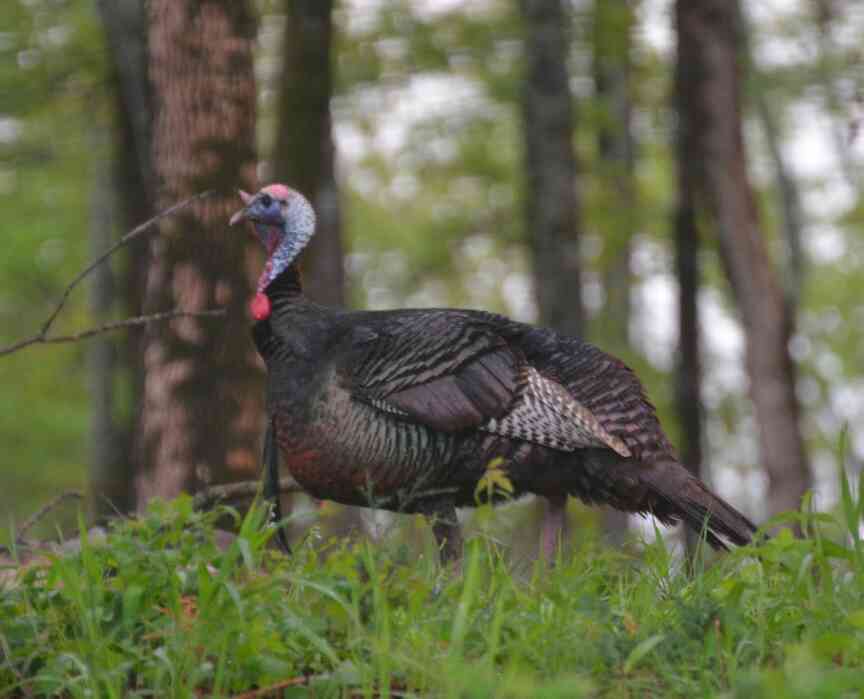
The 2025 spring turkey season ran from April 21 through May 11. This is a later start to the season, which began on April 15 in 2024 and April 17 in 2023.
Despite a later start, it has proved to be a banner spring for turkey harvest success in the state. The final tally of tom turkeys checked is up by more than 21% over 2024 from 9,335 to 11,332. The 2023 harvest was 9,203 which was up 21% over the 2022 harvest of 7,583.
Beginning April 15, 2024, David Moscicki joined the Arkansas Game and Fish Commission as turkey program coordinator. He came to Arkansas with higher degrees in wildlife management from North Carolina State University.
Regarding the advance in harvest numbers, Moscicki explained.
“That is a huge increase. But it’s not surprising with the upward trends we’ve seen since 2021,” he said, adding that 2024 was the third year in a row of good hatches and it’s the fifth year of more conservative regulations.
Independent reporting for Pine Bluff & Jefferson County since 1879.
“In addition, we had pretty much perfect hunting weather during the season,” Moscicki said.
“From 10,000 to 12,000 is our target for annul spring harvest. The 11,000-plus number is right in that range,” he said.
One month prior to Moscicki joining the team in 2024, the commission added a new turkey tag to regulations. Beginning with the 2025 season, turkey hunters are required to obtain a free Arkansas Turkey Hunting Tag.
These are acquired through the commission’s licensing system. The purpose of the new tag is to better track the number of actual turkey hunters afield in the state.
“At the end of the day, it’s intended to understand hunting pressure on our bird,” Moscicki said.
He explained how without this turkey specific tag, the commission has no quantitative means of knowing which licensed hunters are pursuing gobblers and which aren’t.
“This first year we focused more on promoting the new tag. We will continue to promote the Turkey Hunting Tag in 2026,” he said.
Greater enforcement for obtaining the tag is intended for ongoing seasons. Moscicki explained where 2025 gobblers were harvested across the state.
“North Arkansas saw the greatest number of birds taken in Stone and Izard counties. South Arkansas saw a couple of hot spots in Drew and Grant counties,” he said.
He recommended retaining the regulation of one bird during the first nine days of a 21-day season. Recommendations are open to a 30-day period of public comment before the commission votes on final rule adoption.
Regarding hunter reports of greater gobbling in the north as opposed to less down south, Moscicki explained how remote, autonomous recording devices put in place by the commission from March 1 to May 31 have captured chronology showing gobbling dropping off at the beginning of hunting season and picking back up following the end of the 21 days.
There is also evidence of higher gobbling throughout the recording period in areas totally closed to hunting. Recordings indicate roughly 43% of all gobbling occurs during the 21-day hunting season.
With peak nesting estimated to occur around April 19, results of this year’s hatch are still pending.
The peak hatch occurs from the third week in May to the first week of June. Accordingly, the commission’s brood count observations are conducted from June 1 through Aug. 31.
“With the summer bird survey, anyone can go online and report how many broods and poults are being seen,” Moscicki said.
“There is a diagram provided on (the commission’s) website to help the public judge age of poults. We can extrapolate from approximate age when the hatch took place. That’s largely what we base our regulations on. In theory, we determine season opening dates based on hatch timing,” he said.
“Last Friday, we saw 3-month-old birds on the ground. That’s a good thing,” he said.
Regarding the effect of predation on turkey populations, Moscicki said, “There is always the argument that hogs will eat turkey nests. Hogs are opportunity feeders, eating whatever they come across. Research out of Mississippi in areas where hogs were actually closed out of turkey habitat shows there was much higher nesting success.”
He explained how in most cases they don’t worry too much about coyotes because they are ground bound and generally won’t spend energy chasing prey that will simply take flight.
On the other hand, due to their ability to climb trees, bobcats are known to stalk birds on the night roost.
During a commission meeting on May 22 at DeGray Lake Lodge, Moscicki presented recommendations for 2026 Arkansas spring turkey season opening dates.
The state is divided into three turkey hunting zones: the Ouachita and Ozark Mountain region are Zone 1.
The Mississippi Alluvial Valley and West Gulf Coastal Plains are Zone 2 and inside the Mississippi River levees is Zone 3.
Recommended start dates range between April 5-11 for youth hunt and April 14-20 for regular season in Zone 1, between April 5-11 youth hunt and April 7-13 regular season for Zone 2 and start dates between March 31 and April 3 for Zone 3 with no youth hunt.