
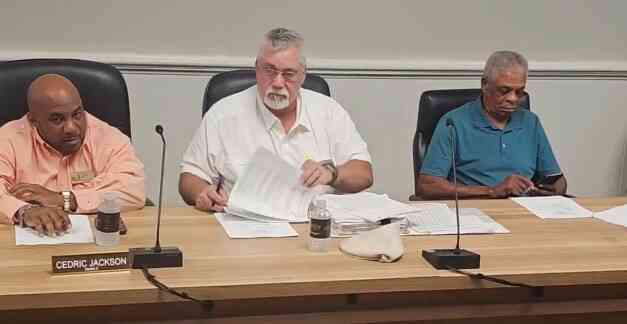
All 13 Jefferson County Quorum Court justices of the peace were present for a special session on Monday, the first time they have all been present at the same time in a long time. The session addressed crucial appropriation ordinances and persistent financial difficulties, especially those related to solid waste management and the FBT bank.
The floor was opened for public comments, where former Justice of the Peace Lloyd Franklin Jr. expressed concerns regarding the county’s financial management, particularly the handling of waste management funds and past appropriations.
According to the appropriation ordinance, County Judge Gerald Robinson is requesting $470,015 from the county general reserve to fund the Solid Waste Contract.
Criticizing the allocation of funds, Franklin questioned Robinson’s past financial decisions. He highlighted the ongoing issues with waste management, noting, “where he’s collected $130,000 and the LRS (Lakeshore Recycling Systems) bill is $155,000 a month.”
“He’s going to be $250,000 behind every year, if you appropriate this half a million dollars,” he said.
Independent reporting for Pine Bluff & Jefferson County since 1879.
As the meeting court moved into new business, Justice of the Peace Rick Victorino raised a concern about the source of the funds, noting that a similar ordinance passed earlier in the year that was intended to come from the emergency reserve, questioning why the source had changed to the general reserve.
Robinson clarified the decision to use the general reserve instead of the emergency reserve. “The reason that we did not want to deal with the emergency reserves, we want to make sure that we use that for a true emergency, whether it be a bridge out or weather, or whatever we do have,” he said. “I do have some upcoming things that I haven’t notified about to DOT, especially some bridge work that we’re going to have to do, so that’s why I do not want to go after the emergency reserve.”
Justice of the Peace Alfred Carroll moved to table the discussion for further clarity. “My concern is that, even with the previous meetings, I was understanding that money to pay FBT bank was coming out of transfers to the road department. Now I’m hearing that we’d like to take the money out of the general reserve,” he said.
During the discussion, there was confusion regarding the purpose of this transfer and its relation to other financial matters, particularly the FBT bank. Robinson reiterated the FBT line item had nothing to do with the Waste Management line item.
He explained the first line item was specifically for the solid waste contract to pay the LRS bill.
The justices of the peace inquired about the current collection rate for LRS compared to the monthly bill. A bookkeeper clarified that while there’s a difference, efforts are underway to increase collections.
Victorino provided specific figures, stating the collection was previously around $125,000 and the current LRS bill is $154,323.
The bookkeeper clarified efforts to increase collections for waste management by providing a second trash can for an additional charge. It was also noted that customers are paying their dues as soon as their trash can is picked up if their bill is past due by $200 or more.
LRS was awarded the contract for residential waste and recycling services in Jefferson County and began providing service in January 2025 after residents complained their trash wasn’t being picked up by their former provider. Customers also refused to pay their trash bill.
The bookkeeper stated that LRS is doing a “much better job” with pick-ups and that they are “turning people over to a collection agency.”
With the waste management bill going two months past due, a motion was made to table the appropriation ordinance, which passed.
The second item was an appropriation ordinance to transfer $445,185 within the road department budget. Robinson indicated this item “is part of what’s going to take care of FBT.”
Last week, Scottie Ray, executive vice president of FBT Bank and Mortgage, attended the meeting and expressed his dismay over the overdue internal transfer of funds needed to pay the FBT lease and lease interest, which has been pending since May 2024.
Robinson called the first of two scheduled quorum court meetings, but it could not proceed because there were not enough members to reach quorum.
Ray detailed the critical financial state, saying, “We’re 126 days late on these leases.” He conveyed the gravity of the situation for the bank: “Tuesday, I have to go to my board and report this … they got to go to the state with this,” he said.
He warned of potential “lawsuits … and repossessions of equipment,” which would severely impact the county’s ability to maintain roads and other essential services. Ray articulated the broader economic implications.
“Why would anybody come here and start a business? We have a railroad, we have water, we have a port, and a major interstate runs through this county. Why would anybody bring any kind of big company here if we can’t even run our county?” he said. “We’re in dangerous territory.”
During Monday’s special-called meeting, all justices of the peace voted to approve the appropriation ordinance, which left Ray satisfied and thanking the justices of the peace afterward.
Also on the agenda was an appropriation ordinance to transfer $12,737 within Meca.
Without further discussion, this item passed unanimously.
In other county business, Robinson vetoed all ordinances passed at the Quorum Court meeting on August 11. This decision was made out of an abundance of caution, he said, due to concerns about the validity of the called meeting.
At the second meeting held on Aug. 11, several appropriation ordinances were put to a vote, largely passing with an 8-0 vote.
One pressing ordinance included an ordinance to create one additional slot and increase various existing slots within the Juvenile Justice Education to align with surrounding school districts. It requested a supplemental appropriation of $217,886 for salaries, FICA, retirement and insurance, with retroactive pay effective January 1, 2025.