
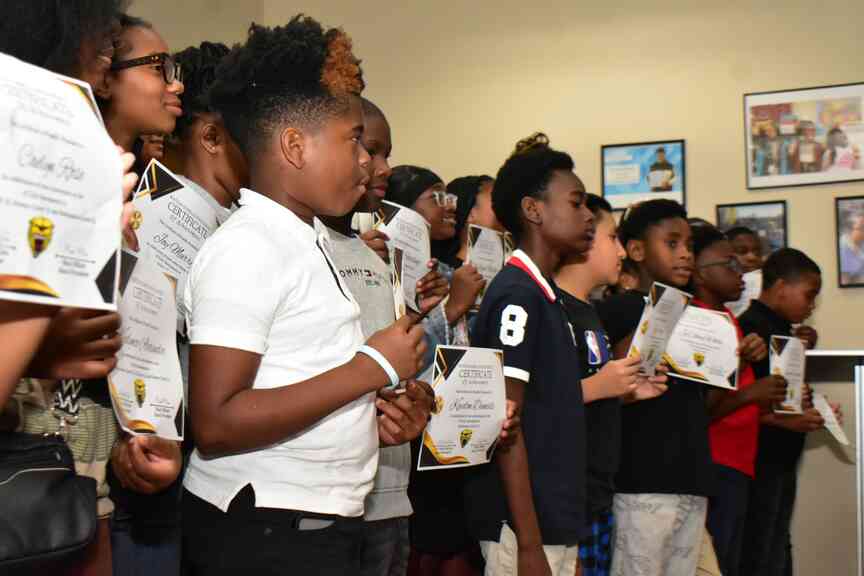
Nearly 200 Watson Chapel School District students were honored for demonstrating either proficient or advanced understanding in the latest Arkansas Teaching, Learning and Assessment System on Tuesday, but district leaders are also facing the issue of low grades issued to each campus based on last April’s ATLAS performance.
In giving a state-of-the-district address, Superintendent Keith McGee reviewed the campus grades on a slideshow — F for Edgewood Elementary (grades K-1) Coleman Elementary (grades 2-5) and Watson Chapel High School (grades 9-12). An appeal to the Arkansas Department of Education was filed for Edgewood and Watson Chapel Junior High (grades 6-8), and McGee said the junior high won the appeal.
According to data from the Education Department released Sept. 19, Coleman was not given a grade, but an appeal was filed for the school.
“We have work to do, people, but we still have good things going in the Watson Chapel School District,” McGee said. “None of us want to see those letter grades with an F. This is not an F board. I’m not an F superintendent. Like I told the staff today, they’re not F principals, F assistant principals or F teachers, students and parents. What we have to do is continue to elevate to make sure everybody is doing their part together.”
Of the 182 students now in grades 4-11 who scored at Level 3 (proficient) or Level 4 (advanced) on the ATLAS, 19 scored Level 4 in math, 17 did the same in science and 22 reached it on English language arts.
Independent reporting for Pine Bluff & Jefferson County since 1879.
McGee further highlighted the growth each campus demonstrated in testing despite the low grades.
He explained Coleman missed earning a D by a narrow margin but grew in the lowest 25% of students in English language arts by 4%; Watson Chapel Junior High grew in achievement in English language arts, math and science by 7%; and Watson Chapel High grew by 3.72% in graduates earning merit and distinction showed growth among the lowest-performing 25% of students in math by 6.31%.
“One thing we’ve really been doing is intentionally is around collaborative team meetings,” said Traci Holland, the district executive director of curriculum and instruction. “Teachers are really collaborating to think about what intentional strategies are we using to engage our students through the HQIM (high-quality instructional material) that we have in place. We’re just trying to connect all of those pieces intentionally, rather than look at the HQIM and following it, but thinking: What do our students need from that HQIM? And how do I need to engage them differently from what that HQIM says, or employ a different strategy from what’s included in the HQIM?”
Assistant Superintendent Aleta Posey said teachers are also considering how to best target instruction for students.
“We’re implementing different interventions that are online-based with Waterford and Thinkverse,” Posey said, naming educational software programs that tutor students. “We’re looking into other avenues and aspects that we can actually use and bring into the learning space to take a hybrid approach to learning.”