
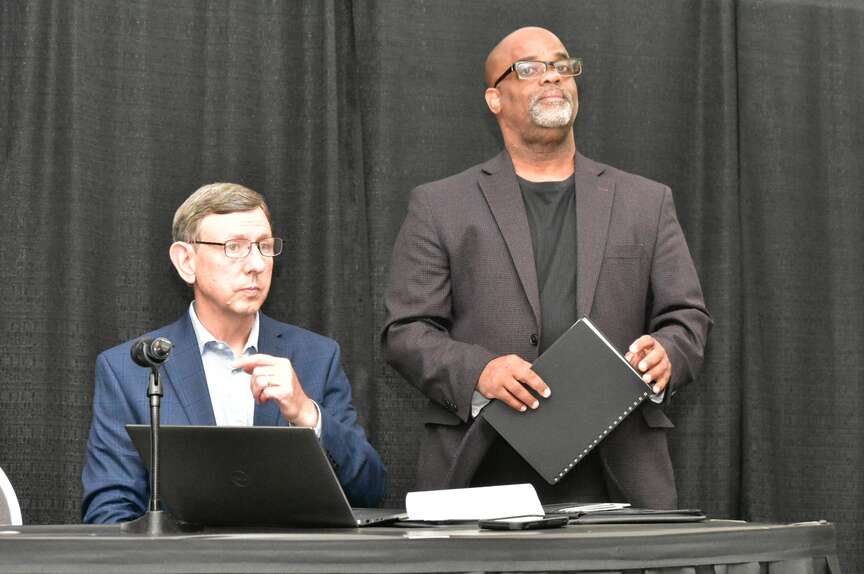
Engineers for a federally funded pilot watershed project supported by the Arkansas Black Mayors Association are asking for residents affected by flooding to send photos and descriptions of the impact by July 28.
Edwin Jones, a Dallas-based engineer, led a community meeting Thursday night at the Pine Bluff Convention Center ballroom. Jones told a small crowd of property owners that engineers plan to finish the planning phase by September in order to get started on a design phase that could last 18 to 24 months.
Residents impacted by flood damage can send any photos and addresses via text to (501) 837-1523 or email either Jones at ejones@ejesinc.com or engineer Philip Massirer at pmassirer@olsson.com by July 28. The ABMA also has a survey available at: https://www.abmawatershedproject.com/projects/city-of-pine-bluff.
Pine Bluff Ward 4 Councilman Steven Mays Sr. pressured Jones for a completion date on the project, and after consulting with legal counsel Karen McCurdy, Jones answered 2030, given the contract from the U.S. Department of Agriculture’s Natural Resources Conservation Service calls for the project to be completed within seven years.
“But that can’t be guaranteed until everything is finalized,” Jones cautioned.
Independent reporting for Pine Bluff & Jefferson County since 1879.
The ABMA in May 2023 announced contracts with a number of engineers to construct or reconstruct watersheds in 14 cities in south and east Arkansas that have historically been impacted by flooding. The Arkansas Black Mayors Association has been assigned to manage the project for the cities, including Pine Bluff and Altheimer. NRCS chief Terry Cosby announced the federal allocation in Pine Bluff in April 2022.
Jones said he and Massirer identified 16 areas within Pine Bluff’s scope with needs for watershed repair. Jones explained each area is prioritized based on the number of homes and structures that sustained flooding, the cost-benefit analysis of each area, and the population of areas where major street flooding has occurred.
“It may only be nine areas that we fix,” Jones said. “But we will select the projects that will have an overall impact for the Pine Bluff watershed.”
Laura Wise, who lives near Atkins Lake just east of Pine Bluff, remains hopeful her neighborhood will receive high priority.
“It’s the only hope I’ve had since I’ve owned my property here for eight years,” Wise said. “The only hope. We get no assistance from the county. The water has to pass through my property to get to the lake and then it goes to the river, but beaver dams, railroad tracks, people who don’t maintain their property, and the county does not maintain our ditches. They don’t really ask the farmers to get permits before they raise the levels of the land, too, for their farming.”
District 65 state Rep. Vivian Flowers, a candidate for mayor of Pine Bluff, urged residents to send any photos of flood damage and addresses to the engineers, taking on a more supportive tone than the disagreement with ABMA officials she aired last year as to the local impatience for planning and whether the funds were being handled locally or federally.
“I think the difference between this year and last year is that it hadn’t been decided yet,” Flowers said. “I thought there was some putting the cart before the horse because, just like tonight, people came out wanting to know when these streets and ditches and the flooding are going to be fixed. And I think it’s very important people tonight understand that, once the planning is over, construction will start next year.”
Another meeting was held Thursday at Mt. Zion Missionary Baptist Church in Altheimer. Mayor Zola Hudson reported a “very good turnout” of at least 20 citizens, including council members and farmers from the nearby Gethsemane community, who received reports from engineer Kelley Eubanks of Fort Worth, Texas.
“They covered a model of what it would look like when it begins to start raining,” Hudson said. “They also gave a recommendation for things we could use for flooding.”
Among those recommendations, Hudson recalled, are cleaning out ditches, weatherproofing homes, having a storm shelter and having a place to store the water to release it to farmers for irrigation.