
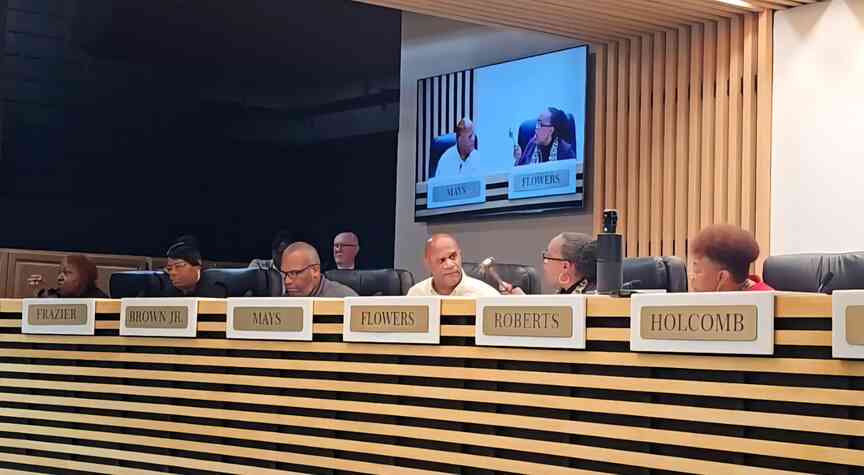
A resolution to authorize a contract with a new waste management company, CARDS, was pulled from consideration during Monday’s special city council meeting, following intense debate among council members and Mayor Vivian Flowers regarding the procurement process, potential litigation and long-standing concerns about waste services.
The decision to table the resolution came after lengthy discussions revealing deep divisions and a desire for more information and negotiation.
During Thursday’s special-called city council meeting, council members voted against entering into a contract with CARDS. Voting in favor of the resolution were Glen Brown Jr. and Yvonne Denton. Steven Mays Sr., Lloyd Holcomb Jr., Bruce Lockett, and William Fells III voted against the resolution. LaTisha Brunson abstained, resulting in an automatic “no” vote. Lanette Frazier, who was present via Zoom, could not vote due to new protocols that require council members to vote in person.
Flowers said the city initiated a competitive bidding process to address long-standing problems with its current provider, Waste Management, and establish new standards for service and accountability, noting the previous contract was 35 years old and had never undergone a competitive review.
The request for proposal outlined specific requirements, including new containers and trucks no older than four years, standardized brush and bulk collection times, a consolidated billing process through the water company and a 4% cap on annual consumer price index increases. A critical provision in the proposal was a 24-hour resolution period for complaints, expecting efficiency with newer equipment and routes.
Independent reporting for Pine Bluff & Jefferson County since 1879.
Flowers highlighted that WM submitted “five pages of exceptions” to the proposal, in contrast to other bidders who had “no exceptions” or only a few minor ones. These exceptions included proposals to keep old containers and trucks, a desire to bill on their own rather than through a consolidated water bill and an offered 8% increase in consumer price index, double the desired cap.
Most notably, WM requested up to 15 business days to rectify problems, a significant deviation from the city’s desired 24-hour resolution period. Flowers also pointed out that WM’s alternative proposal, despite offering a lower rate, lacked the “protections of the fines that would be in place if there was any breach of contract.”
CARDS, on the other hand, proposed “brand new trucks, brand new service equipment, brand new commercial containers and brand new residential carts,” aligning with the proposal’s requirements. While its initial proposal was higher at $19.39 per household compared to WM’s alternate bid of $15.85, CARDS argued that WM’s bid was not an “apples to apples” comparison given their exceptions.
The special session on Monday, convened to address the contentious waste management contract with CARDS, quickly devolved into a passionate exchange. Frazier and Mays vocally expressed their apprehension about moving forward with CARDS, citing concerns about employee treatment, past lawsuits and a general distrust of the company’s long-term intentions. Frazier specifically referenced research she had conducted and information shared with the mayor’s chief of staff, which she felt was not adequately considered by the full council. She emphasized the importance of not moving “from bad to worse” for the citizens of Pine Bluff.
Flowers, visibly frustrated at times, defended the integrity of the procurement process, which involved hiring a consulting firm (SW) for over $44,000 to manage the competitive bidding. She stressed that the process was designed to ensure accountability and to move away from what she described as a “monopoly” that had existed for nearly 40 years.
Flowers argued that rejecting the top-ranked bidder, CARDS, without a justifiable reason would open the city to litigation and negate the investment made in the procurement process. She also highlighted that if CARDS was not selected, the city would not be reimbursed for the consulting fees, as per the agreement.
The city attorney, Althea Scott, provided clarification on the legal implications of the council’s options. She confirmed that while the council could reject all bids and restart the process, it would likely lead to delays and potential litigation, as it would appear to be a decision based on preference rather than a justifiable rejection of the bid. She also stated that if CARDS was not selected, the city would then need to evaluate the second- and third-ranked companies (GFL and Waste Management, respectively) in a similar rigorous manner.
A pivotal moment came with the testimony of Larry Matthews, a long-serving public works director for the city of Pine Bluff. He unequivocally stated that once a request for qualifications is issued, the city is obligated to follow the established procurement process. He asserted that by law, the city should negotiate with the highest-graded person and only move to the next if a contract cannot be made for a “justifiable reason,” not simply a dislike of the company. Matthews highlighted the danger of compromising future procurement processes should the city arbitrarily disqualify a qualified bidder.
The discussion also touched upon the possibility of negotiating additional terms with CARDS, particularly concerning the treatment of current employees, a key concern raised by Frazier and by Brunson in a previous meeting.
Scott confirmed that such negotiations could be pursued if there were additional, previously unaddressed concerns.
Ultimately, Flowers decided to pull the resolution to allow for further engagement and to address the concerns raised by council members. Lockett and Brunson were also absent and Flowers wanted to make sure all council members were included in the vote. She committed to arranging meetings as early as Wednesday to discuss the specific issues outlined, particularly regarding assurances for current employees, with the aim of incorporating them into the contract.
Flowers said this move aims to prevent further potential litigation and ensure the final contract aligns with the best interests of the city and its citizens. The trash service issue, however, remains a highly charged topic that continues to divide the city council.