
Budget talks surrounding the city’s Urban Renewal Agency turned contentious last week as city officials grappled with a multi-million-dollar funding shortfall for the long-awaited go-kart track and other key projects. While the agency Director Chandra Griffin inquired about a transfer of an $860,000 construction allocation, Pine Bluff Mayor Vivian Flowers spoke on the restructuring of the agency to identify existing reserve funds and address a “problematic” operational budget.
The meeting focused on the immediate need for funds to pay outstanding contractor invoices for the track, a project requiring $1.4 million for completion, with $1.2 million expected to be provided by a private partner.
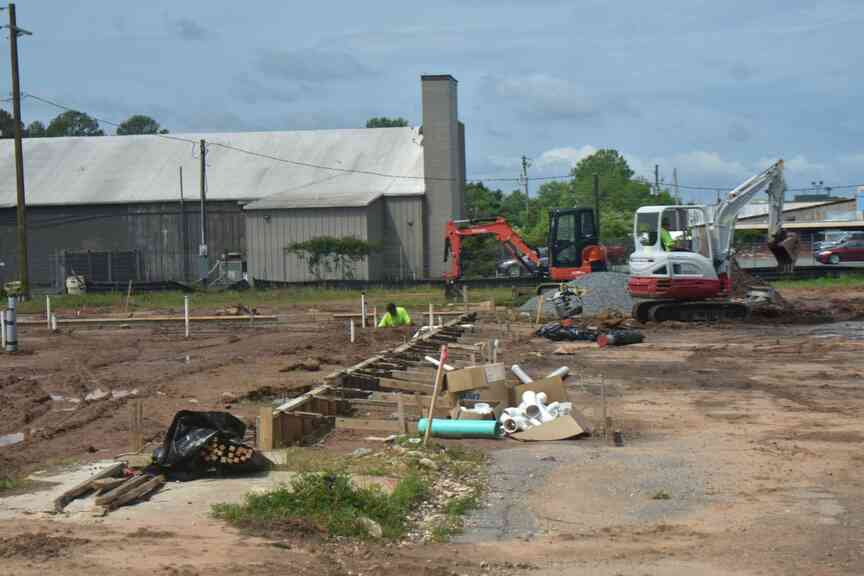
Griffin confirmed that construction is stalled, with a general contractor on site threatening to walk off the job due to a lack of payment. The agency currently has two outstanding invoices totaling approximately $332,487.
According to Griffin, the financial crisis stems from an $860,000 allocation from the 2017 sales tax fund that was approved via a 2024 budget amendment but was never transferred. “It was not moved,” she stated, leading to the current line-item deficit.
This failure led to the construction fund being left “short” and unable to cover the costs.
Independent reporting for Pine Bluff & Jefferson County since 1879.
The agency was unable to pay outstanding invoices for construction, and the general contractor on site threatened to “pull off the site” due to non-payment, according to Griffin.
According to Flowers, a plan was presented that included a compromise with Chairman Jimmy Dill to dissolve the Urban Renewal Agency on Dec. 31st and move the director’s position to Economic Development. This restructuring is projected to save the city more than $100,000 annually by eliminating line-item expenses for things like sanitation, building maintenance and telephone contracts.
The mayor’s proposed compromise regarding the dissolution of the Urban Renewal Agency and the effective date is that the city would move the director’s position (including salary and fringe benefits) to the Economic Development department.
The director would continue to manage Simmons Bank Park, assist the city with a nonprofit and start a land bank. The compromise with Dill was to wait to dissolve the agency until the go-kart track project is complete and to successfully formulate the funds — the $860,000 and the $1.2 million private commitment — to cover the remaining construction and operation costs.
The dissolution would take effect on Dec. 31. However, this date was conditional, as Flowers noted they were waiting to finalize how the funding would be formulated to ensure construction completion and ongoing operation.
Furthermore, Flowers questioned the agency’s financial management after an inquiry revealed that the agency’s bank account holds an untapped reserve of $789,746, despite the low balance in the construction line item.
The amount of money reported as being in the Urban Renewal Agency’s bank account, based on access by Gina Devers, Pine Bluff’s finance director, was $789,746.
The reason this money was not being used for the outstanding invoices is that it was being held in a reserve account/fund and not in the specific line item designated for the construction project.
According to Flowers, the construction line item had a critically low balance of around $14,000. She suggested that a resolution would be required to transfer the money out of the reserve fund and into the proper line item before it could be spent to pay the outstanding invoices.
Flowers argued that a resolution should be passed to transfer this substantial reserve fund, along with the untransferred $860,000 from the 2017 sales tax fund, to ensure the go-kart track is completed and to protect the city’s contractual obligation regarding the adjacent Simmons Bank Park.
Flowers also highlighted the problematic operational budget for Simmons Bank Park (“Sixth in Main”), which is budgeted for $301,000 per year but currently generates only about $4,500 per month in revenue (approximately $54,000 annually). The proposed dissolution and transfer of the director position is intended to mitigate this operational deficit.
According to Flowers, the city’s contractual obligation related to the Simmons Bank Park project and the potential consequence of failure are based on the receipt of $2 million from Simmons to complete Simmons Bank Park and operate it according to how it was intended.
If the city fails to operate Simmons Bank Park as promised, Simmons could take back the part of Simmons Bank Park that it contributed and select another entity to manage it, according to Flowers.
Griffin explicitly stated that the meeting was the first time she’d heard of a remaining balance in the bank account and indicated she was unaware of the amount of cash the agency currently held.
She expressed confusion about the goal of the budget meeting, saying, “I’m not sure what the purpose of this meeting being that there’s no funding.”
She noted that the contractor for the go-kart track was not contracted until October of last year, which was after the agency stopped receiving tax dollars, and questioned the lack of “real conversation regarding how the project would move forward.
Ultimately, the committee chair stated that given the confusion and conflicting information, more discussions are needed before moving forward. The meeting concluded with no immediate resolution to pay the outstanding contractor invoices.
The Pine Bluff City Council will hold a special-called meeting on Monday to address several major initiatives, including the final readings of three proposed ordinances and the adoption of the 2026 city budget.
One of the most significant actions will be the reading of two related ordinances concerning a new city sales tax. A proposed ordinance was presented last month that provides for the levy of a new one percent sales and use tax within the city of Pine Bluff, Arkansas for a period of 10 years. The tax is intended to fund general purposes of city government, and if approved, would be levied from July 1, 2026, through June 30, 2036.
The City Council will also vote on an ordinance calling a special election to be held on Mar. 3, 2026, for electors to vote on the proposed sales and use tax. The ballot question will ask voters to choose ‘FOR’ or ‘AGAINST’ the adoption of the 1% local sales and use tax. Accountability measures include a provision for a biennial forensic audit of the tax expenditures, which will be filed with the city clerk and posted on the city’s website.
In another key vote, the council will address a proposed ordinance abolishing the Urban Renewal Agency. The ordinance would dissolve the agency’s board of commissioners and transfer all of the agency’s assets and liabilities to the city of Pine Bluff.
The stated intent behind the move is to concentrate urban renewal and revitalization efforts within the city’s administrative framework and to eliminate unnecessary duplication of services, which the city believes can be distributed among existing departments. Under the new structure, the current activities, programs, and projects of the agency will come under the administration and direction of the mayor, with oversight by the City Council.