
This is the second of a two-part series.
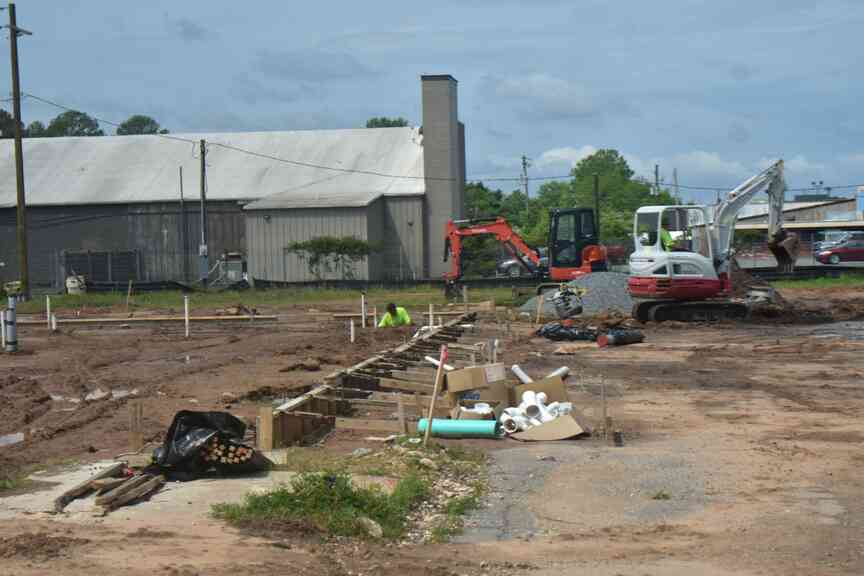
The go-kart track project by Go Forward Pine Bluff is encountering unexpected underground issues.
“We ran into them digging and undercutting the site in preparation for the track,” said Go Forward Pine Bluff CEO Ryan Watley. “They’ve identified a couple of gas lines that were not on the plans. … And so that’s a change order on the pricing rate.”
At a recent City Council meeting, Watley specifically pointed out the financial adjustments needed for the go-kart track, noting, “As of today, we are $32,000 in change orders regarding the go-kart track.” He further explained that these additional costs “dip into what we would think to have for operating capital,” emphasizing the importance of ensuring adequate funding for operational dollars as these projects begin to open.
“Once we get the ground settled … then we should be able to pack the ground and the building should be able to be erected,” said Watley. He said that, despite significant delays with the project, Big Banjo Pizza is still committed to being the vendor. Watley anticipated a potential delay of one to two months, pushing the completion into the next year.
Independent reporting for Pine Bluff & Jefferson County since 1879.
Watley also discussed the downtown buildings purchased by Urban Renewal, which have since been transferred to the city’s community development. “Those buildings have been transferred to the city’s community development. They have had those for at least six months, at least,” he clarified. He noted that while the city has a plan for the buildings, he’s unsure of their current status.
“Several downtown buildings, the Crown Motel, and the old bus station are managed by Urban Renewal, which has funding for another eight months,” said Flowers. “Ultimately, these properties will become city property. So either way, the city is responsible for the growth and determining what that structure looks like, and then what those partnerships look like.”
Regarding the Crown Motel, Watley pointed out that while it still needs to be demolished, the negative activities around it have ceased. He acknowledged ongoing issues with people trying to break in, necessitating the securing of the property.
Watley emphasized that for many projects, particularly the old bus station and others, financing is a complex mix.
“It’s going to take some public finances, some private financing, some foundational financing, some philanthropic financing to pull it all together,” he said. He expressed doubt about it being solely a privatized deal.
The old bus station and Crown Motel were part of the downtown housing vision that has run into issues when it comes to investors securing funding.
The holdup for the Sixth Avenue and Georgia Street housing project, according to Watley, is that the developer is “still working to secure the other component of the financing.”
“They have secured some funding but need to finalize the remaining financing,” he said.
“There is still investor interest in downtown housing on Sixth (Avenue),” said Flowers.
Flowers mentioned “the city was squarely focused on economic development as a public safety initiative, and they focused a lot over the time span of how they built out their (Group Violence Intervention) program, looking at mitigating blight.” She also stressed that housing is important to begin with.
“We’re definitely looking toward that as the strategy for developing and growing our downtown,” she said.
Though train noise was a concern for the previous administration, Flowers said there are more important avenues to discuss. The possibility of creating a quiet zone to address train noise concerns was acknowledged, however.
“As we grow and develop, and if it becomes something that we need to look at, we can go back and grab that data,” said Flowers.
However, she expressed concern about safety issues that may arise.
Without the audible warning of train horns, Flowers believed people might be less aware of approaching trains, potentially leading to accidents or incidents at crossings.
The movie theater initiative faces significant challenges due to the changing industry landscape and does not look promising moving forward into the future for Pine Bluff.
“Post-covid, that industry has been turned upside down and inside out … Someone would have to come in and build that and get their return, and at the rate at which movies are coming to the theaters is a very difficult proposition,” said Watley.
He stressed the need for a group that “believes in our market” and understands the costs and collateral involved.
Watley also discussed the importance of entities like The Generator for economic development and small business support. “Anything it is talking about, economic development, small business development, it’s critical to this community,” he said. He highlighted The Generator’s role in helping aspiring entrepreneurs with no prior business experience.
“I support what they’re doing and I think as we grow the city and do our best to use the funds that we have for the development of the city, you know, I see that as a possible strong public-private partnership,” Flowers said of The Generator.
Overall, Pine Bluff is working to advance multiple development projects, navigating various challenges along the way and requiring a mix of public and private investment. Flowers remains optimistic about the completion of the projects, stating they will be crucial to the community’s economic growth and quality of life.
Offering more insight into the city’s vision for the future, Flowers said the city plans to develop a land bank to offer incentives for downtown development. “We can definitely do things like that. I think we can do it as a program, especially for downtown,” she said.
She also sees Lake Saracen as an opportunity for development, connecting downtown to the University of Arkansas at Pine Bluff. Flowers is “looking forward to some of those plans coming to fruition.”
One such project is the Opportunity House, set to expand to 24/7 operations with the city’s support. “What we are setting out to do is provide funding up to $400,000 this year and next year to supplement any grant funding that they receive,” Flowers explained. Ongoing support includes utilities and groundskeeping.
“We’re really excited,” Flowers added. “They’re doing a great job of the resources they have now, and what we’re trying to do is provide the seed money to help them stand up the 24-hour model.”
She also gave praise to Jimmy Cunningham Jr., the Delta Rhythm and Bayous director. “The downtown Delta Rhythm and Bayous District project is progressing well,” Flowers shared. “That is moving along swimmingly.”
The city is considering options for the former Pines mall, including code enforcement and condemnation if necessary. Flowers said she believes the mall is owned by the same people who owned it when it closed in 2020.
According to an online search of real property in Jefferson County, the 38-acre Pines complex at 2901 Pines Mall Drive is still owned by James, Thuytien and John Vu. The mall is largely empty and in disrepair. Reports of it being breached and sometimes people living there have surfaced and came to a head when a fire was started inside the structure in early 2022, the cause of which was blamed on homeless people.
If the property is condemned and demolished, the cost would attached to the current owners. The city, however, wants to see investors come in and develop the area.
“Despite the current state, there is potential for redevelopment,” said Flowers, adding discussions about the possibility of repurposing the mall into other facilities like health centers or distribution centers are ongoing. The proximity to the airport is mentioned as a potential asset for distribution.
The city envisions more businesses popping up due to the Saracen Casino Resort, which is well on its way to building a hotel and event center.
A previous attempt by someone to purchase the mall did not go through, according to Flowers.
Flowers notes she wants to bring investors to build up the area due to the casino development. She said the Dillard’s Clearance Center is seen as a positive aspect, attracting customers from other states and generating activity in the area. “It is seen as an anchor that could draw more businesses,” said Flowers.
The key for all projects, however, will be funding. The city lent $3 million to the Convention Center and Hotel Public Facilities Board to cover expenses toward breaking ground and securing the necessary funds for the Convention Center hotel project up to their opening. That came after the city put in $3 million in tax dollars toward the hotel project.
The previous administration committed $100,000 to Opportunity House, a commitment which is ending in April. Flowers’ administration plans to provide up to $400,000 this year and next year to supplement any grant funding that Opportunity House receives. Started by Mayor Shirley Washington, the facility was advertised as a homeless shelter, but because the promised funding never materialized, Opportunity House has functioned as a part-time day room.
Urban Renewal currently has funding for another eight months, which includes the cost of maintenance for projects, salaries, utilities and insurance for two years.
By early 2027, it is expected the city will pick up the maintenance costs for Urban Renewal projects.
Any extra revenues received by Urban Renewal may be directed elsewhere if the agency has all the necessary funds. One option being discussed is renovating the Harbor Oaks facility.
Flowers said the city needs to keep a vigilant watch on what happens with federal grants. As the Trump Administration continues to severely cut back a number of federal departments, concern has arisen for losing federal dollars, as seen with a hold or suspension on funds for the Natural Resources Conservation Service-backed watershed projects across Arkansas. Despite potential federal funding changes, the city currently has enough funds to sustain its economy and pay its bills.
“The city is focused on creating a mechanism to attract more money and generate investment for economic growth,” said Flowers. “The city is also looking at ways to address its debt and build reserves to withstand political and economic challenges.”
According to Flowers, the city is looking for both public and private partnerships to fund and develop various projects.
Pine Bluff is actively pursuing numerous development projects, each with its own set of advancements and obstacles. From the Convention Center hotel’s anticipated 2026 completion to the challenges with internet installation at Sixth and Main, and the underground issues at the go-kart track, the city is navigating a complex landscape of funding, infrastructure and changing industry dynamics.
Despite these hurdles, city officials indicate they remain committed to attracting investment, fostering public-private partnerships, and ultimately enhancing Pine Bluff’s economic growth and quality of life through strategic development initiatives.