
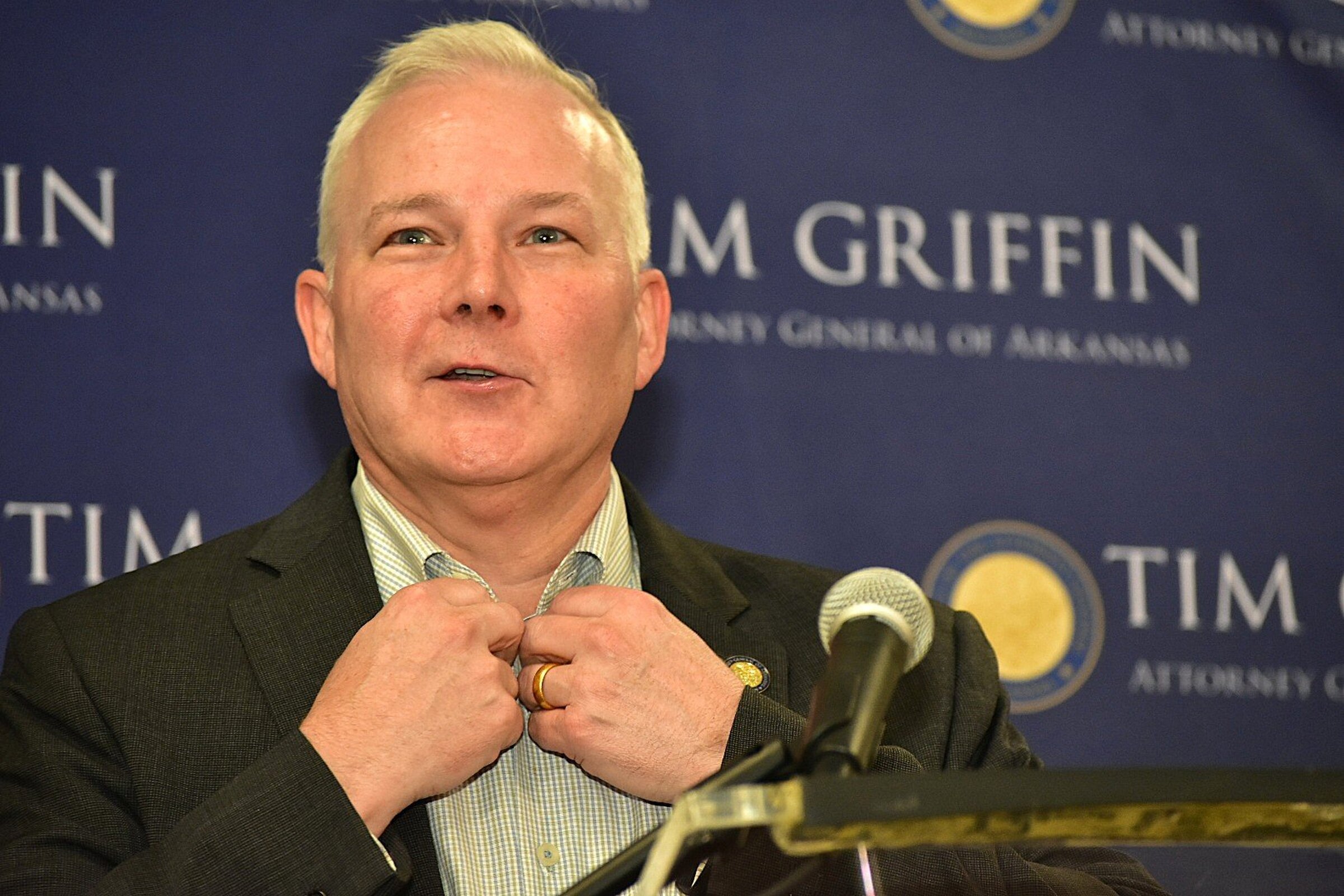
The University of Arkansas at Pine Bluff became the third higher education institution to join Arkansas Attorney General Tim Griffin’s One Pill Can Kill initiative.
Griffin on Tuesday announced the movement to stop fentanyl and opioid abuse in college communities and beyond at UAPB’s STEM Conference Center. The university’s Counseling and Student
Wellness center co-sponsored the presentation with Griffin’s office.
One Pill Can Kill was also introduced at UAPB’s sister campuses in Fayetteville and Little Rock, part of Griffin’s mission to relay the message of stopping opioid abuse at all colleges and universities in the state. The initiative attacks fentanyl and opioid abuse in three areas, according to Griffin: prevention, treatment or recovery after addiction, and law enforcement.
“This country went through a really, really, horrible period where prescription opioids — prescription opioids — were killing Americans all over the country,” Griffin said. “Over-prescribed, people who were addicted, a lack of education in some quarters … and people still struggle with prescription drug opioids. They play a role in medicine, but they are very addictive and they are very dangerous.”
Independent reporting for Pine Bluff & Jefferson County since 1879.
Griffin shared the story of his brother’s death from opioid addiction in March. His brother had a back surgery that went “terribly, terribly wrong,” Griffin said, and left him in excruciating pain, which led him to turn to opioids.
While the U.S. has done a better job of understanding the problem with opioid abuse, Griffin remarked, the pills that were
once easy to get became harder to get.
“Criminals have filled that void with illicit opioids,” Griffin said. “They’re not manufactured in a clean plant where prescription drugs are manufactured. They’re not necessarily what they look like. They’re not necessarily what the label says. They’re illicit. They’re made wherever by whomever with whatever, and you have no idea what’s in it.”
One feature of the initiative Griffin mentioned was using “force multipliers,” a term he took from his service in the Army to explain how campus leaders are trained in prevention and how to spread the message of avoiding use of any illicit pills of opioids.
Students were invited to training on Narcan usage and what to look for in signs of opioid overdose. Narcan is a brand name for naloxone and is used to administer to those who have overdosed on opioids.
Answering a question from UAPB political science teacher Henry Brooks, Griffin said fentanyl, a synthetic opioid said to be 50 to 100 times more potent than morphine, is being mixed with marijuana.
“I ask that because around the country, there’s a lot of marijuana use,” Brooks said. “I don’t think students see that as a problem.”
Leonardo Glover, director of counseling and student wellness at UAPB, said the campus is well equipped to handle cases of opioid abuse.
“We pray that no one is dabbling in any of that, but if you do, just know that we have resources here for you guys,” he said.
The Arkansas Department of Human Services, citing data from the Centers for Disease Control and Prevention, reported Arkansas in 2022 had the second-highest opioid prescription rate in the U.S. with 72.2 per 100 persons, second only to Alabama (74.5). It was reported the national rate in 2022 was 46.8.
Arkansas reported 306 opioid overdose deaths between December 2022 and December 2023, a 13.8% decrease from the year before, according to data from the Arkansas Department of Health.
Griffin’s predecessor, current Lt. Gov. Leslie Rutledge, announced in December 2022 the AG’s office would transfer $140 million in opioid settlement funds to the state’s general revenue. Rutledge told the Arkansas Democrat-Gazette at the time the office secured about $430 million in opioid settlements, and Griffin said $140 million shares of that amount has been allocated to counties and cities.
Griffin said he had not seen any data broken into counties or regions of Arkansas, but his office is funding treatment centers across the state.
“One in particular we funded in south Arkansas is in El Dorado, and a lot of the facilities are in bigger towns,” Griffin said. “They draw from around, so there’s no question that’s having an impact on Southeast Arkansas, but we’re funding this sort of thing all over the state, and our mobile clinic, which is going all around the state including south Arkansas.”
Griffin said he’s heard from treatment centers that patients could not receive treatment without the funds his office has given.
The One Pill Can Kill initiative is not one of the big-ticket items funded by the settlement dollars, Griffin added, but he said his office has committed $50 million to Arkansas Children’s Hospital to build a National Center for Opioid Research.
“There’s no place like it in the country or the world, that I know of,” Griffin said. “We have established that and they have already started construction on that.”