
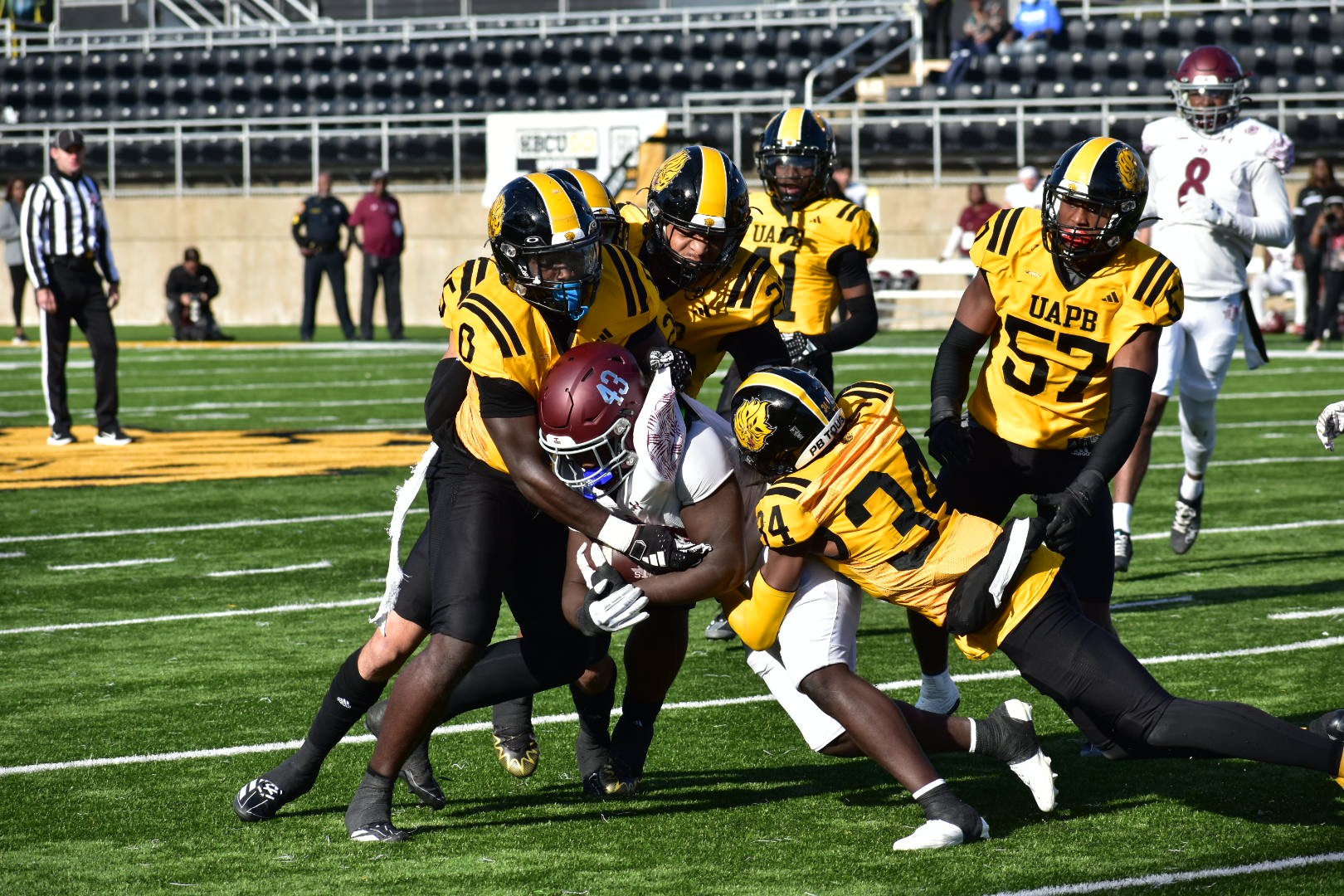
The University of Arkansas at Pine Bluff football team has been penalized for a substandard Academic Progress Rate, the NCAA announced Tuesday.
UAPB will be ineligible for postseason play in 2025 and will face a level one reduction in practice time, according to the NCAA’s APR Database. These penalties apply only to the football program.
According to the NCAA website, a level one penalty entails a reduction in athletic activities from 20 hours per week over six days to 16 hours per week over five days. The extra four hours are to be replaced with academic activities.
UAPB athletic director Chris Robinson told The Commercial difficulties faced during the covid-19 pandemic and with the NCAA’s introduction of the transfer portal led to some down years in APR, and some good pre-pandemic years have fazed out of the rolling four-year total by which the NCAA judges schools.
“The compilation of these past four years, I think one year in particular really got us,” Robinson said. “It was a year we came back, I think we had an 896, if I’m not mistaken. But with covid, the transfer portal, that year factored into this time period and really had a detrimental effect on us.”
Independent reporting for Pine Bluff & Jefferson County since 1879.
The NCAA requires teams to maintain a four-year APR score of 930 or greater to avoid penalties. The highest possible score is 1,000.
Multi-year APR scores for the 2023-24 academic year were released Tuesday. The UAPB football team had a score of 914, marking the third straight year the Golden Lions have been below the 930 benchmark. They had a four-year APR of 921 last year and 923 the year prior. The team was at 931 in the 2020-21 year.
This is the first year since the 2018-19 academic year the NCAA has enforced its APR eligibility requirements after waiving them during the covid-19 pandemic. APR scores were not publicly reported in 2019-20. The NCAA has released them each year since but elected to not enforce the penalties again until this year.
Robinson said the introduction of the transfer portal forced every school to adjust to a new landscape. He cited players transferring in or out having trouble getting their college credits to transfer with them from one school to another, leading to eligibility issues.
He said UAPB has learned from the experiences of the past few years and has fortified its compliance and academic staff to work on correcting the situation.
“We have a very strong compliance officer and a compliance coordinator that are doing some great things there and educating, communicating to all of our athletic department,” Robinson said. “We have an academic coordinator. He has an assistant academic advisor. I think there are four people in that area now, and I think that’s the most we’ve had since I’ve been aware. I think we’re at four now that are working directly with the kids, and they’re communicating to the coaches.”
The UAPB men’s basketball program’s latest four-year APR was 924, also below the benchmark, but that team did not receive any penalties after having a score of 943 a year ago. Robinson said UAPB has already taken steps to address that score and ensure that program doesn’t receive future penalties.
According to the NCAA, APR is calculated by awarding each player receiving athletically related financial aid within a program one point for being academically eligible to compete and one point for remaining in school. A team’s total points are then divided by the total number of possible points and multiplied by 1,000.
Because one of the contributing factors to APR is student-athletes remaining enrolled in school, Robinson said players who enter the transfer portal but don’t end up signing with another school can count against UAPB’s score.
“You’ll find that a lot of kids are still within that portal, and they don’t get out,” Robinson said. “Those things are detrimental to smaller programs like ours. I think as we went through the process, we learned more and was able to adjust and put some measures in place. Now, we’re helping students to go to the school of their choice, if they so choose to do that.”
Robinson said larger schools, such as those in the SEC, aren’t affected by this as much, because those outgoing transfers are usually given opportunities elsewhere simply because of what school they are leaving. Transfers from smaller programs such as UAPB, he said, don’t always get those same opportunities unless they particularly stand out on the field.
Two other SWAC football programs received APR penalties. Florida A&M received the same practice reduction as UAPB but remained eligible for postseason play. Mississippi Valley State was ruled ineligible for the postseason and received the harsher level two practice reduction penalty, which applies both in and out of season. FAMU’s APR is 911, while MVSU’s is 904.
In other sports, the MVSU men’s track program received the same harsh penalties as its football team. Jackson State women’s cross country received a level one practice reduction while remaining postseason eligible.
The Golden Lions finished 3-9 last year with a 2-6 SWAC record. UAPB begins the 2025 football season on Aug. 30 at Texas Tech.