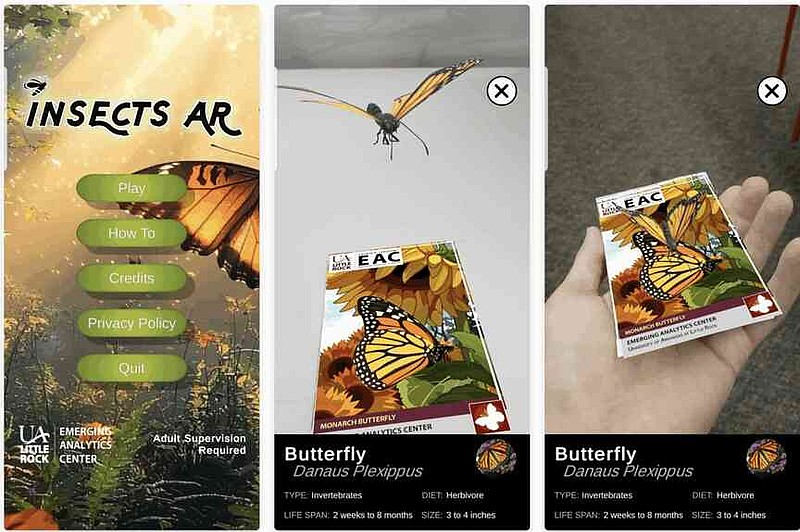
A University of Arkansas at Little Rock student from Pine Bluff is transforming the way people learn about the insect world through technology with the launch of a new mobile app, Insects AR, now available on the Google Play Store.
The innovative app, developed by James Dempsey, a senior computer science major, uses augmented reality to bring detailed, interactive 3D models of insects to life on a phone or tablet. Through the app, users can explore how insects move and what they sound like, as well as learn about their habitats, diets and lifespans, according to a news release.
“The app detects image targets and creates a 3D representation of the insect on that target, placing it into real space,” Dempsey explained. “Once the insect appears, it’s animated and makes noise. You can interact with it — make it fly, show its wings or crawl — and you’ll also see facts about the insect, including its scientific and common names. It’s all available on your handheld device.”
The concept behind Insects AR started years ago as a creative marketing idea for a pest control company that wanted animated business cards displaying virtual insects. Years after UALR’s Emerging Analytics Center brought that idea to life, the concept resurfaced in a team meeting, during which Dempsey agreed to revive it in a new, educational form.
“The idea didn’t just get lost to time,” Dempsey said. “It got brought into the future.”
Independent reporting for Pine Bluff & Jefferson County since 1879.
Working alongside another student programmer and a creative team led by lead artist Jason Zac, who designed the art, animation and sound, Dempsey spent months building and refining the project. The additional students who worked on the app include William Andrew Nickols, Dalen Villa, Cecily Mobley and James McMath. The result is an app that blends technology and science education in an engaging, user-friendly way.
“When we start a project like this, we begin with brainstorming and storyboarding, then assign tasks across the art and development teams,” said Tom Coffin, operations manager at the EAC. “Projects like Insects AR give students experience with industry-standard tools like Photoshop, Illustrator, and Autodesk 3ds Max, while also introducing them to cutting-edge areas like computer vision, real-time rendering, and even AI integration. These skills are directly applicable to careers in software development, game design, and beyond.”
For Dempsey, Insects AR was more than a portfolio piece. It was a chance to dive deep into emerging technologies and gain valuable experience in mobile development.
“I learned how to develop mobile applications, how to use Unity, how to work with augmented reality and how to apply computer vision for spawning digital models,” he said.
Users simply point their device at special image targets available on the EAC website or on handy cards. The app then projects an animated, lifelike insect model, which can be viewed from different angles, into the real world.
The project also represents Dempsey’s broader interests in technology and its applications. After graduation, he plans to work in the tech industry in Little Rock for a few years before pursuing a master’s degree, with a growing interest in social computing and data analysis.
The Insects AR project is part of the EAC’s expanding portfolio of augmented and virtual reality applications, which include research into AI-driven virtual environments, interactive simulations, and immersive educational tools.
Coffin said projects like Insects AR show how UA Little Rock students are helping shape the future of interactive technology.
“This project highlights the power of hands-on learning and collaboration,” he said. “Our students are learning theory while building tools that have real-world applications.
“We’re proud of James and the work our student team has done,” Coffin said. “This app is a perfect example of how UA Little Rock students are using technology to make science more engaging and accessible.”
Insects AR is available now for Android devices on the Google Play Store, and work is underway to bring it to the Apple App Store in the near future. Users can access the required image targets directly from the Emerging Analytics Center website to start exploring the insect world in augmented reality.