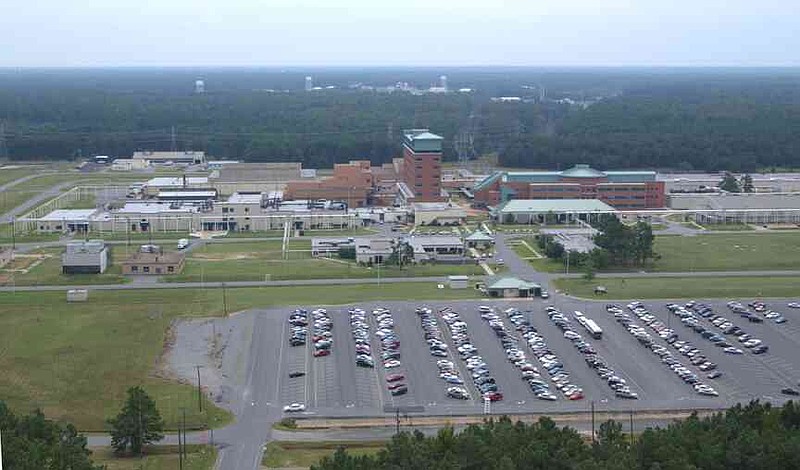
About 75 employees at the National Center for Toxicological Research have been terminated as part of the Trump Administration’s efforts to trim the federal labor force.
The move was confirmed by Bryan J. Barnhouse, head of the Arkansas Research Alliance, a public-private partnership that helps manage the relationship between NCTR and the state of Arkansas.
The cuts were first reported by Arkansas Business.
Rumors of personnel cutbacks at NCTR, located at Jefferson, between Pine Bluff and Little Rock, were circulating on Wednesday, the day after the reductions were announced at the federal level. Calls to the facility were not answered, nor were calls and emails to the offices of U.S. Sens. Tom Cotton and John Boozman and to Congressman Bruce Westerman, whose 4th Congressional District includes the facility.
“NCTR had 285 government employees as of January,” Barnhouse said. “About 75 of them are now gone.”
Independent reporting for Pine Bluff & Jefferson County since 1879.
He said the cuts come from four different areas, including 17 probationary staffers and 22 deferred terminations as well as seven who voluntarily separated and 28 who lost their jobs through a reduction in force move.
Asked how he was made aware of the cuts, Barnhouse said the ARA has worked closely with NCTR for many years.
“It’s my job to know,” he said. “We’re all tightly connected. I have it on good authority that those are the facts. We are in a day-to-day grind with them and locked at the hip.”
The cuts have come down from the U.S. Health and Human Services Department, whose secretary, Robert Kennedy Jr., is trimming another 10,000 jobs across several HHS departments, including the Food and Drug Administration, which oversees NCTR. The move is being referred to as an effort to “make America healthy again,” although critics have said the cutbacks will have the reverse effect.
Barnhouse said more reductions, either to personnel or to the research facility’s budget, were expected, given that HHS is cutting $650 million from budgets across all of its departments. Those contract cuts, he said, will “trickle down to NCTR.”
“They have a $77 million budget, and $52 million of that is payroll,” he said. “That leaves $27 million for everything else, and now they have to cut another $12.7 million out of that $27 million — and still pay severance. There’s no magic pool of money to cover that.”
NCTR conducts science experiments, the results of which are given to the FDA, which can then make informed decisions about such things as toxic chemicals in the environment.
Barnhouse said he worries that, because of the staff reductions, ongoing experiments will be dropped.
“If there’s a science experiment and you have the material necessary to start it, the experiment is begun,” he said. “But now, with these employees gone, you may not have the ability to bring in more material. What happens to the experiment? Do you just turn off the lights and throw it in the trash as you walk out the door and go home? I don’t think so.”
Barnhouse said one of the experiments NCTR has been working on has to do with trace amounts of arsenic found in rice, groundwater and soil.
“They’ve been creating models that look at risk assessments associated with different levels of this potential hazard in terms of the neurological changes that may be impacting exposed populations,” he said. “That’s just one example of the work they perform.”
Asked if the cuts needed to be approved by Congress, Barnhouse said possibly.
“That’s the debate, isn’t it?” he said. “This is a watershed moment, particularly with the probationary employees. Those folks are in limbo. In other federally funded areas, those employees had to be brought back through court order, but they were brought back on administrative leave, meaning they can’t come to work but are still being paid. How is that saving money?”
Barnhouse said the ARA is also attempting to get in touch with the state’s elected officials.
“We’re (acting) to find out,” he said. “That’s in progress. I know that Sen. Boozman is a huge supporter of NCTR. And I think every member of the state’s Congressional delegation has visited NCTR.”
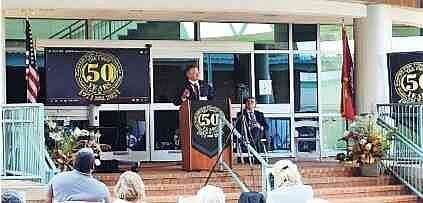
In 2021, on the occasion of the 50th anniversary for NCTR, Westerman released a statement supporting the facility.
“NCTR has undoubtedly improved the lives of every American by developing needed research to ensure safe medicine, food and cosmetics,” said Westerman. “Without facilities such as this, the United States would not be home to the world’s safest and most abundant food supply. Consumers in the United States and around the world may never truly know the impact of NCTR’s work on their daily lives, but every time a patient is successfully treated, or a family safely uses countless familiar products, NCTR’s hard work deserves the credit.”