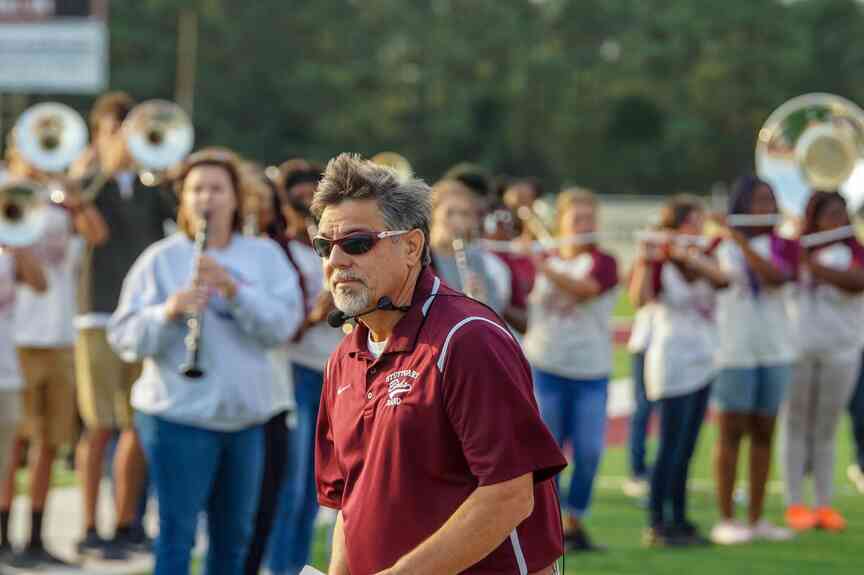
When the Stuttgart High School band performed during the 2025 state band assessments, Band Director Kevin Sherman knew he had witnessed something special.
“I was in tears on the stage,” he said. “At that moment, our students played better than they had in their whole lives. Later, when I got to share the news that all three judges gave us a first division rating, my students hollered for an hour. It was pure euphoria.”
As the band’s 80 members celebrated the triumph of their first division rating as well as a 4th place finish — their best showing since the mid-1980s — Sherman took a step back and reflected on his purpose as an educator.
“The moment you get the result you have been working toward is a reward unlike anything else,” he said. “The success my students achieve in band translates to other areas of their lives. It’s why I do what I do — to see them go on to college or start a career and lead a fulfilling life.”
Sherman’s career at Stuttgart High School began more than 27 years ago. In July, he was recognized as one of 15 finalists for Teacher of the Year by the Arkansas Department of Education. During a ceremony at the Governor’s Mansion, he and the other finalists were presented a certificate and a $1,000 prize by the Walton Family Foundation.
Independent reporting for Pine Bluff & Jefferson County since 1879.
“Being one of the Teacher of the Year finalists was a huge honor,” he said. “I was pleasantly surprised to learn that in addition to myself, three of the other awardees were fine arts educators — a middle school band director, an elementary school music teacher and a high school drama teacher. I think this helps remind people that what we do is as important as what a math teacher does.”
Sherman believes that music education — as well as other fine arts disciplines — engages both the analytic and creative parts of the brain. He advocates for students being involved in the arts at an early age.
“Not only do the arts train us to be multi-dimensional critical thinkers, but they also help us to be a more holistic person,” he said.
Sherman admits he is not a “fuzzy, cuddly” teacher. He emphasizes standards, discipline and pride in performance.
“Advice from my mentor has stuck with me over the years — never tell students a performance was good when it wasn’t,” he said. “Rather, I show them the success we are striving for. Then, through constructive criticism and healthy competitiveness, I help them close the gap toward true achievement.”
Sherman builds character through band by giving students leadership roles, emphasizing resilience and encouraging creative problem-solving.
He said his band consists of an interesting cross section of society — it includes the children of local millionaires as well as children who don’t know where their parents are or who are living with their grandparents. Regardless of background, Sherman asks that his students leave their problems at the door and contribute to their shared project in a professional manner.
“Unlike in math or science, when you are failing at band, you are going to be hurting the performance of the people around you,” he said. “This teaches the importance of being involved in something bigger than yourself. In this way, band becomes a vehicle to get the students to where they want to be in life.”
Sherman said his own journey into music began in his hometown of Quincy, Ill. When he was 12 years old, his father took him to a drum and bugle corps contest at the state fair.
“I don’t know if it was the sound or energy at that concert, but I was totally blown away — I knew that’s what I wanted to do,” he said.
He joined the local drum and bugle corps shortly after the experience. He recalls the hard work he put into honing his craft to play at a high level.
Though he started attending college at Northern Illinois University, Sherman eventually transferred to Sam Houston State University in Huntsville, Texas, where he was recruited to its marching band. A music scholarship covered tuition, books, room and board, plus a small stipend.
“For a while, I was pursuing a business education in college while at the same time working odd jobs such as a drum roadie and even at local golf courses,” he said. “At the time I kind of thought the music part of my life was ending, when in fact it was just beginning.”
After earning his degree in music education in 1997, Sherman considered playing professionally in an orchestra or perhaps teaching in higher education. Eventually, however, he took a job offer for junior high school band director in the rural Delta town of Stuttgart, known for its duck hunting tourism and rice industry.
“I took the job thinking I would just be helping out the percussion kids for a while — I certainly didn’t think I would be staying long-term,” he said. “Meeting Angie, the high school counselor, changed everything. We got married in 2003, and we have since built a full life in Stuttgart.”
Sherman credits his wife with supporting his career, which is demanding outside of normal school hours. He jokes that being married to the high school counselor is like free therapy.
“Whether preparing for the marching season, regional competitions, jazz band concerts or the Christmas parade, I have to put in a lot of time in the evenings and over the weekends,” he said. “My wife and our daughter have always been there by my side.”
As he begins his 28th year of teaching, Sherman’s friends and family have started asking about his retirement plans.
“Some have asked when I’m finally going to be free to play golf on the weekend instead of being busy with more band rehearsals,” he said. “I’m not sure I have an answer yet. I have found a way to make a living doing something that, for me, is emotionally and spiritually rich. Why stop now?”