
In 1908, Robert Baden-Powell established the Boy Scout Association in Great Britain. On Feb. 8, 1910, the Boy Scouts of America, inspired and modeled after the association, was incorporated. By 1912, Boy Scouts were enrolled in every state across the U.S., participating in local and national patriotic campaigns. By 1930, younger boys began enrolling. By 1935, there were over one million active Cub Scouts and Boy Scouts in the United States.
Beginning in the 1940s, the Red Scare, a period in U.S. history when fear of the threat of Communist infiltration during the Cold War between the Soviet Union and the United States ran rampant, patriotic fervor swept across the country.
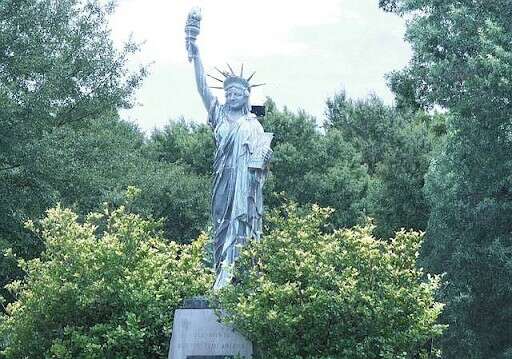
In response to the Red Scare, Jack P. Whitaker, Scout commissioner of the Kansas City Area Council in Missouri, developed a patriotic campaign that would coincide with the 40th anniversary of the Boy Scouts of America. The 1950s “Strengthen the Arms of Liberty” campaign was designed to “impress upon the general public the citizenship training values of the Boy Scouts and to reawaken Americans to their heritage of freedom.” The campaign aimed to place small-scale replicas of the Statue of Liberty, a national symbol of freedom, across the United States.
In February 1949, the Friedley-Voshardt Co. of Chicago offered 290-pound Lady Liberty replicas made of copper sheets for about $350. The funds were raised to purchase the replicas as local adult organizations collaborated with Boy Scout Troops. Later that month, the campaign began with a ceremony at the base of the Statue of Liberty in New York Harbor. On Nov. 20, 1949, the first small-scale copper replica was dedicated in Kansas City, Mo. By the end of the campaign, more than 200 of the statues were created, with the majority of them finding homes in the Midwest.
The first statue erected in the South as part of the “Strengthen the Arm of Liberty” movement was placed in Pine Bluff after a joint effort of local Boy Scouts, the Pine Bluff Kiwanis and Lion clubs. On Oct. 7, 1950, Sen. John McClennan was the main speaker at Pine Bluff’s dedication ceremony, where the Kiwanis and Lion clubs presented the statue to the Boy Scouts, who donated the sculpture to the city of Pine Bluff.
Independent reporting for Pine Bluff & Jefferson County since 1879.
That day, a parade of 200 Boy Scouts, four marching bands and more than 1,000 people attended the dedication. The eight-and-a-half-foot statue was placed in front of the Pine Bluff Library on Fifth Avenue.
During the mid-1960s, when the library and the Pine Bluff city offices moved to the new Pine Bluff Civic Center designed by Edward Durrell Stone, the statue was moved to the center of a grassy median adjacent to the Civic Center. On Nov. 1, 2000, it was placed on the National Register of Historic Places.
After a couple of moves around town, Pine Bluff’s Lady Liberty now sits on city property across from the mayor’s office on the south side of 10th Avenue between State and Texas streets. Located in the vicinity of Lady are other history markers of Martha Beale Mitchell and the Sawdust Bridge.
This article is from ExplorePineBluff.com, a program of the Pine Bluff Advertising and Promotion Commission. Sources: www.nwaonline.com — Pine Bluff’s ‘Lady Liberty’ landmark still stands proud; https://encyclopediaofarkansas.net — Strengthen the Arm of Liberty Monuments; www.history.com — Red Scare.
Ninfa O. Barnard wrote this article for ExplorePineBluff.com.