
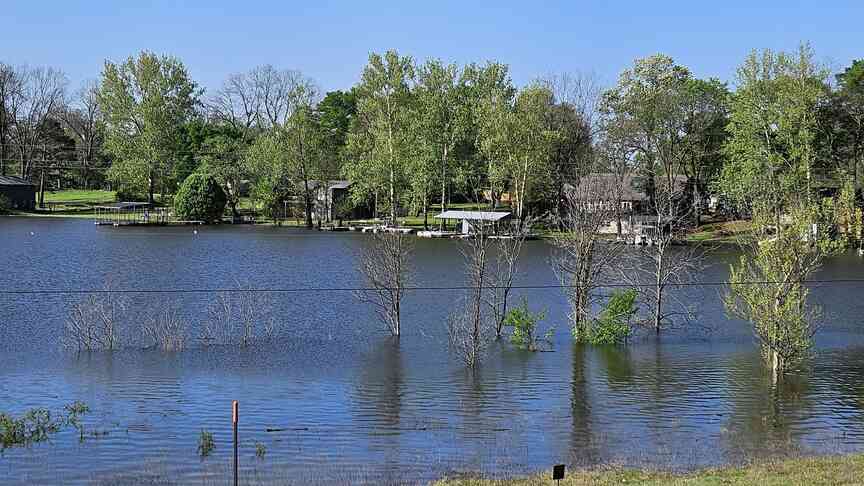
A plan to improve watersheds to mitigate flooding in Pine Bluff and other locations in southern and eastern Arkansas has been halted, thanks to a pause in federal funding.
The Infrastructure Investment and Jobs Act of 2021, also known as the Bipartisan Infrastructure Law, was to provide $918 million to watershed projects across the country. Of that, Arkansas was allocated $96 million toward a watershed improvement plan in 14 communities administered by the Arkansas Black Mayors Association. Pine Bluff was to receive $32 million of that allocation, but Dallas engineer Edwin Jones, chief executive of EJES Inc., said in October 2024 that number has grown to $50 million toward an estimated $200 million of watershed needs for Pine Bluff.
On Jan. 20, however, President Donald Trump issued an executive order entitled Unleashing American Energy that called for termination of the Green New Deal, including a pause in funding through the Inflation Reduction Act of 2022 and the IIJA. Under the executive order, all agency heads are required to submit reports to the directors of the National Economic Council and Office of Management and Budget on their review of “processes, policies, and programs for issuing grants, loans, contracts, or any other financial disbursements of such appropriated funds.” The Arkansas Black Mayors Association signed an agreement with the Natural Resources Conservation Service, an agency of the U.S. Department of Agriculture, to administer the watershed plan in September 2022.
Association Executive Director Frank Bateman said then-NRCS Chief Terry Cosby signed off on a plan for constructing or reconstructing the selected watersheds last November.
“We were in the process of putting out an RFP (request for proposal) for design,” Bateman said.
Independent reporting for Pine Bluff & Jefferson County since 1879.
“We had selected the firm, but we can’t do contracts until we make sure the money is released.”
The association contracted with EJES and FTN Associates, now Olsson FTN, of Little Rock in May 2023.
Bateman said the association has been in touch with three of Arkansas’ congressional delegates — Sens. John Boozman and Tom Cotton, and Rep. Rick Crawford — about possibly releasing the funds that were designated during the Biden administration. Crawford represents Arkansas’ 1st Congressional District, which covers northern and eastern Arkansas.
The association also plans to reach out to Rep. Bruce Westerman, whose 4th Congressional District includes Jefferson County and covers most of the Arkansas River Valley, Ouachitas and southern Arkansas.
“As the United States Department of Agriculture continues to review all projects, my office has been in contact with the department about funding important to Arkansas and will continue to have an open line of communication with Secretary (Brooke) Rollins and her staff to make sure the needs of Natural State residents are met,” Boozman said via email.
Bateman said his board chairperson would like a meeting with the congressmen.
“This is throwing us off two months because although we selected the firm, we’ve got to negotiate the contract and get to work on the design piece.”
An NRCS senior conservationist told The Commercial in July 2022 the timeline for constructing the watersheds was broken into four phases: a six- to 12-month preliminary investigation, 18 to 24 months of planning, another 18 to 24 months of design, and two to five years of construction. Bateman said the planning phase cost about $11 million.
If funding is resumed, Pine Bluff Mayor Vivian Flowers suggests the rebuilding of watersheds could last eight to 10 years once the preliminary phases are done.
“This, more than anything, is about flood prevention because we’re talking about major costs to individuals,” she said. “There are so many people struggling within the city proper and outside the city who cannot keep their homes dry and who cannot get insurance.”
On March 10, Bateman received an email from Amanda Mathis, Arkansas state conservationist for the Natural Resources Conservation Service, with a copy of the executive order from Jan. 20. Mathis informed Bateman the service was still not authorized to resume activities with funds from the jobs act
“At this time obligations, amendments and agreement actions for agreements funded with the IRA and IIJA remain on pause,” Mathis wrote to Bateman.
The association’s plan is one of three related to watersheds in which funding is paused, according to a table Mathis provided to Bateman.
The table shows funding is cleared for 13 other such projects.
Messages seeking comment were left for Mathis.
Earlier this month a storm system caused by a frontal boundary crossing southwest and northeast Arkansas led to flooding in many parts of Arkansas, some of which were to be assisted by the watershed improvements.
“Camden was hit pretty good and Forrest City was hit pretty good, but those were the only ones that were hit in the areas that we’re serving with the project,” Bateman said.
Pine Bluff, Camden, Forrest City, Helena-West Helena and Marianna have money for design and construction aside from job act funds, Bateman said, but nine other communities as part of the plan do not have the components needed for construction. Pine Bluff signed onto the plan with the association in August 2023.
“It was going to help us with 60 percent to two-thirds of our problems, because they were going to be able to address the entire watershed, help the city with some things the city would have ordinarily had to do, and recently we got notification that the project was suspended as a result of the Trump administration and all that they’re doing,” said Flowers, Pine Bluff’s mayor.
During a public comment forum last October, Jones said 10 areas in northern Pine Bluff were to be served by a Caney Bayou watershed project, which he estimated to cost $29.3 million of the federal allocation, and that 18 areas in other parts of the city were to be addressed by a Bayou Bartholomew project priced upward of $25.5 million.
Altheimer, another of the 14 cities the association is assisting, and Pine Bluff escaped major damage from the destructive weather event.
The Arkansas River at Pine Bluff did not reach flood level as forecast.
“It takes a while for the excessive rain to run down,” said Altheimer Mayor Zola Hudson.
“We did not have any trees down or major flooding. If (anyone) did, they didn’t tell me. We missed a lot on our end, and other towns are suffering as the water drains.”
Several areas across a railroad track in Altheimer were flooded but pumps have been working properly and the water is drained, Hudson added.
“We probably had 7 or 8 inches of rain,” she said.
“No one reported anything major to me. We always had a problem with several homes being able to flush until the water ran down.
We were so grateful that none of the storms, the rain or the high wind, affected us to where we had to call in for special help.”