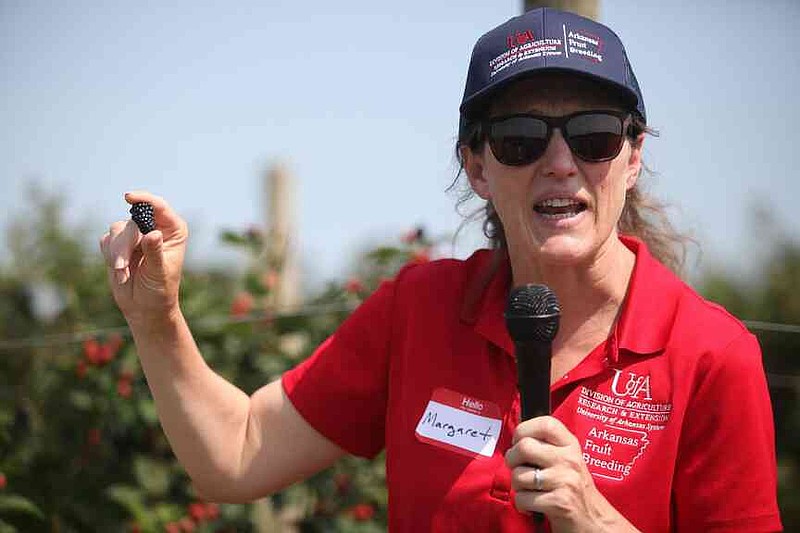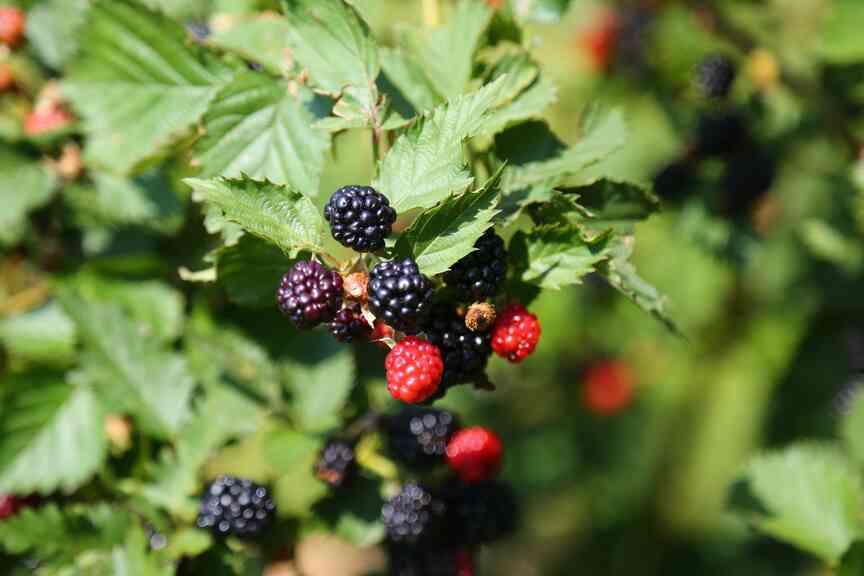
At the annual Blackberry Field Day held June 10, growers from across Arkansas and neighboring states gathered to learn more about the state of the industry, including new varieties in development and new technology that promises to make operations more efficient and profitable.
But first, there’s 2025 to get through.
Jackie Lee, director of the University of Arkansas System Division of Agriculture’s Fruit Research Station in Clarksville, said the season thus far has been “characterized by hail and fire.”
“We had a total of four hailstorms, the worst occurring on March 15, which caused a lot of damage to blackberry canes,” Lee said.
“There were no leaves out at that point — no canopy to protect those canes.”
Independent reporting for Pine Bluff & Jefferson County since 1879.
Additionally, blackberry plants at the station struggled with anthracnose and fire blight stemming from the open wounds left by hailstorms, which Lee said is rare in blackberries.
Johnson County, where the Fruit Research Station is located, wasn’t alone in its battle against the elements — and March wasn’t the end of the spring storms.
As recently as May 18, hailstorms peppering fruit and vegetable producers throughout Northwest Arkansas were enough to strip bushes of their berries and bring some producers’ season to an abrupt end.
While crops at the Fruit Research Station weren’t a total loss and winter injuries were minimal, Lee said her staff had to cull a substantial portion of the season’s first crop of berries.
“We’ve had to cull about a third of this first round of fruit because it wasn’t marketable,” she said.
“We culled about 120 pounds and harvested about 220 pounds. That’s a much deeper cut than in a normal year,” Lee said.
“The good news is that the fruit that’s supposed to come off next week is of really high quality,” she said.
“So I suspect that as the season progresses, fruit quality is going to increase, especially with those mid-season and later-season varieties.”
VARIETIES TO MEET SPECIFIC NEEDS
Lee, who joined the Division of Agriculture in 2016 as a horticulture integrated pest management specialist and was appointed as the station’s director in 2019, has been hosting blackberry field days for seven years.
She said the most frequently asked questions she receives from growers are related to variety selection.
“People want to know what they should plant,” Lee said.
“And the answer just depends on what they’re trying to do. My counter-question is always, ‘What is your marketing strategy? Who’s your target audience for these berries?’ Because that matters.”
Since the Division of Agriculture’s blackberry breeding began in 1964, blackberry varieties developed in Arkansas, including Caddo, Ponca and Natchez, have come to dominate markets throughout the world.
The program was initiated by James Moore and later led by John Clark for more than 42 years until his retirement in 2023.
Margaret Worthington, associate horticulture professor for the Division of Agriculture, now leads the blackberry breeding program in Clarksville.
In 2024, the division released Sweet Ark Immaculate, a late-season blackberry variety Lee said should help fill a niche for both commercial growers and producers running U-pick operations, where later-blooming blackberries help prolong the season.
EVOLVING PROGRAM
The Arkansas Blackberry Growers Association was founded in 2018. Now boasting more than 50 members, Lee said the organization has helped shape the annual field day to better meet growers’ needs and interests.
“One thing we’ve started highlighting more is new technology,” Lee said.
“Last year, we had a drone technology demonstration, both to analyze plants and to spray. This year, we had the University of Arkansas Engineering Department demonstrate some harvesting technology that may be coming in the future for berry growers. So we’ve really tried to highlight other things beyond varieties and production techniques.”
The Blackberry Field Day is just one of several public events hosted at the research station each year.
Lee leads a pruning workshop in February, which covers pruning techniques for blackberry bushes, muscadines, grapes and more.
To learn more about the Fruit Research Station and upcoming events, visit https://aaes.uada.edu/research-locations/fruit-research-station/.
To learn about extension programs in Arkansas, contact your local Cooperative Extension Service agent or visit www.uaex.uada.edu.
Ryan McGeeney is with the University of Arkansas System Division of Agriculture.