
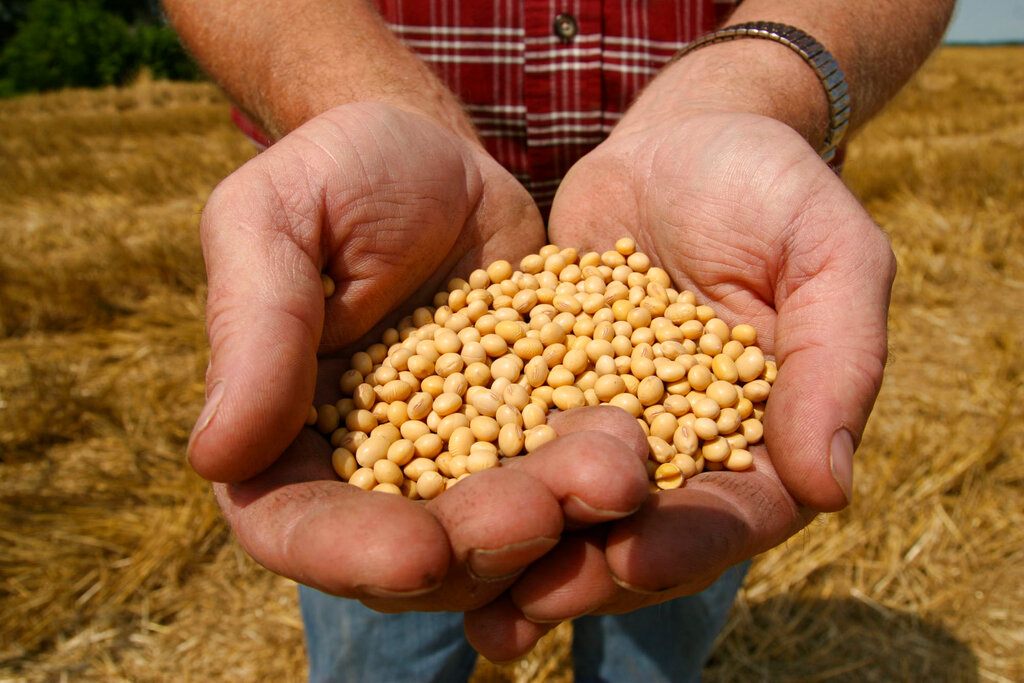
When you’re planning your community garden this year, save space for some soybeans. They’re good for your health and your wallet.
Through May 25, school and community gardeners can get free soybean seeds through the Cooperative Extension Service’s Grow Your Own Protein program as long as they donate their produce to schools, churches, food pantries or other nonprofits serving food-insecure populations.
Request forms are available at https://uaex.uada.edu/seed-request. Requests should be completed and sent to Diedre Young at dyoung@uada.edu. Seeds will be mailed to recipients.
The seed giveaway has been part of the Soybean Science Challenge program for eight years. It started in 2016 with 12 gardens in Arkansas. While Arkansas has been the main outreach for community gardens, the Soybean Science Challenge has expanded to include educational and community gardens across the country. Last year, more than 150 gardens participated nationwide.
Many teachers use the seeds in their school teaching gardens, and several Arkansas Master Gardener clubs grow soybeans to donate to food banks, said Deidre Young, Soybean Science Challenge coordinator.
Independent reporting for Pine Bluff & Jefferson County since 1879.
“I have noticed that teachers and community leaders are starting to focus more on natural whole foods for students and citizens, and as such our garden numbers have increased accordingly,” Young said. “Schools are using the soybeans they grow in their cafeteria food, adding soybeans to soups, casseroles and salad bars. Communities are using soybeans for similar meals plus there have been several inquiries into dehydrating and roasting the beans.”
WHY SOYBEANS?
Part of the goal of the Grow You Own Protein seed giveaway and the Soybean Science Challenge is educating people about the value of Arkansas soybeans to the Arkansas economy, to the labor force and ultimately to feed and fuel the world.
Complete proteins come from animal-based products, soy and quinoa. Soy contains all nine essential amino acids, meaning it has as much protein as animal products such as eggs, meats, poultry and seafood, according to the U.S. Food and Drug Administration.
It’s also inexpensive, versatile and easy to grow. Seeds should be planted between late April and early May and will be ready to harvest in 80-85 days.
Commercially, soybeans are grown in 41 of the state’s 75 counties and rank as one of the top three crop commodities in cash receipts for Arkansas farmers, generating about $1.7 billion.
NEW LEADERSHIP
Young has worked with the Soybean Science Challenge program since it began and will retire this year. Keith Harris has been hired to coordinate the Soybean Science Challenge, which includes the school and community garden seed giveaway.
“I am excited to continue to educate students, teachers and the public about the benefits of soybeans through the Soybean Science Challenge,” Harris said. “Soybeans are one of the most versatile row crops and are used in a variety of products, from cleaning supplies to candles and biofuels to food for farm animals, pets and people.”
The Soybean Science Challenge is sponsored by the Arkansas Soybean Promotion Board and the Cooperative Extension Service. The Cooperative Extension Service is the outreach arm of the University of Arkansas System Division of Agriculture.
To learn about extension programs in Arkansas, contact your local Cooperative Extension Service agent or visit www.uaex.uada.edu.
Tracy Courage is with the University of Arkansas System Division of Agriculture.