
Editor’s note: This is part two of a two-part series.
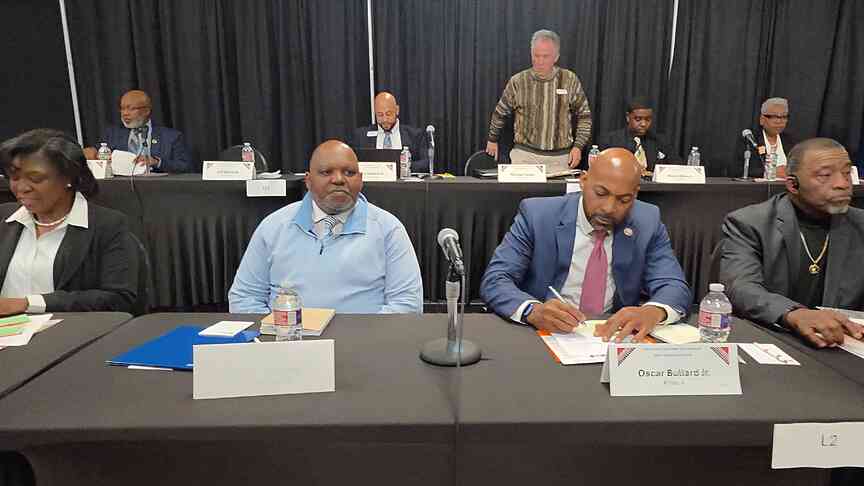
The second session of the Jefferson County candidate forum, hosted by the Divine 9 and Community Partners, featured candidates for county judge, justice of the peace, circuit clerk, county assessor and county coroner.
County judge candidates present were asked how they would reverse the conflict of interest, corruption and division in the Jefferson County narrative.
Efrem Neely’s goals centered on fostering unity and understanding within the Quorum Court and coordinating effectively with other elected officials. He said he aims to educate constituents on the functions of the 13 Quorum Court members and prioritize bringing back the five non-participating members. Neely said he was committed to restoring respectful collaboration with officials, promising a style of leadership focused on “education, cooperation and cohesion” rather than acting as a “dictator.”
Independent reporting for Pine Bluff & Jefferson County since 1879.
Jeff Edwards emphasized that his commitment to “100% transparency” would prevent any conflict of interest concerns. His strategy involves contacting all justices, department heads and employees to foster a unified spirit, stressing, “We are in this together.” He said he aims for the county to operate as “one band with one sound.”
Eric Walden Jr. stated he has “already been doing” this work by actively contacting agencies and JPs to encourage officials to work together to ensure county employees get paid. He also “helped sponsor or send the idea for the legislation for financial relief.” He said he proposes using “trusting communication” and his skills as a “trained mediator.”
Dr. Michael Turley said trust starts with transparency. He noted he has no previously built relationships that would cause conflicts. He stressed the importance of understanding that the process is to “serve you,” and believes the conflict stems from personalities.
When asked what he would do differently as a county judge to work with the justices of the peace and other elected officials, Turley reiterated the idea that “we all serve you” (the 60,000 “voices, voters, owners, investors, customers, employers and stakeholders”) and the need to set aside personalities to understand the process of service.
Walden said he would lead with character, integrity, transparency, trust, and “respecting the legislative body and their role.”
Edwards agreed with his colleagues and plans for a listening tour with each department head to assess needs. Recognizing the Quorum Court as the “check writers,” he promised to work closely with every JP, telling them, “I plan to be you all’s best friend.”
Neely said he would establish a clear and concise “baseline of what everybody’s role is” as defined by law. He said he believes setting boundaries and working cooperatively is key, and suggested using the “system of mediation” to resolve conflicts, rather than wasting money on attorneys.
The candidates for county judge were asked a direct question: Considering the current challenges, what is the single most crucial need or priority for Jefferson County, in your personal, professional or political opinion?
Edwards said the county needs “stability, sustainability and accountability.” He said he believes the core issue is a lack of respect and that once people “treat people as you want to be treated,” everything else will follow.
According to Walden, the county needs a leader “that focuses on people, relationships and progress” to lead through conflict. The leader must be “approachable (and) accessible,” and willing to “sacrifice and compromise and collaborate” with all elected officials and public leaders.
Turley said the county needs “correct, positive recognition” because it is a “diamond in the dark” with a “strategic location.” He highlighted UAPB’s strength in aquaculture and agriculture. Neely said a true leader “empowers their people to be their best” without micromanagement and ensures a “follow-up to satisfaction.” He said he believes the county is missing a true leader and needs respect, stability, honesty, transparency and trustworthiness.
JUSTICES OF THE PEACE
Justice of the Peace candidates were asked: Given the constraints of your limited time and pay in this role, how will you construct a workable budget?
Leo Smith said as a business owner, he knows how to build a budget, start without money and “make tough decisions.”
Oscar Bullard Jr. said the first step is to “review the budget and review the spending” to “eliminate any kind of waste” before determining if the budget is solid.
Randy Green stated the need to “repeal all information that’s in the office” and “study what’s coming in and what’s going out.” He noted that with only 6% of the budget going to roads, they may need to make a change to add more money to that item in the future, and that the Quorum Court must “work together.”
Glen Brown Sr., drawing on experience from four terms on the Quorum Court and three terms on the Pine Bluff City Council (a total of 20 years with a budget each year), explained that the court is “branched up in certain departments,” and they work with the committee to hash out the judge’s budget.
They were also asked how they would separate personal beliefs from their legal responsibility.
Brown said the person elected is there to fulfill a role that is “not a selfish job.” He promised to “do what is right, and what is in black and white,” referencing the necessity to read the “county compliance book” and “municipal law.”
Green stressed the importance of working with the Quorum Court and “keeping it real.”
Bullard cited his “25 years working for the state of Arkansas in law enforcement, enforcing the law at local, state and federal levels,” as proof that he has made and continues to make the right decisions. He emphasized that the government should “work for the people” and that the JP’s role is critical for tax dollars and neighborhood support.
Smith stated he “won’t let his personal beliefs affect the way” he votes. While he is a “man of faith,” sometimes “you have to make a tough decision” in the Quorum Court, and his personal beliefs “will not determine the way he votes.”
The candidates were also asked to describe an experience, other than managing personal finances, that qualifies them to resolve Jefferson County’s budget issue.
Bullard highlighted his experience managing a “small business in finance,” referencing his catering business. Green cited his 26 years as a shoe repairman, where he had to “maintain and work problems out” by moving money to cover expenses when the “money was short.” He also said his degree in electronics means he is proficient with numbers.
Brown mentioned his experience as a barber for over 40 years, managing “several restaurants in Little Rock” and serving as the president of the Goldman Foundation for over 10 years.
Smith stated the success of his construction business was evidence of his experience.
CIRCUIT CLERK
The circuit clerk candidates included Barbara Collins and Connie Compton.
When asked why she should be elected as the next Circuit Clerk, Collins said she it is because she has “done the job,” running on a platform of “proven leadership experience and integrity.” She said she has worked in “every division within the office” including jury administrator, giving her relationships with attorneys and title companies, and she knows “what it takes to run a successful office.”
Compton stated she is “equipped to elevate the office” to the next level through her 25 years of legal experience, which allowed her to gather information and “tools.” She also emphasized her passion for people and “elevating customer service,” quoting Maya Angelou to stress that citizens are customers and should be treated well.
When asked what unique skill or trait one could offer Jefferson County that no other candidate can provide, Compton said it was her ability to “see the big picture,” honed through her 25 years in the legal field and working for various agencies. She said she can bring “valuable input from other agencies” to elevate the clerk’s office, seeing beyond the current local situation.
Collins said her unique skill is being a “people person” with a “genuine love for people,” citing her 16 years as a retail manager and work as a business manager at the Department of Corrections. She is accessible, knows how to listen and believes the office is about serving the community, she said.
COUNTY ASSESSOR
County Assessor candidates Gloria Tillman and Bruce White Jr. were both asked to describe what changes they would implement. Tillman said she would continue to ensure the office is working efficiently, providing “valuable information and accuracy” through “continued education with our employees” to sharpen their skills and keep them updated with “innovative technology.” She also aims to ensure the public is served with “courtesy.”
White said he would ensure that “everyone was treated with the same level of fairness and respect,” which applies to both customers and employees. He stressed that there would be “no big I or little U” and “no picks and chooses,” making sure things are “fair and equitable… all the time.”
COUNTY CORONER
The only county coroner candidate present, Jamal Gordon, was questioned about the changes he would implement compared to the current office holder.
He said his No. 1 priority would be to “put the coroner’s office on its own two feet” by changing the phone lines “from the Mecca system back into the coroner’s office.” He believes the community needs “accessibility to that office.”