
Editor’s note: This is the first of a three-part series on Jefferson County government.
Is the county in trouble? Could there be a government shutdown?
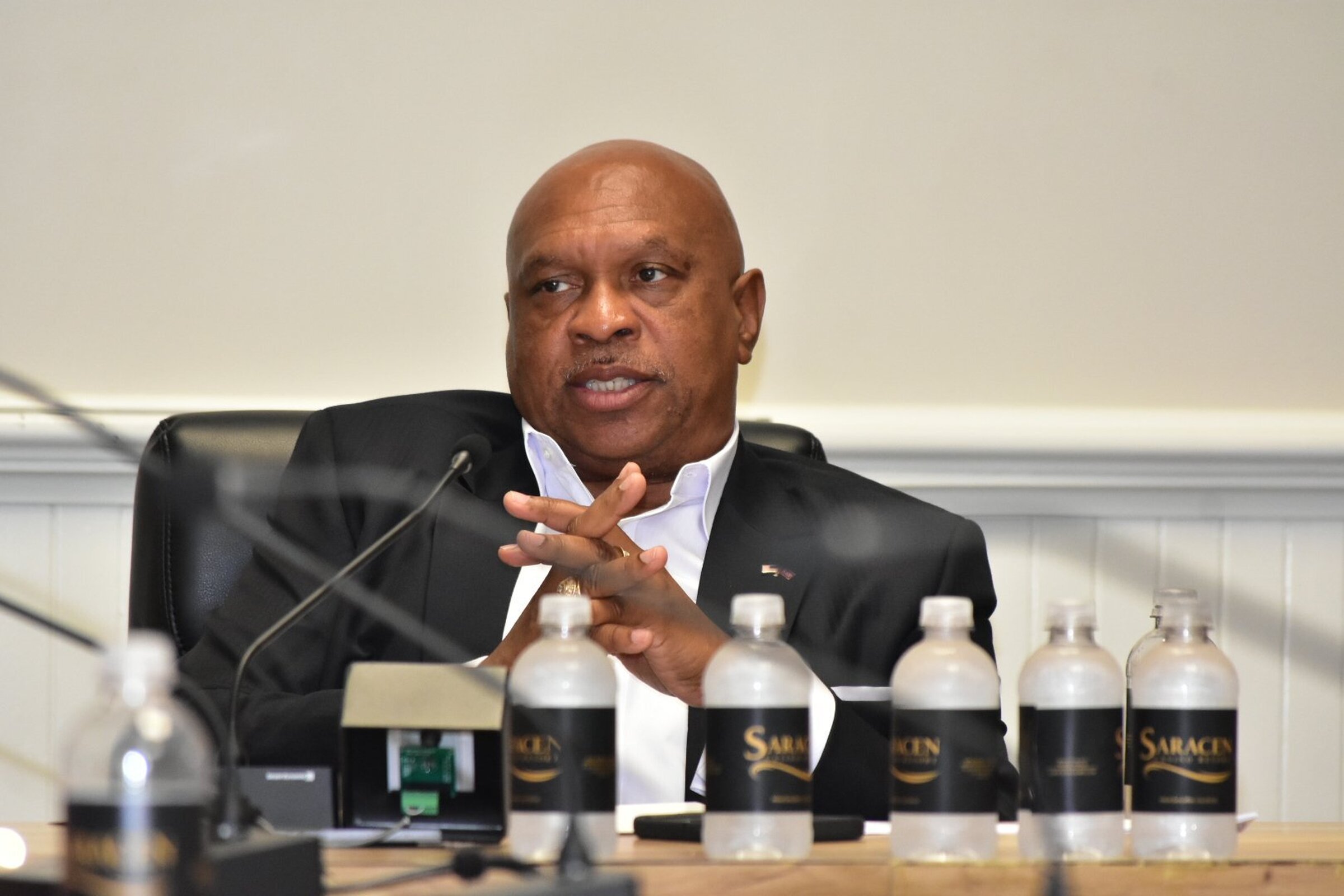
Jefferson County Judge Gerald Robinson thinks so as another scheduled Quorum Court meeting he called could not come to order on Monday due to a lack of Quorum Court members.
Prominent items on the agenda like the tax levy ordinance, which according to county attorney Terry Wynne must be approved, were not addressed because only seven justices were in attendance instead of the required nine to have a Quorum Court meeting.
Independent reporting for Pine Bluff & Jefferson County since 1879.
“CA § 14-14-904 requires the Quorum Court to levy the County, City, and School taxes in its November or December regular meeting,” said Wynne in an email to the JPs. “Additionally, ACA § 14-14-901 et seq. requires the 2024 operating budget for the county to be adopted by ordinance prior to the end of the year.”
The process for doing that is usually routine county business. Schools and cities, for instance, are given tax proceeds from levies on residents. But each year, the Quorum Court has to approve the actual levying of those taxes.
However, neither of those items was addressed. Before the meeting, Wynne warned the justices if the levy of the various taxes were not approved before the adjournment of the meeting, there would be no lawful way to approve the levy for 2024 and those taxes could not be collected.
So why aren’t the justices participating in Quorum Court committee meetings and scheduled Quorum Court meetings called by Robinson? At the advice of their attorney, Kimberly Dale, who is representing eight justices of the peace in a legal matter sought by Robinson, they are not to participate in any meetings called by Robinson, but instead they hold their own meetings.
In July, Robinson filed a lawsuit against the Quorum Court in the 11th District West Circuit Court, Division 2. The lawsuit states that since January the Quorum Court has been operating in violation of Arkansas state law and that “[t]he Quorum Court is paralyzed and unable to effectively transact the business of the people of Jefferson County, Arkansas because it has not established rules of procedure for the conduct of that business.”
The lawsuit has named all 13 justices of the peace: Margarette Williams, Melanie Dumas, Roy Agee, Cedric Jackson, Dr. Conley Byrd, Danny Holcomb, Alfred Carroll, Ted Harden, Reginald Johnson, Reginald Adams, Brenda Gaddy, Patricia Johnson and Lloyd Franklin Jr.
But according to eight of the JPs — Williams, Dumas, Jackson, Carroll, Reginald Johnson, Adams, Gaddy and Franklin — they passed their proposed policy and procedure in June in a meeting that was held after the adjourned meeting held by Robinson. According to his lawsuit, Robinson said the special meeting was held without proper notice and that he was present. Robinson also cited § 14-14-904(d)(1)(B) of state law, which states only in the absence of the county judge can the Quorum Court hold a meeting at which a Justice presides.
The justices also state they passed the tax ordinance by a majority vote of the Quorum Court in a meeting they held in November that was vetoed by Robinson.
“If our meetings are not legal, then why is the judge vetoing them?” asked Franklin.
Robinson used his veto power to veto appropriation ordinances passed by the majority of the JPs during their special-called meetings on Nov. 20 and 21.
According to a letter from Robinson on Nov. 28, he stated the agendas for both meetings included an appropriation ordinance to transfer funds, a vote to approve the tax rates for 2023 to be collected in 2024, an appropriation for Christmas bonuses and other appropriation ordinances where only eight justices attended the meetings.
“The main reason for this veto is the failure of the Quorum Court to follow Arkansas law regarding notice of special meetings,” said Robinson in his letter. “… (I)n the absence of procedural rules, the county judge or a majority of the elected justices may call a special meeting of the quorum court upon written notification of all members not less than two calendar days prior to the calendar day fixes for the time of the meeting.”
According to Robinson, that did not happen. “The special meetings were not valid and any business conducted at them is null and void,” he said. “Because the meetings were improper, the ordinances were not validly passed.”
Robinson also explained because only eight justices were in attendance, they fell short of the necessary two-thirds.
On Monday, after Robinson’s failed attempt to have a meeting, the eight justices met in the circuit judge’s courtroom for several agenda items and voted to override Robinson’s veto.
Some of the other agenda items justices voted for unanimously included an appropriation ordinance to transfer $21,561 from Organized Crime to County General Sheriff budget salaries, and an appropriation ordinance to provide $150,000 to fund election expenses for the upcoming election.
While Robinson may say meetings held by those justices are illegal, they disagree.
“The issue is we have two different sets of meetings going on,” said Robinson, who said he must approve all agendas. “The Quorum Court can have meetings … the issue is that a lot of those meetings don’t meet statutory criteria.”
Robinson said Jefferson County is the laughingstock of Arkansas.
“We have individuals who because of litigations won’t participate in meetings,” said Robinson. “The county attorney has tried to advise them on the procedural rules they were trying to put in place, where many of the rules were to take away my authority.”
From vendors who have yet to receive payment to county employees, many fear shut-off notices at work and home if the requested appropriations and the 2024 budget are not passed by Dec. 31.
Monday: Part two.